
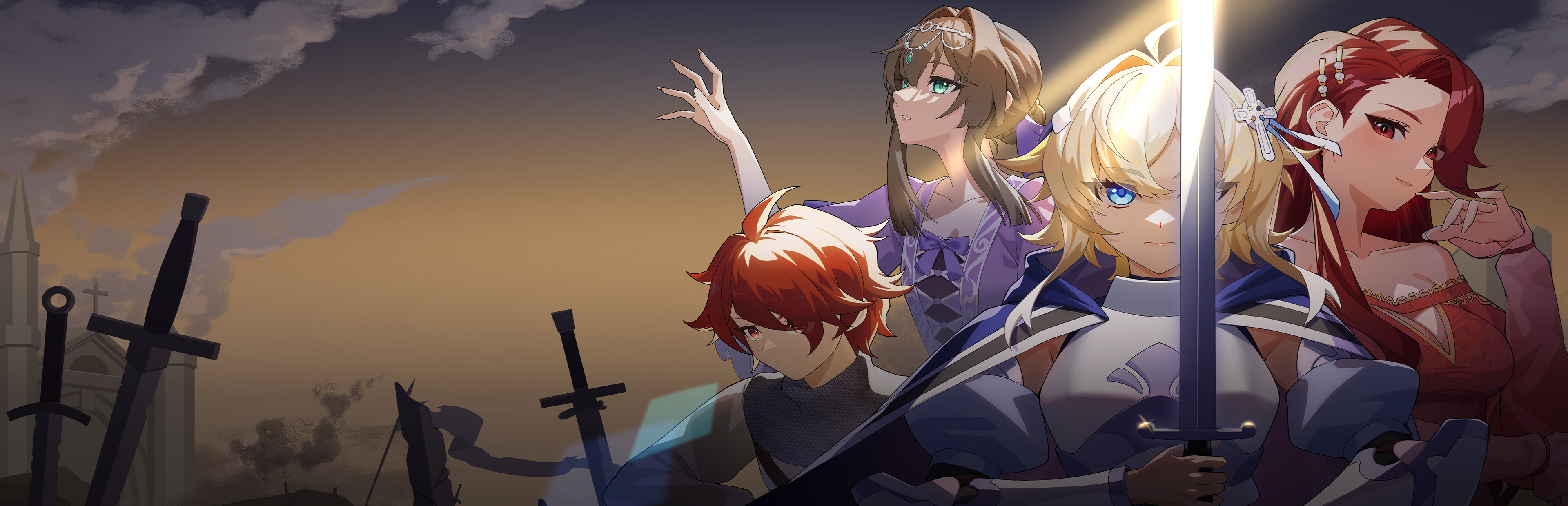
In this update4
Full notes
Full Fire & Crown: A Romantic Tale of the Hundred Years' War update
Read the full published notes in a cleaner layout. The original post stays linked below.
What changed
- Balance
Fire & Crown: A Romantic Tale of the Hundred Years' War changes
Some people start making games out of passion.
Some are overflowing with creativity.
Some have the luxury of being born into money.
Me? I got fired. Then I clicked “maybe I should write something.”
Hi there. I’m M. R. Kazusa, solo developer of the indie visual novel Fire & Crown: A Romantic Tale of the Hundred Years' War. I’m also a part-time history nerd and full-time Type-Moon fan. (Yes, I’m one of those.)
This is Devlog #0. Before I get into what the game is, how it’s being made, or why it even exists, I want to explain how I got here. Or more precisely—how I got kicked here.
1. I Got Fired
I used to be a teacher. Technically, I worked for an “International Education” company that focused on IELTS prep. You know the type—polished websites, fancy pitch decks, and a soul made entirely out of marketing buzzwords.
Our real business model? Selling anxiety. Actual teaching was just the side hustle.
My boss didn’t care whether the lessons worked. He only cared about whether your resume looked good on paper. Teaching was treated like influencer marketing. Students were customers. Teachers were just walking LinkedIn profiles with vocal cords.
I knew pretty quickly the place was a scam. I just hadn’t decided when to leave.
And then my boss made the decision for me.
Long story short, a VIP student casually complained about me. My boss, whose profile picture is—no joke—a PEPE frog, decided that was all the reason he needed. He fired me on the spot, like clearing cache files from a browser.
He’d probably wanted to get rid of me for a while anyway. I refused to buy into his ed-tech-as-QVC philosophy, and I wasn’t the fresh grad he could treat like a ten-year veteran. So after a deeply suspicious and borderline manipulative conversation, I got kicked out of every work group chat, stripped of permissions, and erased like I was never there.
It was kind of impressive. I didn’t know corporate breakups could be this... clean.
To be honest, at that time, I felt a weird cocktail of emotions:
Part bitterness (“Hey, I hadn’t milked you for enough salary yet!”),
Part confusion (“Wait, seriously? That’s it?”),
But most of all—a very familiar one:
Rage. Fire-breathing rage.
2. Office Politics, Featuring a Knife
So I did something petty but cathartic:
I messaged that VIP student—the one I’d helped dozens of times—and said:
“Thanks to you and your entire family.”
She was completely baffled. Had no idea what I was talking about.
A few hours later, she messaged my former boss asking, “Did I get my teacher fired…?”
Turns out, she had just vented a bit—said one job didn’t go well. That’s all.But my boss told me she cried and screamed and complained about me for two hours straight.
That was the excuse he used to kick me out.
And just like that, the classic move was complete: He borrowed a knife to kill with—and the knife didn’t even know it got used.
Later, her mom even contacted me.
I thought she was going to chew me out (I did say something harsh), but instead, she apologized.
She said her daughter had always seen my boss as a “friend,” not a businessman. She shared everything with him—gossip, frustrations, offhand comments—never realizing those comments might get someone else fired.
Honestly, I laughed.
Not because I forgave anyone, but because the whole thing was absurd.
It felt like getting a resignation letter spit out of a washing machine. You don’t even know what mechanical system pulled you in.
3. From Revenge to… Something Else
Right after I left the job, my brain was full of brimstone.
I was reading Divine Comedy at the time, watching Dante throw all his enemies into Hell, giving them comfy seats to roast in forever.
I was very into the idea of literary revenge.
I even started plotting a web novel where my ex-boss was turned into a frog-faced scammer who gets what he deserves. I was workshopping names that would make it obvious to the insiders, but legally safe from lawsuits.
At the same time, I started looking for other ways to make money. I wasn’t ready to go full NEET just yet.
So I applied for a gig ghostwriting essays for international students. Even submitted a sample.
The client accused me of using AI. They ran a detection. Turns out it was human-written. They ghosted me anyway.
In hindsight? Probably dodged a bullet.
Better that than sinking into the gray market swamp of ghostwriting work, slaving over ethically questionable papers for pennies on the dollar. Or worse—writing a revenge story that might get me sued.
So I decided: I’d write something else.
Not for revenge.
Not for self-therapy.
Not for meaning.
Just because if I didn’t write something real, I was going to choke on this feeling.
4. The Ending, or Maybe the Beginning
It’s been six months. I never reported my boss, even though I know plenty of dirt.
Not because I’m merciful—because I don’t have hard evidence.
And I’ve got more important things to do.
He’s still clinging to a dying info-gap business model, running a fear factory in a market that’s getting obliterated by AI.
Me? I’m making a game.
I wrote a 370,000-word script for Fire & Crown. Then I spent the next three months working on it non-stop.
It’s a story about la Pucelle, a crown, a war, and the love and conviction that survive both.
It’s not a revenge story. It’s not a power fantasy. But finishing it helped me let go of a lot.
This devlog might read like a vent post, but that’s not the point.
The point is this: I’m serious about this game.
This isn’t for clout. This isn’t a hobby project. This is the real thing.
And if you’ve made it this far, thank you.
You’re already one step closer to this story than most.
Source
Changelog.gg summarizes and formats this update. How we read updates.