
Full notes
Full Escape Tales: The Awakening update
Read the full published notes in a cleaner layout. The original post stays linked below.
What changed
- UI and audio
- Gameplay
- Maps
- Performance
Escape Tales: The Awakening changes
Due to the fact that creating the demo was a complex project, we'd like to present to you the whole process from a few different perspectives - the software, the graphics, and the sounds.
🧩 First, there was a code…
At the very beginning, without making any decisions or assumptions, our team played the board version of the game. 🎴 Then, they played the digital version available on Tabletopia to identify any issues with the digital adaptation compared to the board game. Based on these observations, the team created an initial sketch of their goals, forming a preliminary vision of the final game. 📝
The team focused primarily on preserving and enhancing the features that players loved in the original version. At the same time, they aimed to address and level out the features players complained about. 🖼️ Additionally, they sought to enrich the overall experience by leveraging the advantages of the digital format, such as improved graphics, music, and a game-saving system.
A prototype was then created as the foundation for a future demo. Deep within the code, the team maintained the concept of a paragraph card game, allowing for straightforward modifications to the gameplay logic. 🎮 On top of this foundation, they added enhanced graphics and other improvements unique to the digital version, such as the ability to note something on the screen while solving puzzles, automate paragraph searches, or automate various actions such as taking a card or putting down tokens. 🪙 The prototype underwent numerous iterations, tests, and adjustments, ultimately culminating in the creation of the demo.
Importantly, from the beginning, the team was guided by the concept of creating a content editor rather than a closed game. Initially, they developed general mechanisms, such as an inventory system and a puzzle-solving panel, which were then adapted to handle varied content. 🕹️ Once this system was functional, the team used it as the foundation to build the demo.
🧩 What about the aesthetic vision?
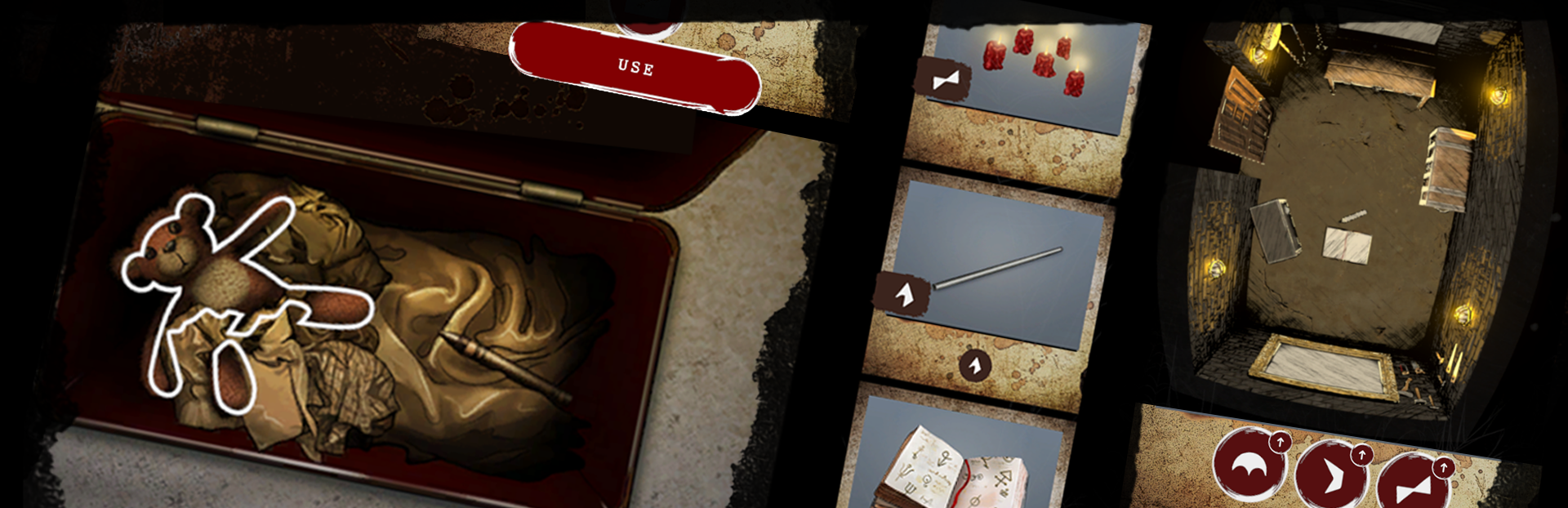
The process of preparing the demo from an artistic perspective included several sequential stages. 🎨 The first was the development of concept art, which allowed for determining the proportions, layout, and character of all essential gameplay elements, such as:
text field
location section
collected equipment, also known as “Inventory”
During this stage, the idea came up to convert flat locations from cards into a 3D model. 🃏 This made the visuals more attractive and made it easier to manage things like adding animations to individual assets.
Illustration 01. One of the first concept artworks.
At this time, the chosen font (inspired by old typewriters) was decided on, and the artistic style of the user interface was developed. 📇
Illustration 02. Font (inspired by old typewriters).
Next, the idea of using old Polaroid photos as inventory assets also emerged. 📸
Illustration 03. An old Polaroid style used for an inventory asset.
Illustration 04 and 04a. GUI (Game User Interface) elements.
Importantly, each of the above elements was continuously consulted from a technical standpoint (implementation feasibility) and user experience (UX).
After the conceptual phase was completed, it was time for the actual production work. 💻 To maintain both visual and gameplay consistency, lists were developed to clearly define the frameworks for the subsequent stages of implementation:
List of all necessary graphic elements
List of narrative illustrations
List of all animations (both GUI and decorative, including text animations)
List of visual effects (VFX)
Simultaneously, initial tests of using shaders on 3D locations began. 🖌️ The goal was to closely replicate the visual style of the paper version (which was undoubtedly achieved) while retaining all the advantages and flexibility of the implemented 3D model.
Illustration 05. Three-dimensional model of the first location with applied shader.
Summarily, step by step, list by list, additional components of the project emerged. Naturally, not everything could be implemented exactly as conceived initially. 🧮 However, the final demo version maintains a very high level of visual consistency with the initial artistic frameworks and the paper prototype.
The demo serves as an excellent platform for continuing the project, with opportunities to adjust and improve individual elements (which is an ongoing process). 📈 Considering the target platform, we continuously evaluate gameplay enhancements (such as VFX and animations), which breathe more life and flair into the paper-inspired version while retaining all its advantages.
🧩 How does the mystery sound like?
Music-wise, we really wanted the main theme for Escape Tales: The Awakening to convey what the protagonist may feel in the story but also incorporate the dark and mysterious feeling of the game. 🎵 For the music you'll hear in further levels while solving puzzles, we took a different approach - to keep it atmospheric and uneasy yet not that engaging.
When it comes to sounds, what's important for us in this project is to make the sound effects feel vintage and kind of lonely. Items you can notice and interact with in each level are supposed to sound as if they were coming from that space. 🔑 They were treated with tools that help you imagine if you actually dropped or moved something in that particular room. We wanted you to feel every inch of the particular location you discover with these sounds. 🎶
That’s all for today, folks! We hope you had a blasting time with us - till the next time! 🤠
Bluekey Games Team
---
If you haven’t played the demo yet - give it a try!
We promise it’s gonna be an unforgettable experience! 😎
--- PS. In the meantime, don’t forget to Add the game to your Wishlist and Follow it to stay up to date. 😏
Please note that what you see in the Dev Diary presents the work in progress, not the final product!
Don't forget to check us out:
💬【𝙳𝙸𝚂𝙲𝙾𝚁𝙳】 https://discord.gg/RW2GYxB2dM
📰【𝙵𝙰𝙲𝙴𝙱𝙾𝙾𝙺】 https://www.facebook.com/bluekeygamesstudio
🐤【𝚃𝚆𝙸𝚃𝚃𝙴𝚁】 https://www.twitter.com/Bluekey_Games
🎞️【𝚈𝙾𝚄𝚃𝚄𝙱𝙴】 https://www.youtube.com/@BluekeyGamesStudio
📷【𝙸𝙽𝚂𝚃𝙰𝙶𝚁𝙰𝙼】 https://www.instagram.com/bluekeygamesst
udio
Source
Changelog.gg summarizes and formats this update. How we read updates.