
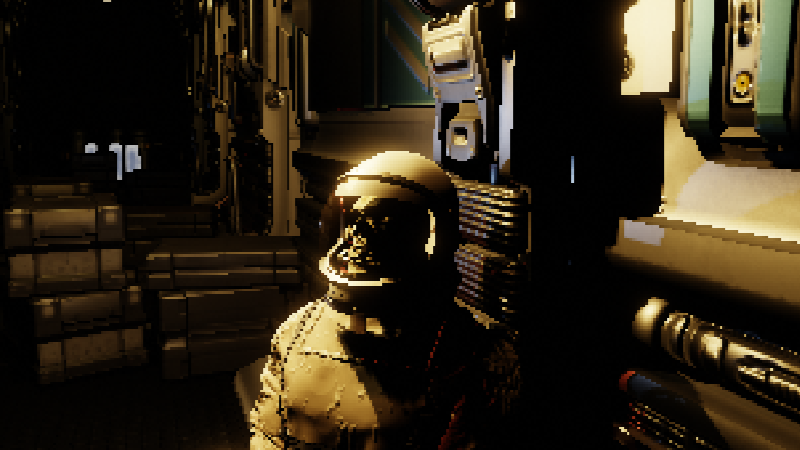
In this update13
Full notes
Full Dead Reckoning: The Long Drift update
Read the full published notes in a cleaner layout. The original post stays linked below.
What changed
- Compatibility
- Events
- Gameplay
- Maps
- Balance
- UI and audio
Dead Reckoning: The Long Drift changes
Devlog — The crew becomes a society
A generation ship is a long argument about how to live. For the last stretch of development, everything we've built has served one idea: the crossing should change who the crew is, not just how much food is in the hold. That work is here. It has left the experimental beta and is live for everyone as 0.4.0. Here's what's come together.
The crew forms a named society
Your decisions across the voyage now converge into a named identity the crew becomes — eleven of them across two lines.
Six ways of ruling
officer rule, shared rule, ship religion, engineer rule, family rule, charter rule.
Five ways of forgetting
by the manual, machine worship, hand skills, improvised repair, forbidden knowledge. At a threshold the ship lays out the decisions that formed it, year by year, and asks whether to make it official. A formed identity hardens through three tiers and never switches — it recolours events you already know, adds options you didn't have before, and eventually replaces the neutral ones entirely.
Every society runs on its own rules
An identity isn't a renamed menu. Officer rule spends named people and keeps a list. A commune's assembly takes its time — and sometimes decides without you. A ritual technocracy scores its offerings to the drive as uptime. The guild-houses hold a weld to one bloodline. A recited charter is obeyed long past the point of sense. Where one of the six ways of ruling meets one of the five ways of forgetting, you get a distinct society — with decisions no other crew will see, and its own account of itself at journey's end.
Decisions that reach the ship
The complaint we heard most was that choices moved numbers and nothing else. So:
A directive that changes the watch now changes the watch — the rotation, the ship's AI's authority, a mandated curriculum, the birth policy. They move the setting, not just the stat.
Authority handed to the ship's AI can be taken back. A colony that shuts it down keeps it down.
What the voyage did to you waits for you at landfall. Founding options close off according to how the crossing went, and the record tells you which roads are shut and why.
The crew count is honest. A ship with twenty people left no longer eats, draws power, and stands a watch as though a hundred were awake.
The long fuse
Some commitments don't come due for decades. A hard call made in the opening years can detonate long after the people who made it are gone — the ship keeping its own account of what you decided, and presenting the bill when it chooses.
Bloodlines and the genome
Genetic diversity can now end the voyage. It drains across generations; a depleted pool kills colonists and suppresses births, and when a founding line's last carrier dies childless, that line is gone for good. Two endings record where the genome went.
Standing science
The science team works long projects — drive harmonics, closed-loop agronomy, a hull-fatigue atlas — decades-long efforts whose pace follows the living staff and slows as knowledge regresses. Field data recovered along the way joins the same queue and takes years to master. What you finish goes on the record, with its year and its source.
The approach
Arriving at a star opens a top-down map of its system — the star, its worlds on their orbits, the belts — with the candidate world marked. A world keeps its habitability to itself until you run the surface scan; a probe gives only a rough read beforehand. Every system you chart stays on the map, and you can always set a course back to it.
The ship answers for itself
A standing complaint was that a subsystem could sit at zero and nothing much happened. That is finished.
The bridge and the drive had no consequence at all. Both do now.
The reactor caps what the ship can hold rather than only draining it — a dead core can no longer be topped back to full by events, research and allocations.
Life support charges for the people actually breathing. It cost the same food for a hundred crew as for four hundred.
The atmosphere plant names its own failure. Life support was the one system that could kill you without ever telling you which plant was doing it; it escalates and announces itself now, the way food and power always did.
Your readouts can stop being trustworthy. A choice preview is a prediction, and a ship whose instruments are failing has no business making a confident one — -12% power hedges to ~-12%, then -?, then?.
THE SHIP — a systems manual in the Captain's Brief, written as the crew's own manual rather than a mechanics screen.
The crew stops using the words it launched with
As technical understanding slips, or the society hardens around a way of ruling, the crew drifts to its own names for its people and its compartments. An engineer becomes a reactor-hand on a ship that learned by the bench, a reactor-priest on one that learned to worship the machine, the one who is allowed near it on a ship that sealed the knowledge away. The roster and the crew postings panel both follow, and the ship tells you the year the founding word went out of use.
A seventh language: Simplified Chinese
Dead Reckoning now speaks Simplified Chinese. Not just the menus — the whole crossing: every event and decision, the mission log, the endings, and the names the crew drifts into for its own people and compartments. It joins German, French, Italian, Spanish and Russian.
We'll be straight about what it is: a machine-assisted translation, done on a small studio's budget. It is complete, and it has been checked for the things that quietly break a translation — the placeholders, the formatting, the font that has to render every character. But it has not yet been read by a native speaker, and the game tells you so the moment you select 简体中文. A proper human pass will follow when the budget allows. If you play in Chinese and something reads wrong, we would genuinely like to hear it on the Discord.
Comfort, clarity, and language
A new PERFORMANCE section: a frame-rate cap (default 60, to cut GPU heat and laptop battery drain) and a REDUCE EFFECTS switch that turns off the CRT overlays on lower-end machines.
The star chart reads cleanly — one marker and one label per body, and labels that scale with your Font Size setting instead of smearing over each other.
HIGH CONTRAST and COLORBLIND MODE, and a great deal more of the interface, now read in German, French, Italian, Spanish and Russian — with the Russian pass corrected by a community translator.
What's next
One more thing worth saying plainly, because it took the longest and is the least visible: the translations are level with the English now. The paragraphs that name what your society became at the end of a voyage — the payoff of everything above — were still English-only in German, French, Italian, Spanish and Russian. They are not any more. Neither is the ship's drifted vocabulary, or the crew postings panel. There is no longer a backlog of text waiting for a translation pass.
All of this is live now on the default branch as 0.4.0. Still on the bench and rolling out after it: more of the settled-society endings written out in full, and a readable ship's-log so you can look back over the decisions that formed your crew.
Play it now
Everything above is live now — just update Dead Reckoning on Steam or itch and play. Bug reports and arguments about how to run a starship are both welcome on our Discord.
Source
Changelog.gg summarizes and formats this update. How we read updates.