
In this update6
Full notes
Full Dead Reckoning: The Long Drift update
Read the full published notes in a cleaner layout. The original post stays linked below.
What changed
- Maps
- Gameplay
- Fixes
Dead Reckoning: The Long Drift changes
Three updates that together rebuild how you arrive at a world: the star chart learns to move between the far view and the near one, a system becomes a place you can see, and a world keeps its secrets until you look. Along the way the plotted course reads true and the colony's dead are named.
Seeing a system
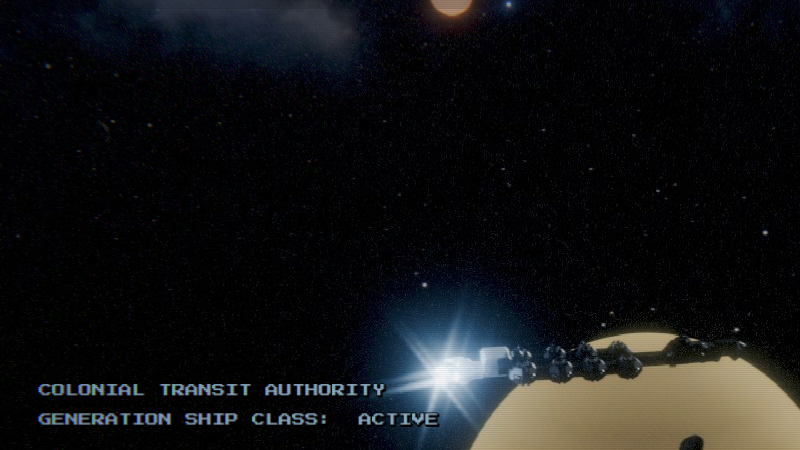
The star chart switches between the interstellar view and a system's top-down map. Arriving at a world opens straight onto that map — the star, its worlds on their orbits, the asteroid belts, the candidate world marked — and drops back to the star field when you move on. No ship in the frame; the view looks out from it.
Any system you've charted can be reopened from the star chart — hover a star and select [ VIEW SYSTEM ].
The interstellar view holds its full star field for the whole voyage, past the heliopause.
Arrival, and what it tells you
Arriving at a system presents its several candidate worlds to weigh, not a single one — and the number of candidates varies, with better sensors improving the odds of finding more.
A world keeps its habitability and details to itself until you run the surface scan on arrival. A probe gives only a rough read beforehand, never the number.
Every system you visit stays on the chart, and you can always set course back to it — to the same world you left, not a re-rolled one.
Navigation set straight
The outbound course plots as one straight line to its star. Through the solar transit the forward leg holds the ship's heading instead of bending toward the destination's true bearing — the route and the ship's nose agree.
A probed world's estimated habitability reads the same figure on the star chart as in the probe report.
The colony
Colonists lost in the landing are entered in the register by name, each with a cause and the year of death, alongside those lost in transit.
Settled colonies stand under an enclosed dome again — a sealed shell on airless and hostile ground, a glassed biosphere on ice and temperate worlds — with the horizon cleared of a stray warm band.
Survival and governance
A ship reading 0% power, food, or hull now genuinely faces the consequences instead of coasting at zero.
The ship's systems hold their bid for expanded authority until the voyage has outrun most of the crew's lifetimes, no longer in the opening decades.
Locked founding directives read as complete, dimmed cards rather than losing their borders.
Fixes and text
Returning to a pending decision from another tab no longer leaves the year unable to advance.
The faction readout columns line up, and the world-survey card no longer clips its labels.
An editing pass on the founding-era passages and the account of those lost in transit.
German, French, Italian, Spanish, and Russian brought level with the corrected text.
Source
Changelog.gg summarizes and formats this update. How we read updates.