
In this update1
Full notes
Full Dandelion Void update
Read the full published notes in a cleaner layout. The original post stays linked below.
What changed
- Gameplay
- UI and audio
- Events
- Balance
- Maps
- Store
Dandelion Void changes
Hi everyone, and welcome to another Dandelion Void devlog. Today we’re telling the story of one of the “faces” of Dandelion Void, which is ironic because they have no face at all. Let’s talk about the twigsnapper! Some of you may have already seen this creature’s art update mentioned in the recent MrAtomicDuck interview of our game director Brian. If you enjoyed that section of the video, please look forward to much more detail in this article. If you missed it then no worries, because we’ll be starting from square one!
Underground Beginnings
The original idea for the twigsnapper came from a conversation between Manzanita Interactive’s two R’s: Roland and Robin (yours truly). Our original enemies, the uproots, were pretty basic behaviorally: they camouflage in plants, and chase you if they see you.
We wanted to give our enemies more of a relationship with their environment and feel more “plant-y,” so Roland had the idea of an extra dangerous creature that might only be able to walk on tiles with roots or vegetation.
Robin latched onto the idea that these “rootbound creatures” would increase the danger for the player when they set foot on a vegetated tile, and she wanted to see if she could make this moment as dramatic as possible. It might even be scarier if the creature was aggroed by you stepping into vegetation, but once it was chasing you it could go wherever it wanted.
She began work on a prototype of a new enemy, which she called the “twigsnapper” since it was provoked by the players crunching their feet on vegetation underfoot. Since only Robin was working on this enemy at the time, the original twigsnapper prototype was visually modest. Her “programmer art” version consisted of the model for the normal uproot with a new brown texture, simple lines for the stalks, and then a set of “feather fronds”; a flat drawing copied several times on intersecting planes.
The original prototype for the twigsnapper, with temporary “Programmer art”
The twigsnapper works likes this:
Idle: When not aggroed, the twigsnapper stands still on a single tile and flicks its three “sensing organs” randomly about, like an insect’s antenna tasting the air.
Alerted: If the player steps on a vegetation tile (roots or ponic) in the twigsnapper’s presence, a sharp sound effect plays and one of its 3 sensing organs begins tracking the player
Chasing: Once three footstep events have gotten all three antennas locked onto the player, the creature becomes properly aggroed and starts chasing you!
One of the main goals of the twigsnapper’s design was to contrast it as much as possible with our standard uproot enemies
Visibility: The green uproots hide in plants and use camouflage to ambush the player. The twigsnapper is highly visible and sits in plain sight
Threat level
The uproots are our “canon fodder” enemies, which die in just a few hits and are only dangerous in numbers.
The twigsnapper is like a miniboss
it’s fast, has a lot of health, and deals a lot of damage, making just one of them a formidable threat.
Distribution: The uproots are a constant presence that can spawn almost anywhere in the map. Twigsnappers are constrained to just a few locations and provide environmental variation as the player explores.
Our beloved cannon fodder, the humble uproots Twigsnappers ended up being a big highlight for our early testers. The initial footstep where you get their attention is a great horror moment, and their status as a harder enemy gives players a sense of achievement when they finally defeat one.
Putting down Roots
This temp art version survived in game for several months, but we always knew we wanted to redo the visuals to give the creature its own identity. Finally, a few months ago our game director Brian and our 3D artist Dara gave the twigsnappers a glow-up!
The redesign process started off with gathering some reference imagery. The temp art was based on fountaingrass, an ornamental plant with bizarre, Seussian fronds that flare out in all directions. Since the organs were meant to be sensors, we also looked at other types of ways that plants sense motion, like the sensory hairs on a venus flytrap “mouth.” Steam post image
We wanted the new version to have a stronger visual transition between the creature’s idle and chasing states. So it didn’t take long to come up with the idea that the creature should be buried while idle, and unearth itself when it chases you. Since this implies both an above-ground and below-ground part of the creature, Brian turned to root vegetables – turmeric in particular, which he admired for its strong color and knobby texture. Steam post image
With some of these core inspirations established, we gathered on a teamwide brainstorming session and started drawing! Steam post imageSteam post image
Going from roughly top to bottom, we started off by thinking about the creature as a radially symmetric lump of dirt with 3 legs on the bottom and three fronds up top. This was a good start, but lacked some of the fear factor we wanted in this enemy (in fact, it was a bit cute). It also didn’t incorporate the root aspect as much as we wanted.
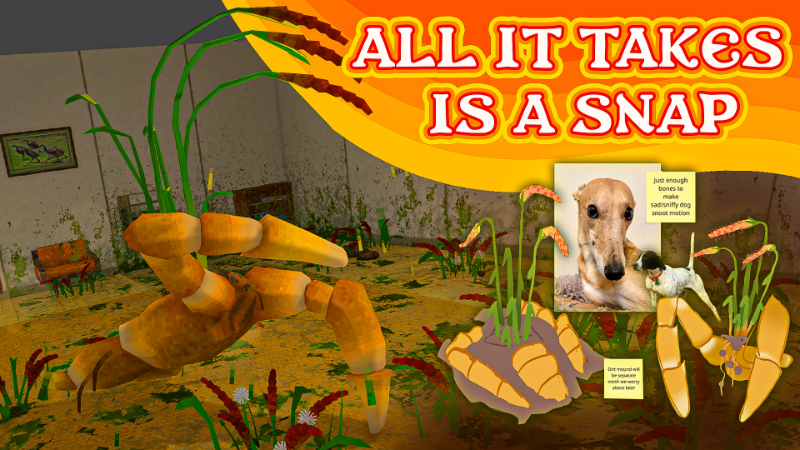
At some point someone had the idea of giving the twigsnapper just two legs and letting the rest of its body drag on the floor. In a way we can’t fully explain, this felt a whole lot scarier to us; possibly it has to do with the creature’s lack of balance, the fact that dragging itself around looks a bit painful, or just that this movement style brings it further away from familiar animal behavior.
We were all pretty excited about this morphology, and at this point Brian had enough information to draw an official concept. You can see that below! Steam post imageBrian took the bright orange with the white accents is straight from turmeric; the knobbyness he kept, while adding some sharp edges to increase the danger factor. The sensing fronds on top keep some of the fountaingrass inspiration, now with a stronger red coloring.
Establishing scale was pretty important – we wanted this creature to be bigger and beefier to account for its abundance of health – so Brian superimposed his concept onto a screenshot next to the temp art Twigsnapper. Next came modelling and animation, which meant a pass-off to Dara. You can see the fruits (or “roots”) of their labor below! If we do say so ourselves, they nailed the assignment: the new twigsnapper design is scary, distinctive, and dripping with identity. In particular, we think this is an enemy that really shows off the creative possibility space of plant-based enemies.
There’s still plenty of work to do on the twigsnapper. On the visual side, we want to add a bit of debris around their base while they’re buried to smooth the hard line between the floor and their body.
On the gameplay side, you might notice that the twigsnapper now lives in a “field” of twigsnapper-inspired vegetation. This is part of an update where we’re going to make them specifically trigger off of footsteps on these special plants that mark their area of influence. This helps the player understand the connection between stepping on plants and alerting the creature, and provides more counterplay opportunities for players to sneak around twigsnappers by finding paths through the vegetation or removing it with a tool.
With all of this said, we’re very happy with the direction this enemy has been moving in!
Three Snaps and You’re Out
Thanks for joining us on this little tour through our twigsnapper’s stages of life. If you liked this article, you might also enjoy this previous entry which did a similar lookback at our good friend the root whipper.
Please look forward to more updates on Dandelion Void development next month. We also have a bit of a bonus tangent below that didn’t fit into the original article. In the meantime, everybody please take care and have a great week!
-- Robin and the Manzanita Interactive team
Addendum: Too Temp, or Not Temp Enough?
As mentioned above, the twigsnapper started off as a temp “programmer art” implementation, then graduated to a redesigned production-quality model. This is a normal part of the game production process; engineers usually program new enemies using placeholder visuals, and then once the behavior of the creature is defined an artist can replace it with a final design.
This does lead to an awkward middle period, though, where the temp art visuals are in the game while the final visuals are still pending. In the case of the twigsnapper, this gap was a full six months!
When you have temporary art in your build, one of three problems can occur when people look at the game:
Case 1: Observers recognize the temp art as temp art
Case 2: Observers mistake the temp art as the intended final visuals and dislike how it looks
Case 3: Observers mistake the temp art as the intended final visuals and like how it looks!
Case 1 (“recognize”) is an issue if you’re trying to hype up your game and the temp art makes it look unfinished. The advantage of case 1 is that because players understand that the art is temporary, they know that the final product will be improved.
Case 2 (“mistake & dislike”) is the worst possible scenario; the observer just thinks that your game is going to be full of bad art.
Case 3 (“mistake & like”) is a mixed blessing: it’s good that the observer has a positive view of your game’s visuals, but there’s the risk that they get so attached to the temp art for a feature that they’re disappointed when it’s replaced.
In decades prior, the issue of temp art wasn’t as big of a deal. Most development happened in private, so players would generally never see it. In this new era of devlogs, open development, demos, and early access, it’s way more likely that players see your temp art. And even “back in the day,” if you were demoing an early build to an executive or a potential publisher, you had to be extraordinarily careful with how you contextualized any temp art.
The reaction to the twigsnapper’s temp art was mostly case 3. In a sheet of written feedback, one of our playtesters told us that they “really liked the monster that was a mixture of flesh and plant parts,” interpreting the brown leaves as some kind of human skin material. It’s always flattering to hear positive feedback, but in reality Robin just made the creature brown because it needed to not be green. We’re also certain that there were case 2 players who didn’t think the temp twigsnapper looked very good, but didn’t comment on it directly.
There’s no one solution to this issue. Some developers refuse to put any work towards temp art so that observers will only ever end up in case 1. Their WIP goblin enemy might just be a gray cube with some floating text labeled “TODO: GOBLIN ART.”
Robin personally prefers to put a bit of work into making programmer art at least somewhat resemble the final vision, or at least not making it so distractingly bad that it makes it hard to take the rest of the game seriously. But there is always the risk of this “uncanny valley,” where the art is passable enough that it gets taken as the final vision. If you make it look too serviceable, even the developers might forget that it needs updating.
In the end we think the new twigsnapper is a massive improvement, even if I do have some affection for the feathery brown uproot temp art. There’s just no replacement for a unique character design!
Addendum Addendum: What’s this guys’ name?
I’ll go on record to say that I think “twigsnapper” sounds cool. But it’s a bit of a mixed metaphor – it’s actually the player who’s snapping the twigs with their footsteps, not the creature. We’ve also found that the rhythm of the name is just a bit too close to our other “root whipper” enemy, and our team gets them mixed up all the time. Are all of our enemies going to be NounVerbers?
In a way you could say that these names themselves are a form of “temp art” that’s started to stick. We needed something to call them when we started making a bunch of code and art files, but I also wouldn’t be surprised if we pick new “official names” that get displayed before we go to launch. Gotta think about this one!
OK! Now the devlog is done for real. Take care everybody!
-- Robin and the Manzanita Interactive team.
Source
Changelog.gg summarizes and formats this update. How we read updates.