
In this update1
Full notes
Full Curse of Resthaven update
Read the full published notes in a cleaner layout. The original post stays linked below.
What changed
- Gameplay
- Events
- UI and audio
- Fixes
Curse of Resthaven changes
Hi everyone, it’s Matt. I’m one of the writers and game designers for Curse of Resthaven!
When we were coming up with the story for CoR, we knew we didn’t want it to be a simple beginning, middle, and end sort of affair. We were keen to try something different, so we introduced the idea of a time loop as an additional mechanic for world building, discovery, and replayability.
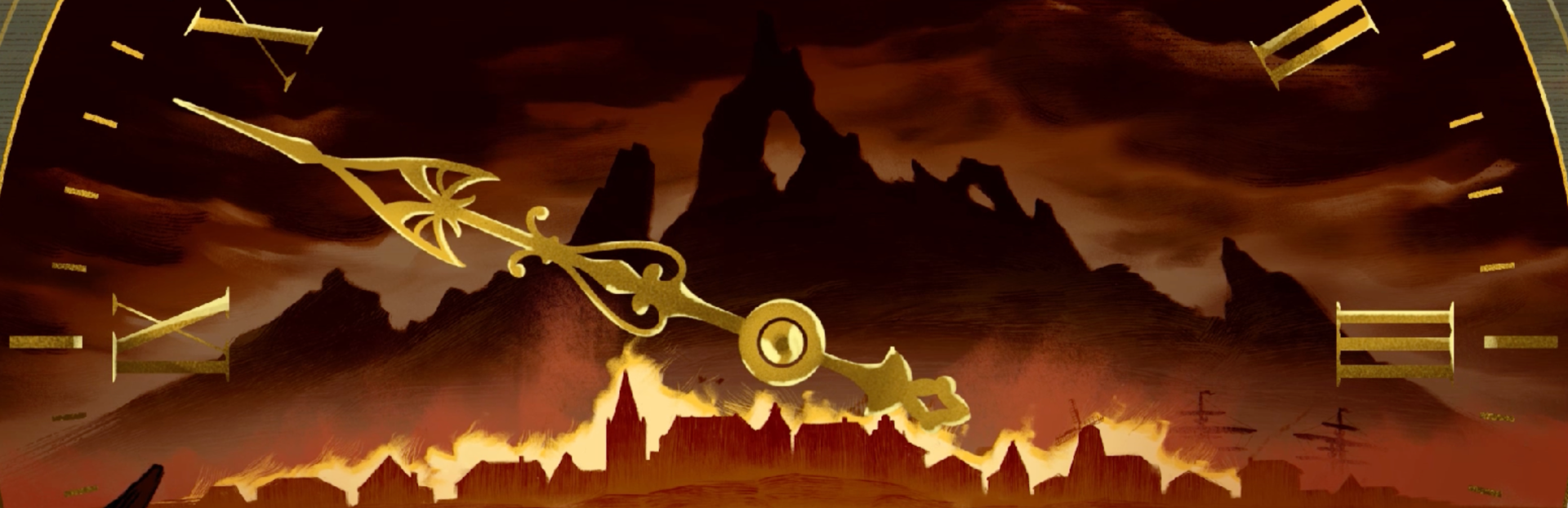
Six days after you arrive at Resthaven, a cataclysm wipes out the colony and all its inhabitants. The island’s fading goddess sends you back to the moment of your arrival, with your choice of boon to help you make progress on your next run.
The obvious benefit of having a time loop mechanic in your video game is it gives a player an opportunity to replay scenarios. Whether it’s repeating entire days/weeks, or rewinding a few seconds of action/combat, it gives the player a vehicle to do a couple of things:
See a problem from a new angle
Take a path they didn’t before
Learn more about an event/scenario
Try a new approach for a hurdle
Perfect the timing of a certain action or tactic
But adding a time loop mechanic into a game can come with some big problems – the biggest of which being that your game may become too boring to play.
So how do you avoid that? How do you make playing the same scenario over and over again NOT boring or tedious?
For my money, there’s two types of time loop mechanics in games:
Instant Rewinds: This is typically used for games that centre around action or combat, where perfecting the timing of a button press or quick time event is the name of the game. In these cases, it’s highly likely a player will instantly replay these moments until it’s perfected. It may be frustrating, but it’s certainly not dull.
Longer Rewinds: This covers scenarios where you have to replay an entire in-game day or longer of content (like, for example, Curse of Resthaven!). This gives the opportunity for player-driven progression, especially in a narrative context, to deepen world building. But there's also a much higher risk of it becoming boring, tedious, and any other words you wouldn’t want to read in a review.
Given our love of storytelling at Hilltop, we definitely like working in the Longer Rewind realm of time loop mechanics. And we think some of the best examples of time loop games are in this vein:
Outer Wilds: A phenomenal, expansive puzzle-box timeloop experience. The system is entirely knowledge-driven, and every loop feels meaningful without artificial gating.
The Legend of Zelda: Majora's Mask: The OG masterclass in scheduling and systemic NPC behavior. Slight friction from repetition and time management, but the loop creates unmatched world reactivity and pressure.
Deathloop: Extremely polished and satisfying once it clicks, especially in how it structures the ‘perfect run’ towards the end.
12 Minutes: The tight loop is mechanically clear, but repetition and trial-and-error can become frustrating.
The Forgotten City: Smart use of resets to streamline repetition and reward knowledge. More of a narrative-gating tool than a deeply systemic loop, but very effective at reducing friction. [Note: lots of direct inspiration from this one for Curse of Resthaven. Fans of this game will feel it!]
Loop of Resthaven
From these games, we’ve learned a lot about what works when it comes to manipulating the space-time continuum. But, more importantly, we paid attention to the problems that can arise when travelling through time (other than becoming your own grandfather).
(For clarity’s sake of what’s to come, it’s important to know that Curse of Resthaven has TOPICS and LEADS. A TOPIC is a question you acquire and can interrogate people about to learn more information. A LEAD is a ‘quest’ you have to solve, where the steps are laid out and it gets updated as you progress.)
The biggest potential pitfalls of a time loop game built around longer rewinds (in my humble opinion) are:
Repetition of information
You learn something through interrogating someone and get a new Lead, an update, or maybe even a new Topic. You get to the end of your loop, rewind, and you have to talk to that person and learn it all again?!? No thank you!
In Curse of Resthaven, once you learn something, you know it. The main character, Governor Ambrose, may be stuck in the time loop like everyone else, but he at least gets to keep his memories (horrors and all!).
Retracing steps
Being forced to walk the same path repeatedly, while great for cardio, can be a lousy way to spend your play time.
Once a location has been discovered, the Governor remembers where it is and can fast travel to save time (but be warned, you’re missing out on organic discovery AND the nice artwork in our game!)
Losing what you’ve collected
You’ve spent all this time gathering items and gold, then they all disappear? Technically, I guess that makes sense, but it feels very punishing.
We, however, give the player the opportunity to upgrade a ‘lead-lined’ chest so they can keep some of their gold and/or items each loop. Technically, I guess that doesn’t make sense, but it’s a nice thing to have.
Not enough or small amounts of progression
You never want to feel like you didn’t accomplish anything. And while that is TOTALLY within the players control (one COULD waste their time by not doing anything before the next cataclysm), we wanted to make sure a player had ample opportunities to progress the main story of the game. And there are. Trust us. You just have to work the steps.
Not respecting a player’s time
We want this game to be fun, that’s what we’ve set out to do. We WANT you to discover things, and interrogate people and chase down leads. If the game is about repeating the same steps over and over again, then we haven’t done our job.
For these reasons, Curse of Resthaven i s more rogue- lite than rogue- like. There’s no permadeath, complete reset of progression, or randomly/procedurally generated content in our game (except for the expeditions, where new ones pop up every loop).
In our game, knowledge is currency. You get to keep your progress and use it to your advantage against the poor souls that are trapped in the time loop and don’t even know it, and you don’t have to keep earning it the hard way. We aimed to create a more forgiving play experience, because at the end of the day, we WANT you to beat the game and see how the story ends.
Of course, this doesn’t cover all the problems that could be found with time loop mechanics, but it’s what we considered / focused on when writing and designing our game. And we hope our hard work pays off.
But if it hasn’t, you’ll never know, because we’ll have gone back in time and fixed it!
Matt
Source
Changelog.gg summarizes and formats this update. How we read updates.