What changed
0 fixes2 additions3 changes0 removals
addedBeautiful corner progressLast week I wrote and built up a bunch of systems and processes to push the visuals for a new "beautiful corner" we are building. Steam post image
changedSam's commentThis also ties in to our randomisation bags, collections of things that we use to randomly select items, weapons or other things we want to randomly placed or selected. So if we have a room that is using the swamp biome, we can just pick the "swamp"-trees/bushes/flowers-pack and pick from that and don't have to create a bespoke room design for each. Our ( encounter → room layout → beautiful tile ) layers thus create a lot of variation. An in-depth explanation of it is to come in a future newsletter.
addedGrass and other wiggly stuffDistributing those flowers and bushes allows for much higher visual density, which in turn can be made more interesting by introducing small hints of movement; this improves how alive the scene feels and adds depth to the world.
changedGrass and other wiggly stuffA great amount of our non interactive in-game objects (think small chunks of moss, little stones and sticks) already use a simple billboarding sprite shader which makes them constantly rotate to the camera. This saves a lot of performance because they do not have to rely on our other camera rotating systems which we built for interactive objects such as enemies, trees and pretty much everything else in Castle Come (We are probably going to do a write up or documentation of this approach for our artstyle in the future here, so stay tuned).
changedGrass and other wiggly stuffThe prevalence of this shader meant that I could just go on and introduce a small, sinus based wave function to the vertices of the sprites in the shader itself to make objects such as bushes and grass wiggle in the virtual wind. Originally, I was sceptical whether it would work out visually, as the constant rotating to the camera would mean a on-going shift of the perceived wind direction, but our artstyle proved to be abstract enough for those issues not to arise.Steam post image
Castle Come changes
addedLast week I wrote and built up a bunch of systems and processes to push the visuals for a new "beautiful corner" we are building. Steam post image
changedThis also ties in to our randomisation bags, collections of things that we use to randomly select items, weapons or other things we want to randomly placed or selected. So if we have a room that is using the swamp biome, we can just pick the "swamp"-trees/bushes/flowers-pack and pick from that and don't have to create a bespoke room design for each. Our ( encounter → room layout → beautiful tile ) layers thus create a lot of variation. An in-depth explanation of it is to come in a future newsletter.
addedDistributing those flowers and bushes allows for much higher visual density, which in turn can be made more interesting by introducing small hints of movement; this improves how alive the scene feels and adds depth to the world.
changedA great amount of our non interactive in-game objects (think small chunks of moss, little stones and sticks) already use a simple billboarding sprite shader which makes them constantly rotate to the camera. This saves a lot of performance because they do not have to rely on our other camera rotating systems which we built for interactive objects such as enemies, trees and pretty much everything else in Castle Come (We are probably going to do a write up or documentation of this approach for our artstyle in the future here, so stay tuned).
changedThe prevalence of this shader meant that I could just go on and introduce a small, sinus based wave function to the vertices of the sprites in the shader itself to make objects such as bushes and grass wiggle in the virtual wind. Originally, I was sceptical whether it would work out visually, as the constant rotating to the camera would mean a on-going shift of the perceived wind direction, but our artstyle proved to be abstract enough for those issues not to arise.Steam post image
This time it is Basil writing. I've really been looking forward to try out our newsletter and writing long form formats have always been something which is dear to me.
Beautiful corner progress
Last week I wrote and built up a bunch of systems and processes to push the visuals for a new "beautiful corner" we are building. Steam post image
By designing said corner, we want to clear out some issues we had with how borders of the world would behave and answer questions about the overall visual density and structure the final game will have. We have found that building hand crafted scenes is a good way to inform decisions for generative systems, instead of desperately trying to solve visual questions directly in world generation code.
One of the systems I wrote distributes a collection of objects along a predefined path, using parameters such as density and noise controls to mask out parts for a more natural distribution and simple rotational operations to align or randomise objects along the line.
With this system, we can quickly seed out digital flowerbeds, grasslands and stone rims, enabling us to cover up hard transitions between 3D meshes and cutting through larger areas of white space in the arena designs. Steam post image
This also ties in to our randomisation bags, collections of things that we use to randomly select items, weapons or other things we want to randomly placed or selected. So if we have a room that is using the swamp biome, we can just pick the "swamp"-trees/bushes/flowers-pack and pick from that and don't have to create a bespoke room design for each. Our (encounter → room layout → beautiful tile) layers thus create a lot of variation. An in-depth explanation of it is to come in a future newsletter.
Grass and other wiggly stuff
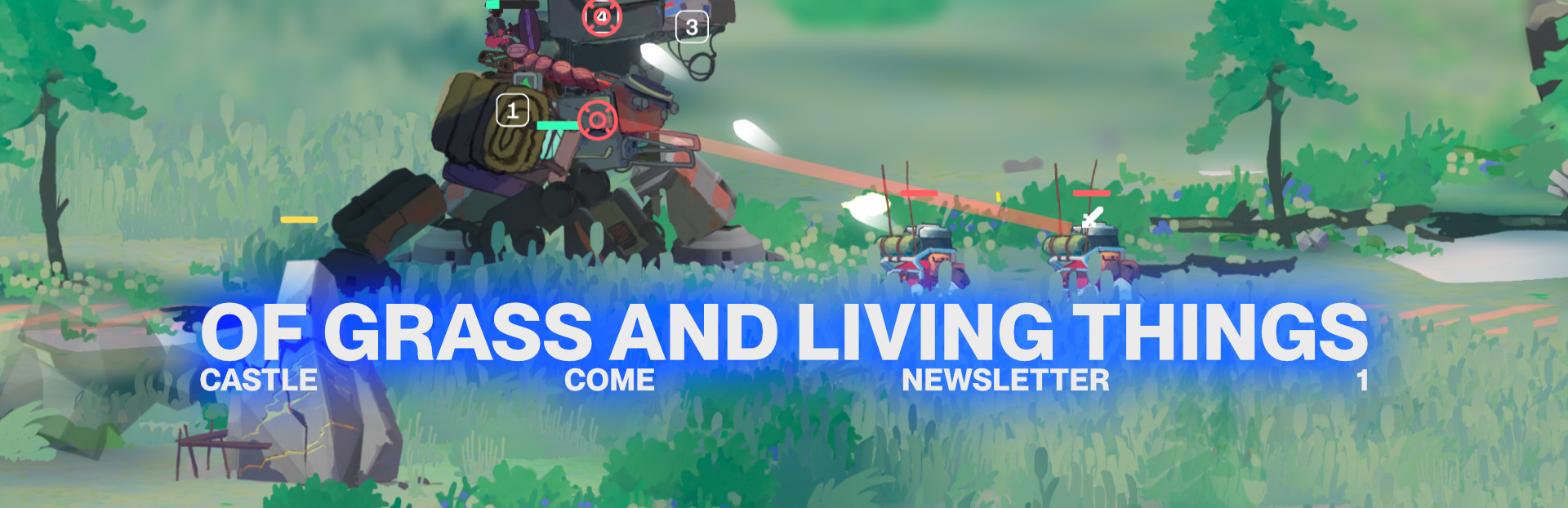
Distributing those flowers and bushes allows for much higher visual density, which in turn can be made more interesting by introducing small hints of movement; this improves how alive the scene feels and adds depth to the world.
A great amount of our non interactive in-game objects (think small chunks of moss, little stones and sticks) already use a simple billboarding sprite shader which makes them constantly rotate to the camera. This saves a lot of performance because they do not have to rely on our other camera rotating systems which we built for interactive objects such as enemies, trees and pretty much everything else in Castle Come (We are probably going to do a write up or documentation of this approach for our artstyle in the future here, so stay tuned).
The prevalence of this shader meant that I could just go on and introduce a small, sinus based wave function to the vertices of the sprites in the shader itself to make objects such as bushes and grass wiggle in the virtual wind. Originally, I was sceptical whether it would work out visually, as the constant rotating to the camera would mean a on-going shift of the perceived wind direction, but our artstyle proved to be abstract enough for those issues not to arise.Steam post image
So there's that, we have wiggly, distributed grass now. and dusty fireflies
yours dearly and until next time
Basil
PS: As we only post the Castle Come relevant news here, if you're into indepth info what's going on here you can sign up:
Get the full newsletter