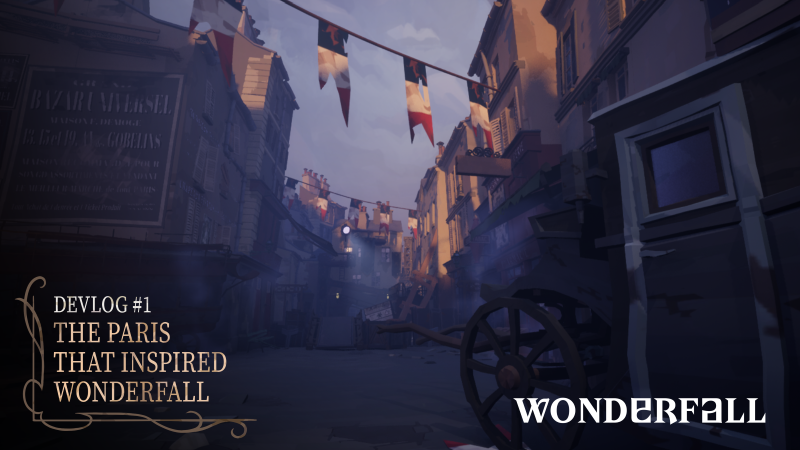
The Paris That Inspired Wonderfall Wonderfall takes place in a reimagined 1920 Paris, where a force called Entropy is turning the city to sand.
In this update6
Full notes
Full Wonderfall update
Read the full published notes in a cleaner layout. The original post stays linked below.
What changed
0 fixes0 additions5 changes0 removals
Gameplay
Store
changedThe Paris That Inspired WonderfallWonderfall takes place in a reimagined 1920 Paris, where a force called Entropy is turning the city to sand. To build that world, we started where any good reconstruction starts: with the real thing. Our environment team digs through archival photographs of the city, studies the buildings, the proportions, the textures, and rebuilds them in 3D.
changedShopfronts and CobblestonesThe reference photo shows a tight Parisian street. “Comestibles” painted on the shop to the left, a “Rue de Perpignan” sign on the wall, storefronts squeezed together. Our version keeps that framing, the same narrow gap between buildings, the same wall-mounted gas lamp. But the cobblestones are gone. The ground is cracked. A broken cart sits there, already touched by Entropy.
changedBalconies and Tall FacadesIn the archive photo, you can see the iron balconies on the left, windows stacked high, a gas lamp with an ornate bracket, a hand cart abandoned on the cobblestones. We kept a lot of this. The “Charcuterie des Trois” shopfront on the left with its wrought-iron sign bracket, the windows running up the facades, a streetlamp casting warm light in the distance. On the right, a large poster still clings to the wall. The pavement is broken apart. Rubble everywhere in the foreground. This is what Entropy does to a street.
changedStorefronts and Iron FencesThe archive shows “Bossuet Taillandier” beneath a large banner, cobblestones running toward an iron fence on the right, a gas lamp further down the road. Our version swaps the shop name for “Epicerie Generale” but keeps the layout: carts and barrels at street level, the fence on the right, worn textures on every surface. Same bones, different skin.
changedArchways and Wall AdvertisementsOne of our favorites. The reference has painted wall advertisements for “Besson, Constructeur d’instruments,” an archway at the end of the passage, a “Vins en Gros” shop across the way. In our reconstruction, the wall reads “27 Rue Larrey, Peintures, Vitrerie.” The archway still stands. Exposed pipes run along the walls now, chunks of stone are missing, and behind the gate there is a warm glow. Something is still going on back there.
Wonderfall changes
changedWonderfall takes place in a reimagined 1920 Paris, where a force called Entropy is turning the city to sand. To build that world, we started where any good reconstruction starts: with the real thing. Our environment team digs through archival photographs of the city, studies the buildings, the proportions, the textures, and rebuilds them in 3D.
changedThe reference photo shows a tight Parisian street. “Comestibles” painted on the shop to the left, a “Rue de Perpignan” sign on the wall, storefronts squeezed together. Our version keeps that framing, the same narrow gap between buildings, the same wall-mounted gas lamp. But the cobblestones are gone. The ground is cracked. A broken cart sits there, already touched by Entropy.
changedIn the archive photo, you can see the iron balconies on the left, windows stacked high, a gas lamp with an ornate bracket, a hand cart abandoned on the cobblestones. We kept a lot of this. The “Charcuterie des Trois” shopfront on the left with its wrought-iron sign bracket, the windows running up the facades, a streetlamp casting warm light in the distance. On the right, a large poster still clings to the wall. The pavement is broken apart. Rubble everywhere in the foreground. This is what Entropy does to a street.
changedThe archive shows “Bossuet Taillandier” beneath a large banner, cobblestones running toward an iron fence on the right, a gas lamp further down the road. Our version swaps the shop name for “Epicerie Generale” but keeps the layout: carts and barrels at street level, the fence on the right, worn textures on every surface. Same bones, different skin.
changedOne of our favorites. The reference has painted wall advertisements for “Besson, Constructeur d’instruments,” an archway at the end of the passage, a “Vins en Gros” shop across the way. In our reconstruction, the wall reads “27 Rue Larrey, Peintures, Vitrerie.” The archway still stands. Exposed pipes run along the walls now, chunks of stone are missing, and behind the gate there is a warm glow. Something is still going on back there.
The Paris That Inspired Wonderfall
Wonderfall takes place in a reimagined 1920 Paris, where a force called Entropy is turning the city to sand. To build that world, we started where any good reconstruction starts: with the real thing. Our environment team digs through archival photographs of the city, studies the buildings, the proportions, the textures, and rebuilds them in 3D.
We thought you might like to see what that looks like. Four streets. The archive photo, then what Entropy made of them.
Archive photographs by Charles Marville, who documented the streets of Paris in the 19th century.
Shopfronts and Cobblestones
The reference photo shows a tight Parisian street. “Comestibles” painted on the shop to the left, a “Rue de Perpignan” sign on the wall, storefronts squeezed together. Our version keeps that framing, the same narrow gap between buildings, the same wall-mounted gas lamp. But the cobblestones are gone. The ground is cracked. A broken cart sits there, already touched by Entropy.
Balconies and Tall Facades
In the archive photo, you can see the iron balconies on the left, windows stacked high, a gas lamp with an ornate bracket, a hand cart abandoned on the cobblestones. We kept a lot of this. The “Charcuterie des Trois” shopfront on the left with its wrought-iron sign bracket, the windows running up the facades, a streetlamp casting warm light in the distance. On the right, a large poster still clings to the wall. The pavement is broken apart. Rubble everywhere in the foreground. This is what Entropy does to a street.
Storefronts and Iron Fences
The archive shows “Bossuet Taillandier” beneath a large banner, cobblestones running toward an iron fence on the right, a gas lamp further down the road. Our version swaps the shop name for “Epicerie Generale” but keeps the layout: carts and barrels at street level, the fence on the right, worn textures on every surface. Same bones, different skin.
Archways and Wall Advertisements
One of our favorites. The reference has painted wall advertisements for “Besson, Constructeur d’instruments,” an archway at the end of the passage, a “Vins en Gros” shop across the way. In our reconstruction, the wall reads “27 Rue Larrey, Peintures, Vitrerie.” The archway still stands. Exposed pipes run along the walls now, chunks of stone are missing, and behind the gate there is a warm glow. Something is still going on back there.
A Word from the Team
“We rely on a blend of historical documentation and artistic reconstruction. We study period photographs to understand building structures, materials and proportions, then translate those elements into 3D models while staying as faithful as possible to the original volumes. We also put a lot of work into textures to capture the wear and imperfections characteristic of the city during that period. We tie everything together with lighting and atmosphere to faithfully recreate the feel of Paris.”
Meet Léon
This is the Paris that Léon calls home. He is a teenage orphan in a city that is slowly turning to sand. Most of the people he knew are gone, taken by a mysterious force called Entropy that is consuming Paris block by block. Léon is immune to it. He does not know why. And he is going to have to go deeper into these crumbling streets, shaping the sand itself, to find out.
More on Léon soon. Wishlist Wonderfall now to play the demo soon.