
HomeGamesUpdatesPricingMethodology
Steam News7 August 202616d ago

【Developement Thread 7】Lines of Transportation

Transportation lines are one of the most important elements in the game, serving as the links that connect cities with one another and with the front lines.

Full notes

Full War in Asia update

Read the full published notes in a cleaner layout. The original post stays linked below.

What changed

0 fixes0 additions4 changes0 removals
  • UI and audio
  • Balance
changedTo achieve this without forcing the player into excessive micromanagement, the game introduces a Priority system. In the stockpile interface, you can freely raise or lower the priority of any particular good. Cities with a high priority for a certain resource will receive supplies from other cities, while goods stored in lower-priority cities may be shipped elsewhere.
changedIf you still find manual management too cumbersome, you can delegate transportation management to the AI. Each turn, the AI will automatically allocate available transport capacity, taking shortages and frontline demand into account while ensuring that city production can continue, and then distributing supplies to the areas where they are needed most.
changedEvery unit of goods has a specific weight , which, together with the capacity of a transportation line, determines how much of that good can be moved during a single turn.
changedYou can also upgrade stations through a city's administration interface, increasing the transportation capacity of some of its connected routes.

War in Asia changes

changedTo achieve this without forcing the player into excessive micromanagement, the game introduces a Priority system. In the stockpile interface, you can freely raise or lower the priority of any particular good. Cities with a high priority for a certain resource will receive supplies from other cities, while goods stored in lower-priority cities may be shipped elsewhere.
changedIf you still find manual management too cumbersome, you can delegate transportation management to the AI. Each turn, the AI will automatically allocate available transport capacity, taking shortages and frontline demand into account while ensuring that city production can continue, and then distributing supplies to the areas where they are needed most.
changedEvery unit of goods has a specific weight , which, together with the capacity of a transportation line, determines how much of that good can be moved during a single turn.
changedYou can also upgrade stations through a city's administration interface, increasing the transportation capacity of some of its connected routes.

Transportation lines are one of the most important elements in the game, serving as the links that connect cities with one another and with the front lines.

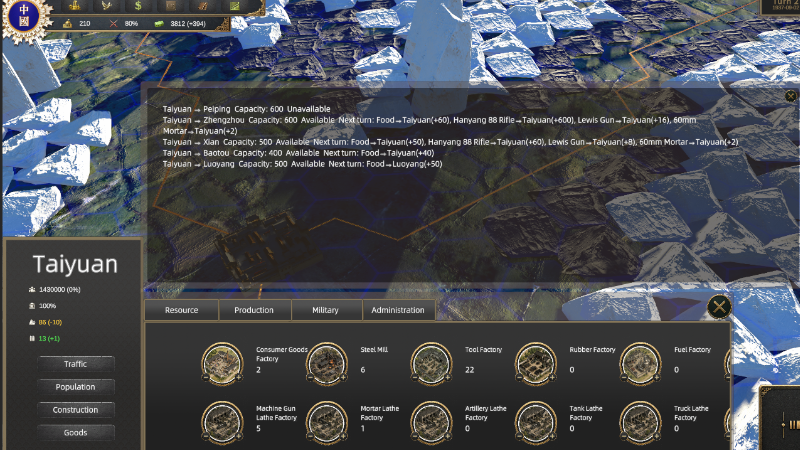
Unlike most strategy games and wargames, we aim to represent historical transportation networks through a more concrete and hands-on system. You can precisely manage the traffic on each transportation line, as well as the flow of individual goods along those routes, allowing resources to move between different cities. Weapons, food, and ammunition can be continuously supplied to the front, while vital raw materials and industrial goods can be transported back toward the interior.

A frontline city often faces enormous supply demands and must rely on transportation lines connecting it to cities in the rear. However, if you have stockpiled enough supplies in advance, units around the city can continue operating for a long time even after all of its transportation links have been cut.

This also encourages more flexible operational planning. Severing a transportation line that enemy forces depend on may not produce an immediate result, but its long-term impact can be decisive.

To achieve this without forcing the player into excessive micromanagement, the game introduces a Priority system. In the stockpile interface, you can freely raise or lower the priority of any particular good. Cities with a high priority for a certain resource will receive supplies from other cities, while goods stored in lower-priority cities may be shipped elsewhere.

If you still find manual management too cumbersome, you can delegate transportation management to the AI. Each turn, the AI will automatically allocate available transport capacity, taking shortages and frontline demand into account while ensuring that city production can continue, and then distributing supplies to the areas where they are needed most.

Every unit of goods has a specific weight, which, together with the capacity of a transportation line, determines how much of that good can be moved during a single turn.

You can also upgrade stations through a city's administration interface, increasing the transportation capacity of some of its connected routes.

Source

Steam News / 7 August 2026

Open original post

Changelog.gg summarizes and formats this update. How we read updates.