
Full notes
Full Victoria 3 update
Read the full published notes in a cleaner layout. The original post stays linked below.
What changed
- Gameplay
- Balance
- Events
- Security
- Maps
Victoria 3 changes
Ahoy, moin, and a happy Thursday Victorians!
It’s First Lord of the Admiralty Cabin Boy Tunay here to introduce you to the ins and outs of naval combat today. Additionally, we will also talk about Gunboat Diplomacy, a paid feature of The Great Wave, further down below.
As always, all values, images, icons, texts and other things shown are work in progress and subject to change!
Fleet Missions
Before one can engage in combat at sea, one must first set sail.
The way this has been handled before was that you would pick a fleet of your choice, set its admirals to the naval orders that you’d like them to execute, and then send them off to a node somewhere in the world to conduct their mission.
With Update 1.13 and The Great Wave, however, we are changing our approach to this. For one, formations will only be led by a single commander going forward—as outlined in Dev Diary #176. And secondly, navies are no longer assigned to a single node and neither will you choose an order on your admiral. Instead, you will now choose a mission for your fleet to pursue—for example, the “Intercept” mission—which will then take you to the new mission planning screen, from which you will be able to assign entire sea regions to the mission. That means a single fleet will now be able to cover several nodes at once—at additional supply cost, that is—up until a limit that we currently define based on your Admiral’s rank. Once the fleet has arrived at its mission area, it will be assumed to be everywhere at once for the duration of its mission—and, should there be an overlapping opposing fleet conducting a mission as well, we (and the enemy) will be able to roll for commencing a naval battle each week.
Setting up the Royal Navy to patrol in a suspiciously coastal France-shaped area
For this, we employ two new attributes that exist across our ships: Detection and Visibility. Where we compare the sum of our detection in the fleet versus the enemy Visibility to determine the chance to spawn a naval battle in a given sea region as the attacker and likewise the enemy fleet may do so as well.
Larger ships tend to generally contribute a higher visibility value than smaller ships or submarines, with the latter, of course, being on the lower end of visibility. On the other hand, some ships, like Carriers, have excellent detection capabilities.
This new system also comes with the added benefit of no longer having to play whac-a-mole with enemy fleets. As long as your mission is set up, your fleet will try to target any enemy fleets in the area, including those that are merely passing through, which used to not be possible in the old system.
The following naval missions will be available to all players:
Project Power
Generates Involvement, and improves a nation's interest level in strategic regions adjacent to the mission area
Intercept
Will try to catch and attack enemy fleets that are either passing through or operating in the mission area
Blockade
Blockades enemy states adjacent to the mission area. The way this works now—as opposed to the old one-fleet-one-sea-node system—is that your total blockade strength will be divided up between all mission areas and eligible states.
Raid Supply Lines
Replacing the former “Convoy Raiding” order, the fleet will try to disrupt enemy supply lines by hunting down and targeting enemy supply ships in the mission area specifically, and otherwise trying to avoid battles
Protect Supply Lines
The counter mission to “Raid Supply Lines”, where the fleet will try to protect supply ships passing through the area, and avoid enemy fleets otherwise
Additionally, owners of The Great Wave will add a couple of other options to their arsenal that I will list below:
Port Bombardment
An alternative to blockading which creates devastation in states adjacent to the mission area up to a capped value per state, and even has a chance to reduce levels of coastal buildings
Piracy
Unrecognized nations will be able to engage in the age-old traditional and very honorable business of piracy by sending them off to skim off a percentage of trade volume passing through the mission area, and depositing it directly into the state treasury!
Privateering
Privateering is much similar to Piracy, though differs in that recognized nations also have access to it and that is only available while at war. This allows you to target the civilian vessels of enemy nations specifically by handing out letters of marque to your fleets
Hunt Pirates
Works much akin to Intercept or Protect Supply Lines, but your fleet will only be sent out to crush pirate fleets that are set to the “Piracy” mission, and maybe capture the odd pirate king and have him executed in Loguetown along the way
But wait, I hear you say, if privateering requires you to be in a state of war, does that not imply that piracy can be conducted in peace time? Astute observation—and I will get to this in the gunboat diplomacy section of the diary—but first let us finally talk about battles themselves.
Naval Battles - Roll Initiative!
When two opposing fleets meet at sea, and one or the other lands a successful detection roll, a battle will be created.
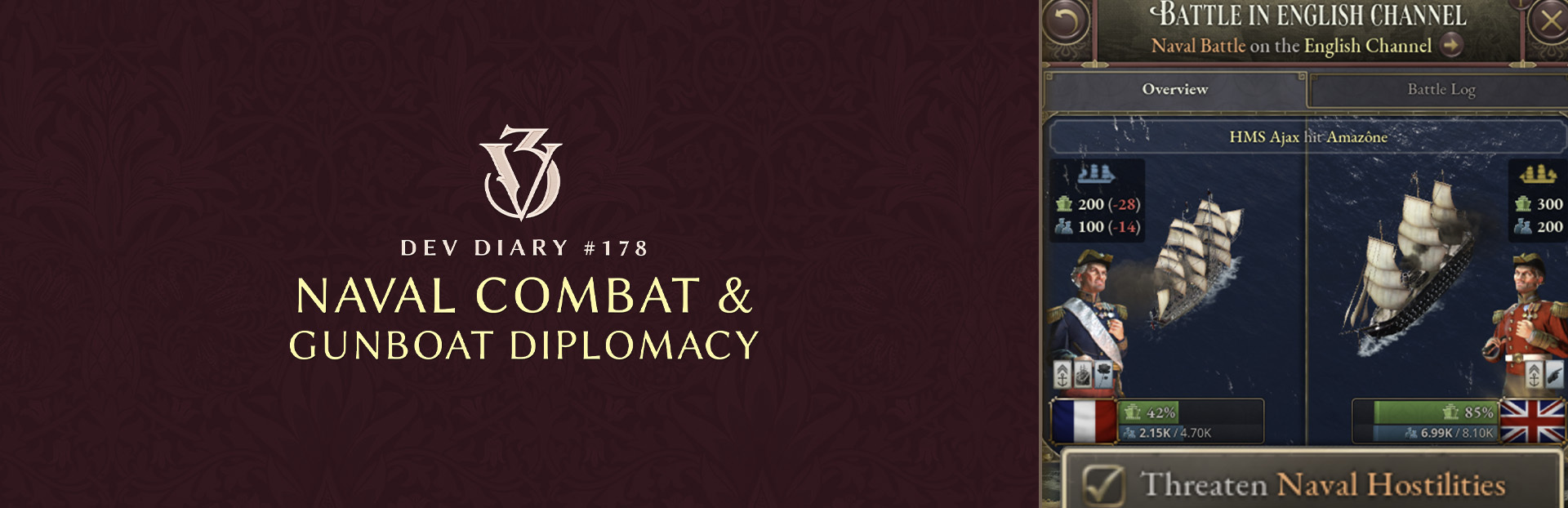
Time to blow the French navy out of the water
When creating our battle, we first determine the weather, which will be reflected in a battle condition. Differently from land battle conditions, however, which combine both natural events, tactics and fortunate or misfortunate events for each commander, naval battle conditions only apply one modifier across the entire battle, affecting both fleets equally.
A battle condition could be a dense fog, making it difficult to spot other vessels, or a strong tropical storm posing a risk to the lives of sailors.
Naval battle conditions do not just apply a modifier penalty to certain stats, they may—depending on the condition—also damage ships (and their crew) directly. The amount of ships affected and the damage inflicted is up to chance, though within certain bounds.
Nature's capriciousness is also represented through the turn-order and can always be viewed in our new battle log. In a sense, this makes Poseidon a third-party in every naval engagement!
The French escort ships have taken quite a beating already
When starting a battle, all involved ships will roll for initiative first. This will determine their starting position in the turn order. Once we have determined our order, we start taking our turns. A ship may engage in one of three actions: Attack, Disengage and Prepare.
Attack
A ship may choose to attack an opposing ship. To do so, it will try to pick a target, and then make an attack roll. If successful, we will also roll for a potential crit, after which we apply damage to the enemy vessel.
Ships without any armament, like supply ships, can not attack. Obviously.
This is where I would like to introduce you to our next set of attributes: Screening and Vulnerability.
A higher Vulnerability makes it more likely for a ship to be targeted by enemy vessels. Generally, your capital ships as well as your supply ships will suffer from a high Vulnerability. You can think of Vulnerability as a pendant to threat, or “Aggro” in other games.
This can be countered with a sufficiently high Screening value in your fleet, however, reducing the likelihood of your high value ships being attacked back down to a minimum base value—as long as your fleet has enough total Screening to cover its total Vulnerability. Screening will be provided to you by your escort ships; for example, your frigates and destroyers.
Disengage
Once ships start taking damage from each other, they may instead opt to use their turn in an attempt to disengage and withdraw from the battle. Their likelihood to attempt to disengage increases the more damage they have already sustained in battle.
Note that ships that wish to disengage from battle will be given priority, and may roll to do so at the beginning of the turn for as long as they are allowed to take an action, regardless of their position in the turn order. Should they fail to do so, of course, they become sitting ducks until their Readiness (see below)has recovered.
Prepare
A ship’s ability to do an attack or disengage roll is limited by its Readiness
When a ship has taken a turn, its Readiness will deplete to 0, and it will have to spend several turns building it back up, by choosing the Prepare action. During this time it may be attacked by opposing ships. Readiness is gained at different rates for different ships—as such, some ships may be allowed to act more often, while others might take longer between each individual action. This will naturally reshuffle the turn-order over time.
We do let you know how fast or slow different ship types gain Readiness, as it is simply a modifier like any other, but we don't actively show you each ship's Readiness in a given battle at any given time. Turns out JRPG style ATB bars are a lot easier to handle on the eyes in a party of 4 as opposed to a party the size of a fleet of dozens of ships!
Our two fleets will then continue to fight each other until there are no more ships left in combat, on account of all ships having either withdrawn from battle or having been sunk by the enemy.
Overall, our changes to combat were made to go in hand with the changes to ships themselves, since they are no longer disposable containers of manpower but real objects that need to be built and maintained; losing them should feel that much more impactful.
To that end our aim was to make combat results much more nuanced as well. One may suffer a heavy blow at sea without losing the entirety of their fleet as ships disengage and withdraw from the battle. On the other hand you may still inflict a complete “Battle of Tsushima” style disaster upon the enemy fleet, bonus points if they are also dealing with adverse weather conditions on top.
Lastly, I would like to give you a quick breakdown for our battle relevant ship attributes and what they actually do:
Hit Points
Your HP—should be pretty self-explanatory, of course—but if this reaches 0, your ship will sink to the bottom of the ocean
Crew
Crew serves as a secondary HP bar—when this reaches 0 you will also lose your ship. More importantly, however, every time you lose a sailor we write that down as a casualty, which means some individual in the according Naval Administration will be killed.
Hull Damage
How much damage a ship can inflict to another ships hull, and therefore their HP
Crew Damage
How much damage a ship can inflict to another ship's crew. This is scaled by the relative damage that is inflicted on the enemy hull. If we were to inflict 0% damage on the hull, then no sailors will be harmed either, but should we inflict 20% of our hull damage value on the enemy, we will also be allowed to inflict 20% of our crew damage value on the enemy crew.
Armor
A ship's armor will reduce any hull damage it receives by that value. There is no variance or chance, here, meaning that a sufficiently armored ship can straight up deflect attacks from an inferior, outdated vessel, though it might still get damaged by a critical hit
Speed
For one, speed determines how quickly a fleet can get around on the map with the lowest speed vessel determining the speed of the entire fleet.
In battles speed also serves as a factor in attack rolls and disengage rolls. In the former, a faster ship will be less likely to be hit by an opponent vessel. In the case of disengage rolls, a higher speed will be more likely to result in a successful disengage roll and withdrawal from the battle.
Critical Chance
Increases our chance that upon a successful attack roll we also roll a critical hit
Critical Damage
The value by which our critical hits will have their damage multiplied by
Accuracy
By default, every attack roll has a minimum 20% chance to miss which can be counteracted by improving a ships accuracy or reduced by bad weather, for example
Readiness Gain
How much readiness is gained by each Prepare action, determining how quickly the ship is allowed to attempt another Attack or Disengage action
Now let's move on to the part where I tell you about the new things can do with that beautiful navy of yours:
Gunboat Diplomacy & Naval Hostilities
As part of The Great Wave, we are adding what I like to refer to as “fleet based diplomacy” or “naval suggestions”.
When signing a treaty, you will find that there is a new checkbox called “ Threaten Naval Hostilities ” next to the preexisting obligation boxes. Threatening another nation with the might of your navy will add extra acceptance to that singular deal that you would really like them to accept, and it will instantly cause a diplomatic incident, increasing your infamy as well as reducing your relations with the target nation and their neighbors.
Should they be so wise to accept your terms, there will be peace in our time, of course—but if not, you will automatically engage in a state of Naval Hostilities. For a duration of 180 days you will be able to engage the other nation at sea, bombard and blockade their ports as a punishment for objecting to your great and mutually beneficial proposal - all without entering a formal state of war.
With this feature we really aimed at delivering further on the immersion of being an imperial power but also attempted to step into more nuanced and era-appropriate definitions of diplomacy and war by experimenting with ways to have armed conflict outside of formal wars. Which is something we have been meaning to try for a while!
O’man this won’t end well for you
We also use this system when dealing with pirates at sea. You’ll be able to hunt down their fleets and attack pirates without having to start a diplomatic play against the nation that is engaging in it.
That’s all folks! Come aboard next week when Narrative Designer Hansi takes us to the shores of Japan
Schedule of our upcoming Dev Diaries:
April 09 - Narrative Content of The Great Wave
April 16 - Art & Music of The Great Wave
April 23 - Changelog & Achievements
April 28 - Release of The Great Wave and Update 1.13
Source
Changelog.gg summarizes and formats this update. How we read updates.