
Full notes
Full Tiny Eden update
Read the full published notes in a cleaner layout. The original post stays linked below.
Repeated intro
Hello everyone,
What changed
- Gameplay
- UI and audio
- Store
Tiny Eden changes
In our previous devlog, we talked about why indoor gardening is different and how growing plants inside an apartment changes the kinds of decisions you make. Space, light, containers, shelves, windowsills, and even the shape of a plant’s roots can all affect how your garden develops.
This time, we want to look at something that sits underneath all of that, the soil.
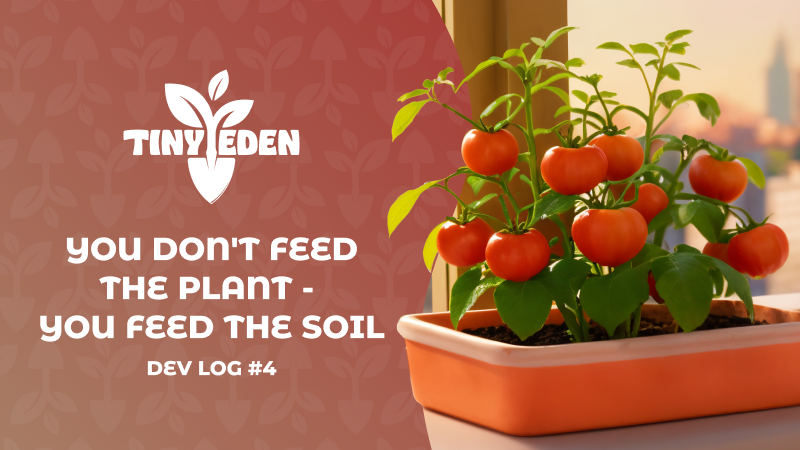
When people think about plant care, the first things that usually come to mind are planting, watering, waiting, and harvesting. Those steps are important, of course, but they are only part of what helps a plant grow. A healthy plant does not begin with the leaves, it begins below the surface.
It is likely that many people who read this will know a lot more than what I've written, so don't take that personally! There are still many people who won't know what the missing parts are!
In Tiny Eden, soil is not just the place where planting happens, it is part of the growing environment, especially because the game is built around indoor gardening. When you grow plants indoors, the soil is not part of a large field or garden bed, it sits inside a container of sorts, meaning that the growing space is much smaller and more controlled.
Because of the above, what goes into the container matters a lot! This is something we noticed a lot while growing plants ourselves (remember, every plant that you can grow in Tiny Eden has been grown by our team indoors). Some plants were easy to sprout, but keeping them healthy over time became much harder. The soil mixture, how much water it held, how quickly it dried out, and whether the roots had enough room all affected how well the plant continued to grow. That real-life experience helped shape the way we think about soil in the game.
It might be easier to think of “soil” not as one single thing, but as a growing mixture. A good growing mixture can be made up of different parts, with each part doing something useful. Compost can provide nutrients, sand can help with drainage, clay can help with water and mineral retention, and other materials can change how loose, dense, rich, or dry the soil becomes.
This matters because plants do not all want the same conditions. Some prefer soil that holds moisture for longer, while others do better when water drains away more quickly. Some need a richer mixture, while others can struggle if the soil is too heavy or compact. All in all, these are some of the real-life ideas that we wanted to bring into Tiny Eden.
However, it is important to say that we are not making a strict simulation. We are not asking players to become soil experts before they can enjoy the game. Tiny Eden is still meant to be cosy and relaxing to play, so the soil system is introduced gradually.
Early on, plants have simple soil needs. For example, a plant may only need a basic mixture of compost and sand. When you fill a pot, the game shows what the plant needs and how much of each material has been added, so you are not expected to guess. You might see something like compost at 0.0/6, sand at 0.0/4, and later plants might also need clay mixed in.
The idea is that the game guides you at first, while still letting you understand what you are doing. You are not just clicking a button that says "make soil"; you're learning, little by little, that the mixture itself is part of the growing process.
As you progress, this can become more interesting. On top of the basic soil mixture, you can also improve the final growing conditions with fertilisers and nutrients. A balanced fertiliser can give the plant a more general boost, while more specific fertilisers can help with different parts of growth. Nitrogen supports foliage, phosphorus helps with root development, potassium helps keep the plant healthy and can improve the harvest, and micronutrients help round out the mixture.
This gives the player another way to care for their plants without making the system overwhelming. At the start, you follow clear needs and simple mixtures. Later, as you learn more and gain access to more materials, you can start thinking more carefully about what each plant benefits from.
For us, that is one of the things that makes indoor gardening satisfying. It is not only about placing plants and waiting for harvest day, it is about slowly learning what each plant needs, preparing better growing conditions, and understanding why one setup works better than another.
Tiny Eden is not trying to make soil complicated for the sake of being realistic. Instead, we want it to be another easy-to-understand, yet detailed layer of decision-making, something that makes the garden feel more alive!
Because sometimes, the best way to help a plant grow is not to focus only on the plant itself, it is to take care of the soil that supports it.
Stay tuned, follow us on social media, and make sure to wishlist Tiny Eden on Steam if you have not done it yet.
https://store.steampowered.com/app/3375110/Tiny_Eden Join us on Discord >>> https://discord.gg/tinyedengame Follow us on X >>> https://x.com/TinyEdenGame Watch us on TikTok >>> https://www.tiktok.com/@tinyedengame Explore on Instagram >>> https://www.instagram.com/tinyedengame
Source
Changelog.gg summarizes and formats this update. How we read updates.