
Full notes
Full Theropods update
Read the full published notes in a cleaner layout. The original post stays linked below.
Repeated intro
Hey everyone, Kostas and Sarah here! We’d like to share our progress over the last few months in this update and what we have next on our to-do list. Let’s dive in!
What changed
- Gameplay
- Performance
- Events
- Fixes
Theropods changes
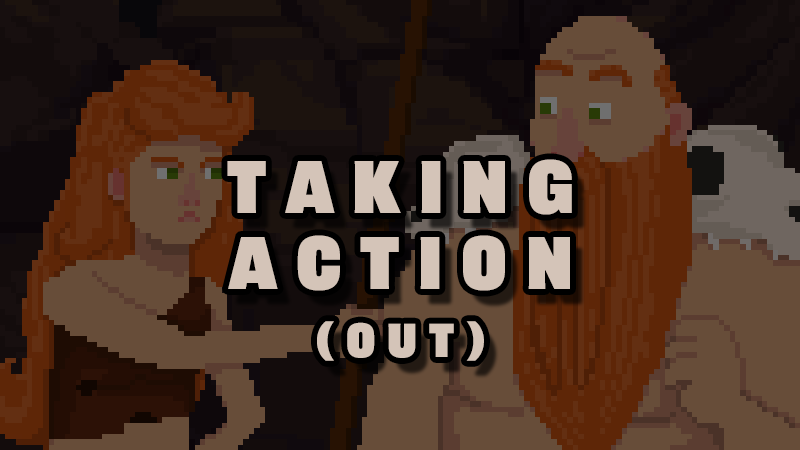
The core of an adventure game is its story and naturally, any great narrative requires a level of drama. Narrative tension is often conveyed through exposition, interactions between characters and setting high stakes from the outset, but it can be tricky to truly immerse players within the world when typical conventions around point and click games don’t allow for fast-paced gameplay or action scenes. So how do you communicate these emotions to the player?
What We’ve Been Working On
Over the past few months, we’ve spent time creating assets and moving much of the game over to the new engine. With this work complete, alongside fundamental interactions, story and core gameplay, we were keen to turn our attention to the question that has been on our mind from the start - how do we represent action scenes within a point and click game?
Our initial idea was to simply lean into the curve and include a number of sequences that required fast movements or typical player action. These are uncommon within point and click adventure games, and we understand why.
Point and click games are typically enjoyed from audiences that appreciate slow, contemplative gameplay. When looking at the average computer specs for similar titles, performance can be limited, so it stands to reason that any level of challenge of this type would need to be appropriate.
Some action sequences in point and click games have been done before. For example, Full Throttle had a full minigame, which was of course impressive but players found it difficult to play.
Unavowed created a ‘sense’ of urgency, although it felt rather artificial.
After researching many other games, we decided that Canabalt best embodied the ideas we hoped to create for Theropods, essentially a one-click runner.
Action sequences fundamentally act as a departure from the core gameplay of a point and click game. When porting to consoles, we would further have to consider how to approach establishing a set of controls for exploration and a second set for action. This was not going to be feasible. So, what other options did we have?
Option 1: Action with a failure state could be communicated through quick-time sequences, but we would continue to face many of the issues above, even if the skill requirement were less extreme.
Option 2: We could perhaps allow for slow, methodical gameplay set against the backdrop of an accelerated soundtrack and visual cues such as action happening in the background or looped animations that appear to threaten the player.
Option 3: Replace gameplay with cinematics. Even though creating cutscenes was going to be a lot of work, it would be significantly less complicated and time-demanding than creating the action sequences. Action sequences also had the risk of not working at all and us having spent a ton of resources for nothing.
Check out these action tests we did:
Pterodactyl Action
Tiny Dino Action
Barbarian Chase Action
So this option we decided to go with, as it requires no frantic movements on the part of the player. It also avoids any issues in console porting, or in departing from the conventions of the genre. Cinematics also act as a reward to the player. It’s an opportunity to sit back in your chair and let something play out on screen in response to the challenges you have faced in gameplay. Through music, visuals and cinematic storytelling, we can communicate the necessary emotion to the player.
Additionally, creating a game where there is no dialogue and only one ‘fixed’ camera angle with no facial expressions from the characters was proving very difficult to tell the story. Having cutscenes would not only allow for better storytelling, but also more emotional since we are now able to get close-ups and look into the characters’ faces.
Adding cutscenes was quite a challenge for us; we needed to create new assets, such as backgrounds, animations, and sprites, and upscale each of these to fit a full-screen presentation. We decided to make cutscenes that match the art style of the game, but with a minimalistic style, in order to reduce the time required to deliver the game to a high standard.
Here are some examples of our options when we were deciding on a style for Theropods: Lunark has incredible rotoscoping and a strong colour palette, but it wasn’t the style we wanted to adopt.
Blasphemous also has crazy-good, detailed cutscenes, but it would take us a lot of time to complete scenes with this level of animation within our time and budget.
The Lion’s Song is a good anchor for what we planned for our game; a minimal colour palette and relatively simple animation.
Here is what we came up with!
What’s Next?
Working on the cutscene art assets is our focus for the coming weeks. You can watch along as we complete this work over on Twitch! We’re streaming most weeks on Thursday afternoons.
As of today, the team has already finished the story and puzzle design. We’re currently working on the animations for the second to last chapter before they can be turned into pixel assets and added to the game. We feel like making the art first is more important so we can easily add the assets when needed.
Our next focus will be tied closely to gameplay as we create the next version of the build, minus puzzle integration. Once the concept is proved with this build over the next couple of months, we will add the puzzles, chapter-by-chapter before opening it up to a playtest. This is the opportunity to adjust the UX for the inventory menu since there’s still room for improvement - and of course then add the cutscenes into the game.
We’re actively pitching our game to different publishers, and it’s of course a challenging campaign for us, alongside making the game itself and working on marketing, with a little help recently from Acorn Games , no stranger to point and click adventure games. We aim to partner with a publisher aligned with the team’s vision, and that’s partly why it’s taking a long time for us to find the right one. As of now, the team is still funded by our previous Kickstarter and our own savings, we hope to find a publisher in the near future to help us with multiple go-to-market strategies.
That’s it for now. We’re thankful for your support, and we look forward to being able to let you guys try the game soon. See you on the next dev blog!
With love, Kostas and Sarahl
Source
Changelog.gg summarizes and formats this update. How we read updates.