What changed
0 fixes3 additions2 changes2 removals
- Gameplay
- UI and audio
- Maps
- Server
removedMay 2026 --- I'm a solo developer, a retired police Sergeant, and an ex-military. I'm building a game called **The Sworn** — a US police precinct management simulator set in the fictional city of Anchorpoint.
added# What Is The Sworn? You play a newly promoted Captain handed command of West Side Precinct — Anchorpoint Police Department. The station is yours to build from the ground up. You hire officers, assign them to departments, set policy, manage shifts, and respond to incidents across a living city. Calls come in through a Computer-Aided Dispatch terminal (CAD). You grade them, assign units, set response codes. Code 1 is routine, no lights. Code 2 is urgent, lights only. Code 3 is full emergency, sirens, drop what you're doing. Your officers go. That's the surface. The game goes much deeper than dispatch. The city evolves. Crime spreads through districts. Neighbourhoods degrade if you neglect them and recover when you prioritise them. Investigations span multiple days. Detective work generates case files. SWAT operations require planning, briefing, and a clear use-of-force policy before you ever deploy. Every decision ripples outward — into crime statistics, public trust, council scrutiny, and your budget. The departments at Early Access launch are Patrol, Detectives, and the beginnings of specialist units. Post-launch planned updates will add K9, SWAT, and Traffic Division.
removed# Why Am I Building It? Since the days of the Commodore 64 and writing BASIC line by line, I've been an avid gamer. Getting into game development wasn't something I'd planned. It came out of darker ground than that. I was medically retired with complex PTSD after years on the job. Working through that, sitting with the things I'd seen and dealt with, I started asking a question I couldn't put down: 'if I had been the one in charge, would I have looked after my people better than I was looked after — or would I have used them the same way, as a resource and a number?'
changedThe Computer-Aided Dispatch (CAD) terminal — first implementation is in. This is the strategic command screen the Captain works from. Incoming calls are triaged by you. Identify the urgent calls and dispatch units, if resources are busy, stack the calls. Set the response code and any tactical orders, allocate the right resources. It's a first pass — every button is wired and every panel is in place, but it still needs full end-to-end testing before I'll call it done. That's the next priority.
changedThe main HUD is in. The in-world heads-up display the player sees outside the CAD — time and date pulled from the game's time system, current call count, available units, the entry points into the CAD, the department computer, the build menu, and settings. First implementation complete.
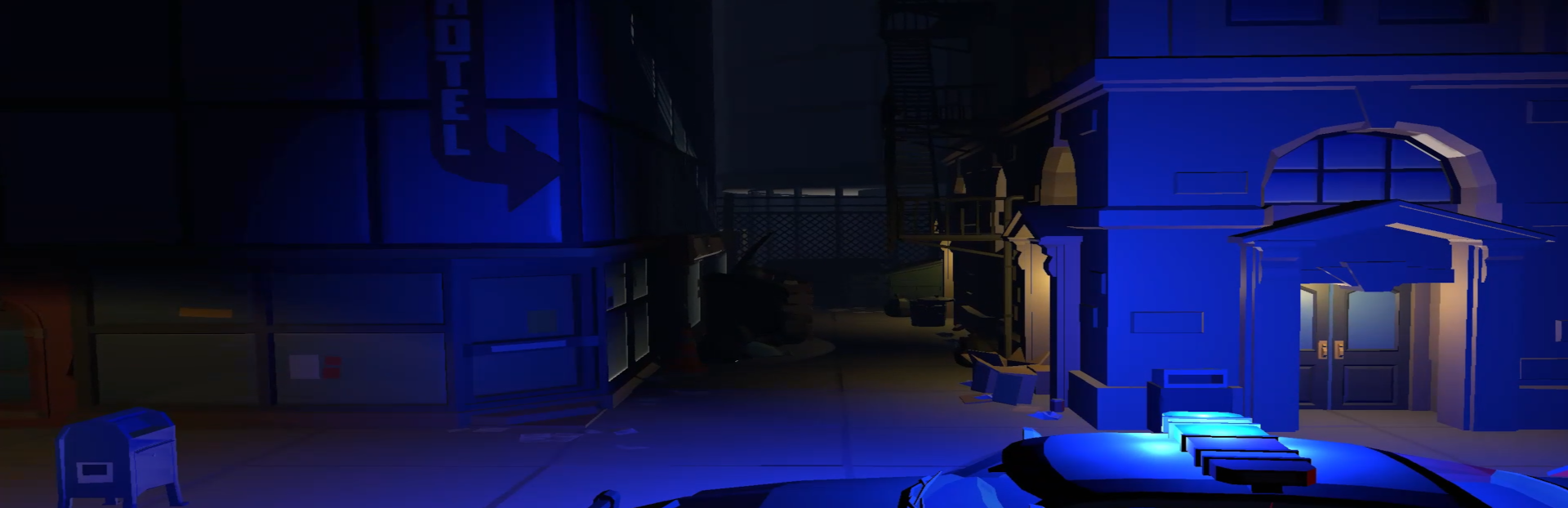
addedDay and night lighting is done. The full day/night cycle is working — dawn, day, dusk, night, deep night, each with its own lighting profile, sun and moon angle, sky and fog colour. The system drives off the game's time manager, so when an hour ticks over in-game, the lighting transitions accordingly. The next lighting work is artificial — street lights, building windows, vehicle headlights gating off the time of day. The map is laid out with place holders, specific more detailed buildings to be added. Vehicles and traffic are implemented though with limited variation at the moment.
The Sworn changes
removedMay 2026 --- I'm a solo developer, a retired police Sergeant, and an ex-military. I'm building a game called **The Sworn** — a US police precinct management simulator set in the fictional city of Anchorpoint.
added# What Is The Sworn? You play a newly promoted Captain handed command of West Side Precinct — Anchorpoint Police Department. The station is yours to build from the ground up. You hire officers, assign them to departments, set policy, manage shifts, and respond to incidents across a living city. Calls come in through a Computer-Aided Dispatch terminal (CAD). You grade them, assign units, set response codes. Code 1 is routine, no lights. Code 2 is urgent, lights only. Code 3 is full emergency, sirens, drop what you're doing. Your officers go. That's the surface. The game goes much deeper than dispatch. The city evolves. Crime spreads through districts. Neighbourhoods degrade if you neglect them and recover when you prioritise them. Investigations span multiple days. Detective work generates case files. SWAT operations require planning, briefing, and a clear use-of-force policy before you ever deploy. Every decision ripples outward — into crime statistics, public trust, council scrutiny, and your budget. The departments at Early Access launch are Patrol, Detectives, and the beginnings of specialist units. Post-launch planned updates will add K9, SWAT, and Traffic Division.
removed# Why Am I Building It? Since the days of the Commodore 64 and writing BASIC line by line, I've been an avid gamer. Getting into game development wasn't something I'd planned. It came out of darker ground than that. I was medically retired with complex PTSD after years on the job. Working through that, sitting with the things I'd seen and dealt with, I started asking a question I couldn't put down: 'if I had been the one in charge, would I have looked after my people better than I was looked after — or would I have used them the same way, as a resource and a number?'
changedThe Computer-Aided Dispatch (CAD) terminal — first implementation is in. This is the strategic command screen the Captain works from. Incoming calls are triaged by you. Identify the urgent calls and dispatch units, if resources are busy, stack the calls. Set the response code and any tactical orders, allocate the right resources. It's a first pass — every button is wired and every panel is in place, but it still needs full end-to-end testing before I'll call it done. That's the next priority.
changedThe main HUD is in. The in-world heads-up display the player sees outside the CAD — time and date pulled from the game's time system, current call count, available units, the entry points into the CAD, the department computer, the build menu, and settings. First implementation complete.
May 2026 --- I'm a solo developer, a retired police Sergeant, and an ex-military. I'm building a game called **The Sworn** — a US police precinct management simulator set in the fictional city of Anchorpoint.
This is the first devlog, so I'm going to cover three things: what the game is, why I'm building it, and where it actually is right now.
# What Is The Sworn? You play a newly promoted Captain handed command of West Side Precinct — Anchorpoint Police Department. The station is yours to build from the ground up. You hire officers, assign them to departments, set policy, manage shifts, and respond to incidents across a living city. Calls come in through a Computer-Aided Dispatch terminal (CAD). You grade them, assign units, set response codes. Code 1 is routine, no lights. Code 2 is urgent, lights only. Code 3 is full emergency, sirens, drop what you're doing. Your officers go. That's the surface. The game goes much deeper than dispatch. The city evolves. Crime spreads through districts. Neighbourhoods degrade if you neglect them and recover when you prioritise them. Investigations span multiple days. Detective work generates case files. SWAT operations require planning, briefing, and a clear use-of-force policy before you ever deploy. Every decision ripples outward — into crime statistics, public trust, council scrutiny, and your budget. The departments at Early Access launch are Patrol, Detectives, and the beginnings of specialist units. Post-launch planned updates will add K9, SWAT, and Traffic Division.
# Why Am I Building It? Since the days of the Commodore 64 and writing BASIC line by line, I've been an avid gamer. Getting into game development wasn't something I'd planned. It came out of darker ground than that. I was medically retired with complex PTSD after years on the job. Working through that, sitting with the things I'd seen and dealt with, I started asking a question I couldn't put down:'if I had been the one in charge, would I have looked after my people better than I was looked after — or would I have used them the same way, as a resource and a number?'
I started this project for myself. Just to see if I could build the thing I'd always wanted to play and never found. The longer I worked on it, the clearer it became that other people might want it too. Police games — almost without exception — ignore the human side of the job. The part that doesn't go home with you in the squad car. The part that you carry for the rest of your life. This is my attempt to bring some of that reality into a game. The welfare system is at the centre of the design. Every officer in the game has a personality, hidden behavioural flags, a masking state, a trauma history, a trust rating with the welfare officer. It runs silently from day one of Early Access. Your officers accumulate history. The job affects them. Whether you notice — or care — is on you. The badge number on the game's logo, '2567', is my real service number. I'm not trying to make a political statement about policing. I'm trying to make something honest about what it's like to do the job, and what it costs.
# What's Actually Working Right Now I want this devlog to be straight with you about where the build is, not where I wish it was. So here's the honest state.
The dispatch loop is working end to end. Incidents are generated in the background by a criminal simulation system that runs whether the player is watching or not — criminals exist as data, plan crimes, commit offences, and leave evidence at scenes. They exist as entities in the background, going about their criminal lives whether you catch them or not. They develop their skills, become more brazen and make choices on what crimes they commit. When an incident fires, it surfaces as an incoming call. You triage it, dispatch a unit, the unit responds. That whole loop is live.
The Computer-Aided Dispatch (CAD) terminal — first implementation is in. This is the strategic command screen the Captain works from. Incoming calls are triaged by you. Identify the urgent calls and dispatch units, if resources are busy, stack the calls. Set the response code and any tactical orders, allocate the right resources. It's a first pass — every button is wired and every panel is in place, but it still needs full end-to-end testing before I'll call it done. That's the next priority.
The main HUD is in. The in-world heads-up display the player sees outside the CAD — time and date pulled from the game's time system, current call count, available units, the entry points into the CAD, the department computer, the build menu, and settings. First implementation complete.
Day and night lighting is done. The full day/night cycle is working — dawn, day, dusk, night, deep night, each with its own lighting profile, sun and moon angle, sky and fog colour. The system drives off the game's time manager, so when an hour ticks over in-game, the lighting transitions accordingly. The next lighting work is artificial — street lights, building windows, vehicle headlights gating off the time of day. The map is laid out with place holders, specific more detailed buildings to be added. Vehicles and traffic are implemented though with limited variation at the moment.
The criminal simulation backend is solid. Criminals are seeded into a database at startup. Each one has age, criminal XP, addiction, desperation, anger, network links to other criminals. Reoffending risk is calculated from those factors. Evidence degrades over time. When criminals are arrested, sentenced, released, or removed from the population for natural reasons, the system tracks all of it. New criminals are generated to replace removed ones so the population stays balanced.