
In this update9
Full notes
Full 三国仁义传 The Righteousness: SanGuo update
Read the full published notes in a cleaner layout. The original post stays linked below.
Repeated intro
Hello everyone,
What changed
- Gameplay
- Performance
- Maps
三国仁义传 The Righteousness: SanGuo changes
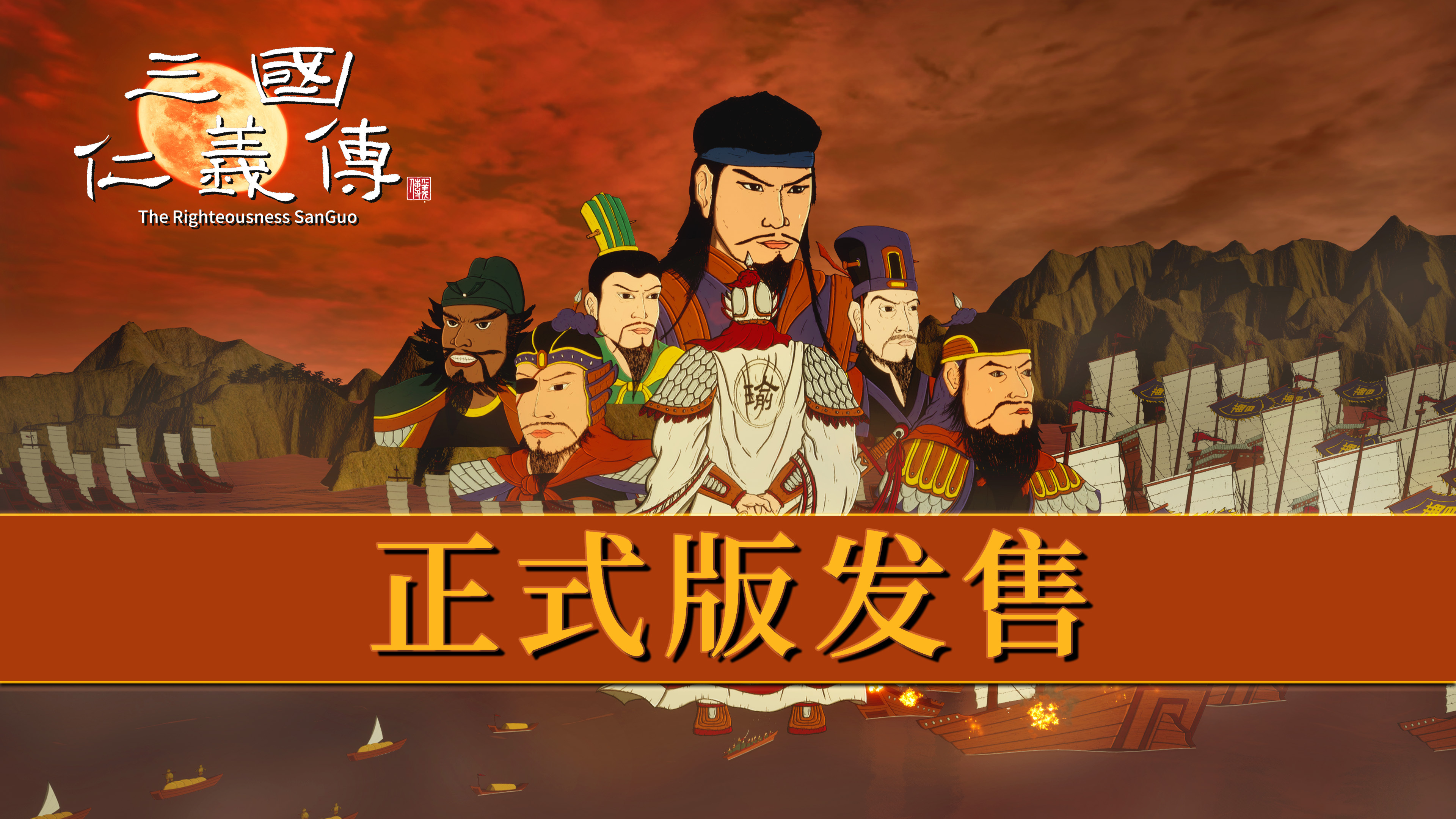
After seven long years of development and polishing, plus one year in Early Access, we have finally officially launched the full version of The Righteousness: SanGuo! It is currently available with a 20% launch discount!
Whether you’ve been with us since the early demo, or you’re a new face drawn in by the unique art style, welcome to this fantasy world of the Three Kingdoms built by a father and son — imperfect, but created stroke by stroke with love.
1.0 Official Version — What’s Included
Over the past year, while updating content, I listened to community feedback, continuously tested and revised the game, restructured a large amount of core logic, improved performance, and enhanced overall visual quality. In The Righteousness: SanGuo you can now experience:
Visual Style: The game’s art draws inspiration from traditional Chinese lianhuanhua (comic books) and 1990s Chinese school textbooks, with fully hand-drawn character designs intended to capture Chinese cultural flavor.
Length & Settings: About 15 hours of gameplay visiting more than 10 distinct locations — from peaceful villages to brutal battlefields, from desert winds to snowy forests — offering a unique tour of China-inspired landscapes.
Characters & Enemies: Over 80 hand-drawn characters redesigned with inspiration from Shan Hai Jing — from bold heroes to fearsome exotic beasts — showcasing that the world is full of wonders.
- Collectibles & ProgressionMore than 20 rare treasures to discover. Unlock new abilities to reach new areas and explore the unknown.
Gameplay Variety: Multiple gameplay modes woven into the narrative — storm enemy camps on horseback, aerial battles with mythical beasts, and even a road-trip across the land for a fresh play experience.
Steam Achievements: Track every milestone you reach in the world of The Righteousness: SanGuo!
Seven Years: From Young Dreamer to Thirty
This game started from a single idea I had after waking up from a dream. I taught myself game engine development from scratch, fought through the development process, and finally turned it into a real game — seven full years in total.
At the beginning, I had just graduated from university and only a few years into my career. Now, seven years later, the game is complete, and I have reached the age of thirty.
No Marketing, Just Passion
Honestly, we didn’t do much advertising.
Without financial support, for art I turned to my retired father, who loves to draw. We clicked immediately — he drew character sketches, and I made revisions. That became our original workflow.
Steam post imageSteam post imageSteam post image
Photos of father drawing and me developing meanwhile
When character design was done, I forced myself to learn animation rigging, so the animations inevitably look a bit “amateur.” Combined with the unique art style and gameplay, many people said it did not cater to mainstream taste, so no publishers wanted to join.
Steam post imageSteam post imageSteam post image
Early dev memos, checklists, and screenshots
Why I Never Gave Up
On this seemingly dark road, people always appeared at the right time to illuminate the path forward:
Thank you to the honest veteran developers who pointed out issues sharply, telling me that the game needed not just a shell, but a soul.
Thank you to the teams at 游民星空 and indienova for writing articles and doing interviews for us. When I tried to thank you, you all said in unison: “This is what we should do for domestic indie games.” I’ve always kept that in my heart.
Thank you to 小黑盒 and the KOLs in various communities — you promoted the game for free and helped spread the word.
Most of all, thank you to all the players. Though our player base is small, every one of you is a treasure. You gave detailed suggestions in groups and comment sections and tirelessly reported bugs.
In the seven years of lonely trekking for my father, myself, and The Righteousness: SanGuo, it was your roles as strict mentors, enthusiastic peers, selfless media, and lovely players that let us truly see the meaning of Ren Yi (benevolence and righteousness).
About Innovation and the Art Style
Since this is version 1.0, I want to be frank.
Regarding art and innovation: I see our art style and visuals as one of our strongest traits, even if many people don’t like it. Some have said the art is unattractive, that the innovation wasn’t done right — I certainly struggled to innovate. But why persist? Because for indie games, I can decide for myself. If I don’t like what I’m making, who else will? Our goal was to evoke traditional Chinese comic book feeling mixed with the school textbook memories of a ’90s kid. This creates a rough yet enduring aesthetic — see for yourself closely.
I believe some tasteful friends will appreciate this unique texture.
About the Gameplay
When it comes to gameplay, a polite way to describe it would be “standing on the shoulders of giants.” To be completely honest, though, this is a stitched-together hybrid. I simply combined the games I’ve loved since my teenage years and poured nearly twenty years of memories into this project.
One of the deepest roots behind making a Metroidvania-like game was my love for Castlevania: Symphony of the Night. At the time, I didn’t fully understand how difficult this genre really was. I thought it would be manageable — and that single decision turned into a seven-year journey.
The idea of opening the game with a world map and triggering random encounters came from the early 2D Final Fantasy titles. To give it a stronger Chinese flavor, the visual style of the world map was inspired by classic Chinese RPGs such as the Xuan-Yuan Sword series, especially Xuan-Yuan Sword: The Scar of Sky.
After a random encounter is triggered, combat shifts into a smaller side-scrolling battle. This design was inspired by Bandai Namco’s classic 2D Tales of series, which I’ve always loved.
The large-scale mech battle against Xuanwu was inspired by the Super Sentai–style games I played on the NES as a child, where each stage often ended with a massive robot boss fight that left a deep impression on me.
There is also a flying stage, created as a tribute to Salamander, a game I’ve loved since childhood.
As for the horseback stage, it was inspired by Shinobi III: Return of the Ninja Master. Imagining Zhou Yu charging straight into the enemy ranks on horseback — there was simply no way that wouldn’t be cool.
I originally wanted to include even more gameplay variations, but only after building everything myself did I truly understand how difficult it is to develop each feature. Game development is a process of moving from addition to subtraction. At this point, I feel the gameplay has reached a relatively balanced state. As for the ideas that were left behind, perhaps they will see the light of day in the future — just not yet.
About the “Shadow Puppet” Misunderstanding
Some friends said the animations look like “shadow puppet style.” Though it may seem like that at first glance, I must admit it’s due to my technical limitations.
At first I didn’t understand 2D animation techniques well, so animation flows are smoother and rounder. Combined with controller feel, some people sense a bit of shadow-puppet vibe. I find it interesting and kept it — and hope you like it.
I am from Northeast China working in the South. Honestly I don’t understand shadow puppetry deeply and I don’t want to appropriate intangible cultural heritage superficially. If I were to truly do shadow-puppet style, I’d do homework and craft it properly. That said, if The Righteousness: SanGuo accidentally inspires interest in Chinese traditional culture, that also feels great.
Next Steps
With 1.0 live, our priority now is stability:
Optimize game stability and fix bugs first.
Free content updates are planned later, but they won’t affect the main story’s integrity.
Finally
After saying so much, I realize I haven’t properly thanked my family. Perhaps it was because they are so close that I often forget to say “thank you.”
For these seven years, they have always been with me. My father even picked up his pen again to redesign characters with me.
This isn’t just my game — it’s our father-and-son memory. Without my family’s support and companionship, I absolutely could not have endured these long seven years.
Please continue to follow us and add the game to your wishlist — thank you!
At thirty, my original intention remains unchanged. May you fight joyfully in the world of The Righteousness: SanGuo!
—
HarvestDog Studio Producer Huangjin Arukado
Source
Changelog.gg summarizes and formats this update. How we read updates.