
In this update6
Full notes
Full The Quiet After update
Read the full published notes in a cleaner layout. The original post stays linked below.
What changed
- Gameplay
- Store
- UI and audio
The Quiet After changes
A very crafty discussion
Today I want to talk about craft.
I’ve been deliberate about centering the game's artists in most of our posts, in the teaser, in any way I can think of. The reason (aside from my artists being awesome) is obvious to anyone with a passing interest in game development or creativity in general. I’m sending an intentional signal about what this game is and what it isn’t; what tools shape it and which don’t.
Art is the easiest place to show that, because I can literally point at brush strokes. Writing and code are less visible, so I wanted to talk a bit about where those come from and how I treat them.
So let’s talk about that part of the work.
Writing: from a teenage book to a visual novel endings
For writing, I can’t think of a time I wasn’t doing it, nor a time when I didn’t want to be a published author. My life goals have changed since the first time I picked up a pen in grade school, but I never stopped writing or journaling. It has always been how I process the world.
I did publish a book in 2013, about growing up bipolar, which, as a clinician today, I understand should read more accurately as growing up with negligent and abusive parenting. But at the time, I believed the problem lived inside me, so that is the story I told.
https://www.amazon.com/dp/1493619950
Not that I really recommend it. It is objectively terrible.
My point is only this. Not that the book is bad, but that I finished it. I wrote it, edited it (with the assistance of some very kind and generous teachers), worked with an artist, and shipped a thing into the world. That process taught me I could complete a creative project even if, years later, I outgrow it.
Part of why I don’t like the book is the teenage angst, but another reason is that my prose has changed entirely since then. Through clinical work, school, and life experience, I’ve learned to write well at a technical level and from within a character rather than from outside.
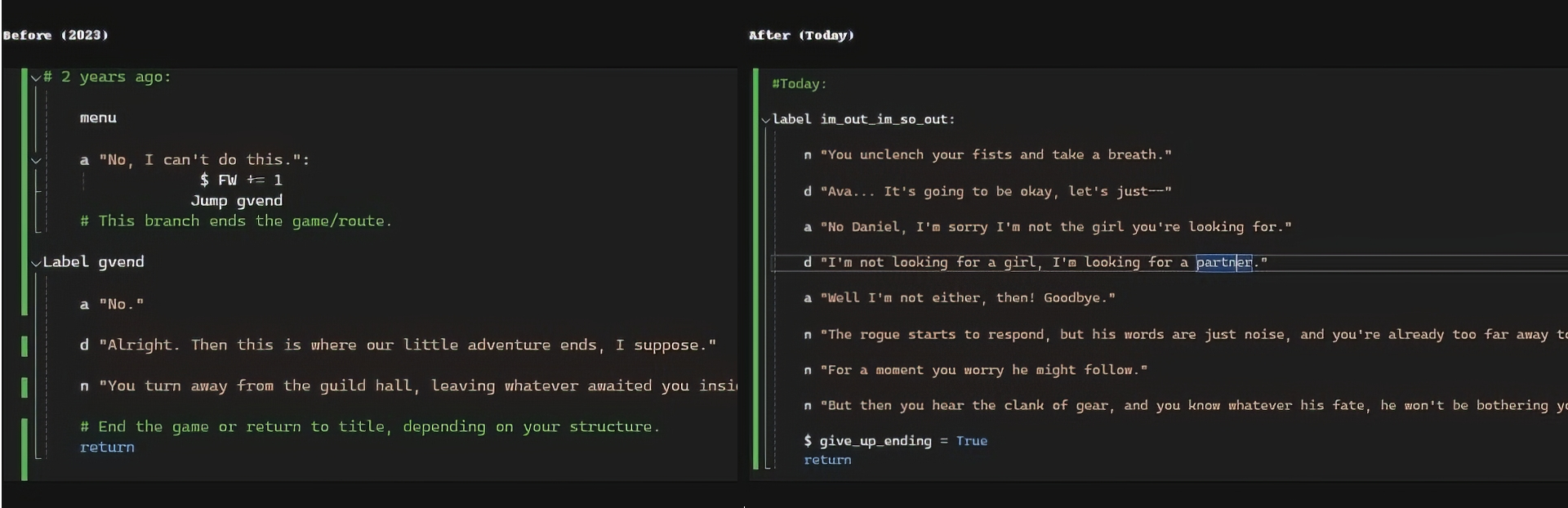
You can see that shift even inside this game. The banner of this devlog features two endings. The one on the left is from 2023. The one on the right, I wrote last week. I didn’t even realize the original draft still existed when I rewrote it, but it did, and I got to compare.
The 2023 version (serviceable but distant)
menu: a "No, I can't do this.": $FW += 1 jump gvend label gvend: a "No." d "Alright. Then this is where our little adventure ends, I suppose." n "You turn away from the guild hall, leaving whatever awaited you inside for someone else to discover." return
It tells you what happened, but only that. It doesn’t put you in the character’s skin or offer an emotional landing.
The new version (embodied and emotional)
label im_out_im_so_out: n "You unclench your fists and take a breath." d "Ava... It's going to be okay, let's just--" a "No, Daniel, I'm sorry, I'm not the girl you're looking for." d "I'm not looking for a girl, I'm looking for a partner." a "Well, I'm not either, then! Goodbye." n "The rogue starts to respond, but his words are just noise, and you're already too far away to hear him." n "For a moment, you worry he might follow." n "But then you hear the clank of gear, and you know whatever his fate, he won't be bothering you anymore." $ give_up_ending = True return
That is the hard-won development of craft. That is the difference between generated and crafted content.
Coding: from a terrible first site to a handmade visual novel
Code followed a similar path. Around sixteen, while I was working on that book, I decided I needed a website for it. I used Microsoft Expression Web to build a tiny corner of the internet for other bipolar kids. The site was clumsy, but it worked, and it even included MRI scans of my brain, which is more than I can say for the book.
Years later, when I started making The Quiet After, I first used Visual Novel Maker, a Java-based engine I genuinely loved, but it had limits; I needed a more flexible solution. Eventually, I moved to Ren’Py, a game engine built on a truncated form of Python. Easy to learn because of its limitations, but flexible enough to outclass what I could do in VNM. It lets me wire up all the strange branching, pacing tricks, and emotional timing this story needs.
I am never going to be a legendary programmer, but I know my way around a script file well enough to be dangerous, and like with writing, the difference between my first attempts and what I am doing now is night and day.
So where does AI fit into all this?
Well, for me it doesn’t really.
If a tool fixes typos or catches a missing colon, I treat it like spellcheck or a linter. Helpful, but it is not making the thing. The words, choices, pacing, and structure come from me.
I use a linter for my code (Ren’Py has a built-in one), and I prefer Grammarly and programs like it, the digital equivalent of an extra set of eyes for spellchecking my writing.
Whether or not you consider that “AI use” is up to you.
But the truth of it is, The Quiet After is written and coded by my own hand, and the artwork comes from the hands of my incredible collaborators, Ralu and Dexter.
The game is built from the same messy, slow craft that gave me an embarrassing teenage book and a terrible first website, and the same years of practice that let me look at an old ending and know exactly how to make it hit harder.
If what you want is something handmade in the middle of an industry rushing toward imitation, that is what I am trying to build here.
And I sincerely hope you'll like it.
Best, Marshall
Founder, Grigsbys World Productions, LLC
Source
Changelog.gg summarizes and formats this update. How we read updates.