
Full notes
Full THE LIFT: Supernatural Handyman Simulator update
Read the full published notes in a cleaner layout. The original post stays linked below.
Repeated intro
Hello Keepers,
What changed
- Gameplay
- Events
- UI and audio
THE LIFT: Supernatural Handyman Simulator changes
This time we’ll tell you about the THE LIFT’s core systems.
In the most general sense, we’re making a game about walking around and discovering the world.
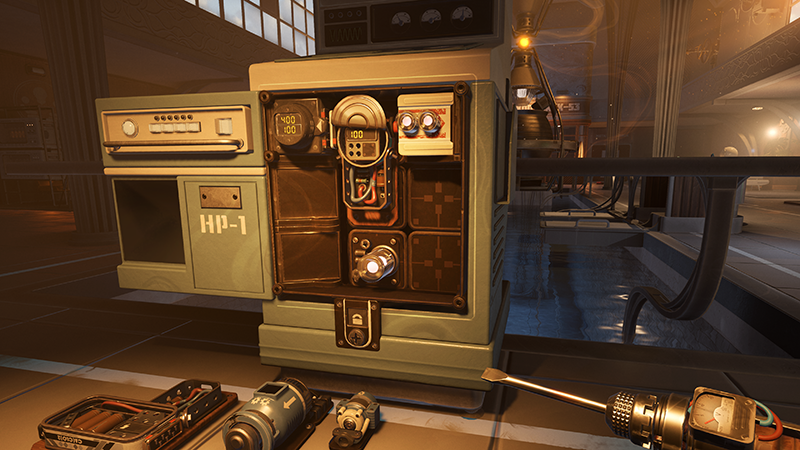
Sometimes you find stuff you can repair stuff with. This is the beating heart of the game—from furniture to circuits, you make things work again, opening doors to new discoveries.
That by itself is fairly limited; you don’t get much say in what you get to do if you can only stumble upon resources randomly. So we throw universal LOOT in the mix—you can exchange it for TOKENS and get to choose what kind of resources you want the most.
Then, we’d like you to have a simpler, more straightfortward way to interact with the world, so we add DECAY you can clean up. This also helps pace the game a little bit, making you discover the world a bit slower, to avoid getting overwhelmed with both play & story. Decay also often hides the best loot!
We want to give you as much agency as possible in how you approach your problems. The modular circuit system gives you a lot of freedom in what what kinds of modules you can use, so we add craft as an alternative way to get modules—less convenient, but often more optimal.
Craft uses the exact same resources you use for repairing little things in the world—so there’s a tiny choice you make every time; does a specific module worth more for you right now than getting the wavegauge a little higher?
With time, you gain even more possibilities—you unlock a (secret!) way to create new loot from waves in the air, and a mechanism that lets you make some resources directly from loot, more constricted than exchanging it for tokens, but often more advantageous.
Repairs are somewhat self-sufficient in terms of motivation, but we’d like to reward you for putting effort in fixing things you don’t necessarily need to progress the story—that’s why WAVEGAUGE exists. You get immediate feedback that you did something right, you get closure when it hits that sweet 100% for a location; also, with FLORA, as you clean a place, you often can open a door to some new secret, and with COUPONS you get some of the best resources in the game.
And then it’s actually all about the game’s NARRATIVE. The story and progression & side quests make you interact with every system in new and unique ways, and give you rewards that feed right back into the systems.
That’s just a tiny, extremely simplified slice of the game’s systems! We’ve left out electricity, nectar, many kinds of modules, giant boss devices, unlockable tools, and lots more. And while this may sound complicated, this complexity is introduced slowly very many hours of play.
The game isn’t really difficult, rather it allows you to tackle your problems in any way you’d like. You can beat the game without fixing a single light bulb or 100% most locations before seeing half the story; you can use the craft system for all your modules or not use it a single time.
At its core, the game is still about walking around and fixing things, and that’s the paramount thing we’re trying to make just right; every other mechanic is only in service of keeping you in this flow. And, some of the most memorable parts of the game are completely unrelated to any gameplay system, like little story vignettes or simple clutter you can clean up for no reason at all.
That’s it for now! We can’t wait for you to try all of this out yourself :)
Eugene Radaev, Lead Game Designer of Fantastic Signals
P.S.
Hey folks,
Ivan here!
I know everyone is waiting for the news about our next playetst and I have them and, actually, even more than that!
We will be participating in the Future Games Show on June 6th, where we will do a deep dive into our approach to developing the game and announce the date of the next playtest.
Until then, keep the lights on, Keepers!
Source
Changelog.gg summarizes and formats this update. How we read updates.