
In this update1
Full notes
Full The Core update
Read the full published notes in a cleaner layout. The original post stays linked below.
What changed
- Gameplay
- Events
- Performance
- UI and audio
The Core changes
Hello there!
In today’s devlog, we want to share some insights about our inspiration for the game! Let’s jump right in!
I’ve been working in mobile games for several years, and one of the things I’ve done is develop prototype games for publishers to test. Among the many prototypes I’ve worked on were a few ball-based games. One of them involved a turret mounted on a ball. So, I came up with a light story for the game, where the ball is a robot escaping from some hostile underground environment. For what I wanted to do, the mobile platform (touch input) didn’t end up working well, so I scrapped the game and moved on.
A couple of years later, after having several successful mobile games, I wanted to try my hand at developing a fully immersive PC game. One of the ideas that came back to me was that ball-based robot game. I liked this idea for a few reasons:
It's unique in that the player character is a rolling robot sphere.
It’s physics-based, and I like games with realistic physics.
There is a lot of potential for game mechanics with spheres - pipes, rails, etc.
So, in early 2024, I started working on this game, originally just as a way to get my feet wet in PC games, as it is very different from mobile.
As I progressed and learned, I began to entertain the idea of trying to make this game a commercial release - which is what brought me to this point!
Coming from mobile, where all my games were cartoonish, colorful, and bright, I really wanted to do something dark, grungy, and atmospheric. So, it really was a no-brainer to go with a realistic, gritty visual style. Also, as a solo dev whose strength is on the programming/coding side, I don’t have the artistic skills to get too stylized with 3D modeling and texturing.
In my initial dev cycle of the game, I modeled everything. However, as I got more serious with the project, I replaced some of the common items in the game with higher-quality assets, and the assets are easier to find and match to the game if the game’s style is realistic.
As for the character style, I borrowed heavily from the Portal games, which I love and have been a huge influence on my game development. In Portal, white and black surfaces are common, as well as the idea of a “core” which we see in Wheatley and the corruption cores in Portal 2.
As a self-taught musician (piano and guitar), music was another thing that drew me to working on a PC game. I wanted to compose music for the various settings of the game, and that has been a lot of fun.
My main goal with the music so far is to communicate the mood of the different environments you move through. There is a lot of eeriness, mystery, and things like that.
However, as with upgrading the 3D assets, I want to do what’s best for the game music-wise, so I’m now working with a composer who is filling out the game with some great music. Some of my music will remain, but most will be his in the final version of the game.
Coming from mobile games, where I did a lot of puzzle games, I think that’s something I’ve developed some skill at. The challenge in this type of game is how to naturally work a puzzle into an environment... where the player has to solve the puzzle to progress, but not make it feel too much like a puzzle. That is challenging but also really fun for me.
My recent development efforts have been on a part of the game called “Cain’s Trials,” where the puzzles are more modular. The player can jump in at any time and solve some puzzles or play a small game scenario, and then jump back out and continue with the main game. This has really opened up the game to a lot of potential for new content, as a single trial can be a game within a game, so to speak.
As I mentioned before, the basic requirement for the original design was that it be a rolling sphere that is an AI robot.
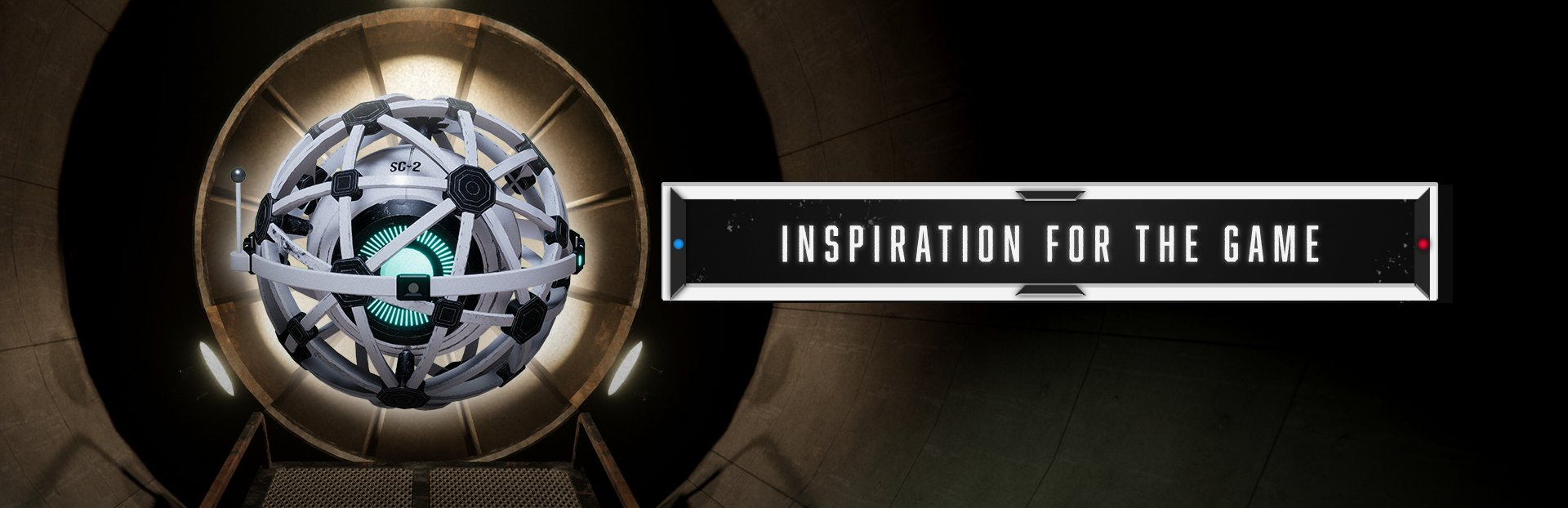
However, I didn’t want the character to just be a rolling ball. I wanted it to have a “face” that could look in specific directions while moving. So, I came up with the concept of having a center “core” that remains stationary and an exterior rolling frame that allows it to move in any direction.
In this universe, these “cores” were common in everyday life before some event occurred, and now humans don’t seem to be around anymore. So, the characters are based on that.
For other characters we encounter in the game, I’m using spheres as a recurring theme in their designs.
Having the player be a rolling ball offers opportunities and challenges as compared with a typical character-based FPS.
One challenge is that the character is low to the ground. So, from a third-person view, we need the player to feel like they are immersed in the game and can still look around, inspect, and explore as they would for an FPS. So, I try to design things to support that.
An opportunity to take advantage of is designing sound for a rolling ball. I’ve put a lot of work into the sound of things. You want the rolling sounds to reflect the different surfaces you roll on. Small bumps and impacts on different surfaces should be satisfying. So, that is something that I think players will notice when playing the game.
Another issue is lighting. Because the character is a rolling ball, we can’t use static baked lighting as would be appropriate for a normal FPS. In “The Core,” lighting is very important to make the character feel right in the environment. The character needs to cast shadows in a realistic way, or it will feel like they’re just floating above the ground. Shadows are expensive performance-wise, so I put a lot of work into light and shadow optimization.
Thank you for reading this Devlog, and we’ll see you in the next one!
Source
Changelog.gg summarizes and formats this update. How we read updates.