
In this update1
Full notes
Full The Core update
Read the full published notes in a cleaner layout. The original post stays linked below.
What changed
- UI and audio
- Gameplay
- Performance
- Events
The Core changes
Hello there!
Today, I wanted to talk a bit about the art style and music in The Core.
A lot of the game comes down to atmosphere, so the way the world looks, the way it is lit, and the way it sounds were all important from very early on. I wanted these pieces to feel like they belonged together and supported the same mood.
So in this devlog, I’ll go over some of the choices behind that direction and how they came together.
I came from working on mobile games for years, where the visual style is cartoony and bright. I wanted this game to be the opposite of that… dark (in some areas), atmospheric, with realistic and dramatic lighting.
Along with that, I wanted the world to feel old, gritty, and in a state of decay.
As for the player model design (SC-2, as known in-game), I wanted the color contrast to stand out against the dark and muted backgrounds. I took a lot of inspiration from Portal (whites and blacks with blue/cyan lights); I created the player model in Adobe Substance Modeler to give it the detail of wear and tear that I needed.
Enemies are primarily black and red - just as a visual cue to make them appear more dangerous.
The foundation of the game is that you’re playing as a rolling sphere, and your movement is physics-based. So, to communicate that and give the right feeling, the player needs to see the ball rolling and reacting in the environment to understand why things are moving the way they are (i.e., if you’re on a slope, the ball will slowly roll down the slope, etc.)
There is a first-person mode (most useful in tight spaces), but the primary view of the game should be third-person so the player can perceive the ball physics while moving around.
The Core has a realistic visual style, and I would say one of the more challenging things has been light optimization. Lights (and shadows) are among the most performance-intensive items in rendering the environment. Although most environments in The Core have a dark feel, there are many lights in strategic places to ensure the player can see what they need to see.
Every light has to be optimized to cast shadows that show only the required amount of detail - and only show them when the player is within a certain distance. So, it’s a balancing act to build an environment that performs well while also having the lighting necessary to be immersive and atmospheric.
Also, due to the nature of this game, the shadows cast by the player need to be real-time so that, visually, the player feels grounded in the world. We need to see the shadows move along with the player. This also increases the challenge, as shadows typically need to be higher resolution than what would normally work for a first-person view.
The flipside to the challenges of optimizing lighting is that lighting is probably my favorite part of designing levels and environments. Lighting is so important. I’m convinced that the most basic environment (even just white boxes), lit well, can be more interesting to look at than the most intricate and detailed environment if not lit well. So, lighting is so important to me!
Other than that, I really just enjoy creating environments. Most of my environments are modeled with ProBuilder in Unity, which is a very fast way to model and test. Usually, it will take two or three passes of “design, test, delete, and restart” to get everything right for a particular environment or location. I don’t really mind, though, because I really enjoy doing it!
I would say another part of the game that I’m proud of is the in-game UI. When you approach something you can interact with, you will see UI elements pop up around it to show what you can do. It makes the world feel reactive, and I think it came out nicely.
In my previous career in application development (for financial and medical companies), I designed very complex UIs, and I think that knowledge has been helpful with designing the UI for The Core.
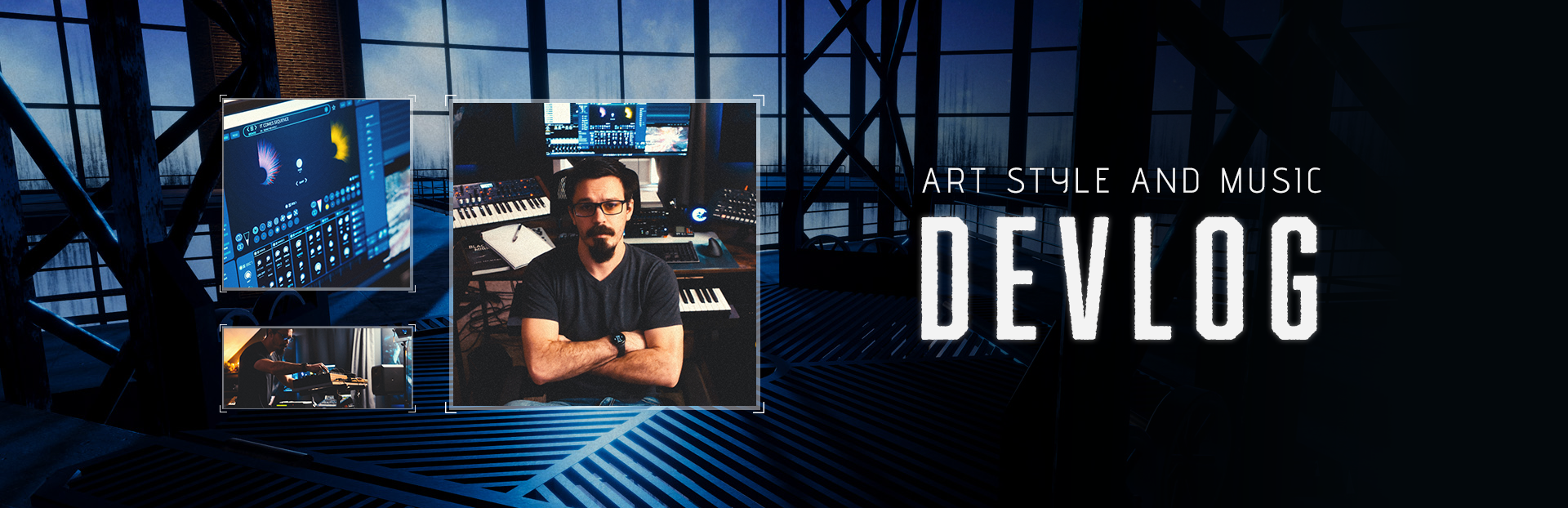
For the soundtrack, I brought on composer/sound designer Venus Theory. I had seen many of his YouTube videos over the years and thought he would be perfect for capturing the sound I wanted for The Core. From the start, he has been amazing to work with. He will send over ideas for a particular setting in the game, and sometimes it’s hard to pick just one because they’re all so good! He is very talented at his craft.
I will let him explain his thoughts on composing for The Core:
VT: For me, the soundtrack of The Core was designed as a sort of love letter to games from my childhood in the 2000s. The idea of this ‘digital era nostalgia’ seemed like a perfect fit, given the themes of the game’s story and character arcs. For the OST, I’ve been utilizing a combination of retro music gear of the era and modern production techniques to re-imagine the sound of my favorite games if they were produced today and expanded upon with the production technology we have now. It’s been a very fun process to combine late 90s/00s music gear like digital romplers and early VA synths with things like spectral synthesis and modern resampling techniques to give the game a life of its own that feels familiar while finding new territories to explore.
Music for me is largely a visual process, and finding ways to explore the contrasts between moments, emotional beats, and the environments is important not only to give the music an informed style that fits the moment-to-moment changes but to make it as ‘transparent’ as possible so that it blends almost seamlessly with the narrative and gameplay experience.
VT: The game soundtrack is still in the works, but currently, we have about 16 tracks in the game to establish the vision for the overall soundtrack. You’ll hear everything from the digital, colder environments of the early game to the lush and expansive cues in the surface world, with a few surprises tucked in along the way to introduce some new story elements.
VT: Each area has its own treatment sonically to help establish things like the identity of the environment, the types of tasks the player will undertake, and the story beats along the way. We’re aiming to give each area its own moment to shine since the environments players will encounter are so varied. But, among all of these, there are thematic ties to keep the music grounded to the main character and his journey. I won’t spoil too much, but things eventually get weird!
VT: There are some fun ‘easter eggs’ in the game's soundtrack for those who love games of that late 90s/00s period. The synthesizers being used for much of the game's soundtrack are also responsible for the iconic themes and sounds from games of the era, so if you listen closely, you might find some patches you recognize!
Just a reminder that the playtest is starting on the 22nd of May!
Source
Changelog.gg summarizes and formats this update. How we read updates.