
In this update4
Full notes
Full The Atlas Problem update
Read the full published notes in a cleaner layout. The original post stays linked below.
What changed
- Gameplay
- Balance
- Events
The Atlas Problem changes
(Check out the full post on the Atlas Problem site!)
"Every 14.5 hours, Saturn tries to tear our station apart. We built it there anyway." Sarah Agarwal, Structural Engineer
Welcome to Atlas Station - humanity's most audacious engineering project, constructed on a tiny moon dancing at the very edge of gravitational destruction. When we set out to create The Atlas Problem, we wanted to ground every gameplay mechanic in real science. Today, we're pulling back the curtain on the astronomical realities that make Atlas Station both invaluable and incredibly dangerous.
Steam post image Saturn XV, a.k.a. Atlas, as seen from the Cassini probe in 2007
Saturn XV: The Shepherd Moon
Atlas isn't fictional - it's a real moon discovered by Voyager 1 in 1980, measuring just 37km × 34km × 27km. To put that in perspective, you could walk across it in about 6 hours. This tiny celestial body exists in one of the most precarious locations in the solar system: just outside Saturn's Roche Limit. The Roche Limit is the cosmic 'danger zone' where Saturn's gravity becomes so powerful it literally rips apart anything that gets too close - like Saturn trying to tear apart its own moons. Think of it as the interplanetary equivalent of a boss arena with an instant-kill mechanic. Atlas is hanging on at the very edge of this limit, with only two other, much smaller moons orbiting closer to Saturn. It's literally shepherding Saturn's A-ring, its gravity keeping billions of ice and rock particles nicely contained to the A-Ring. It's this unique position that makes Atlas both incredibly valuable and incredibly dangerous for human operations.
The A-Ring Debris Field: Resource and Hazard
Saturn's A-ring flows around Atlas like a cosmic river of interplanetary material -- what we call the Debris Field. The ring material is primarily frozen water - perfect for life support systems - mixed with silicates and other stuff essential for long-term space operations. This debris moves at 16.7 km/s relative to Saturn, but here's the useful part: relative to Atlas's surface, it's only moving at about 4 m/s.
Steam post image Concept art showing debris flow patterns around Atlas Station
This creates an unprecedented opportunity - a constant stream of useful material flowing past your doorstep at a leisurely walking pace! But it also means your station is under bombardment from (micro)meteorites at all times. Every structure must be built with an eye towards keeping it protected from the constant stream of debris.
Building on Dust
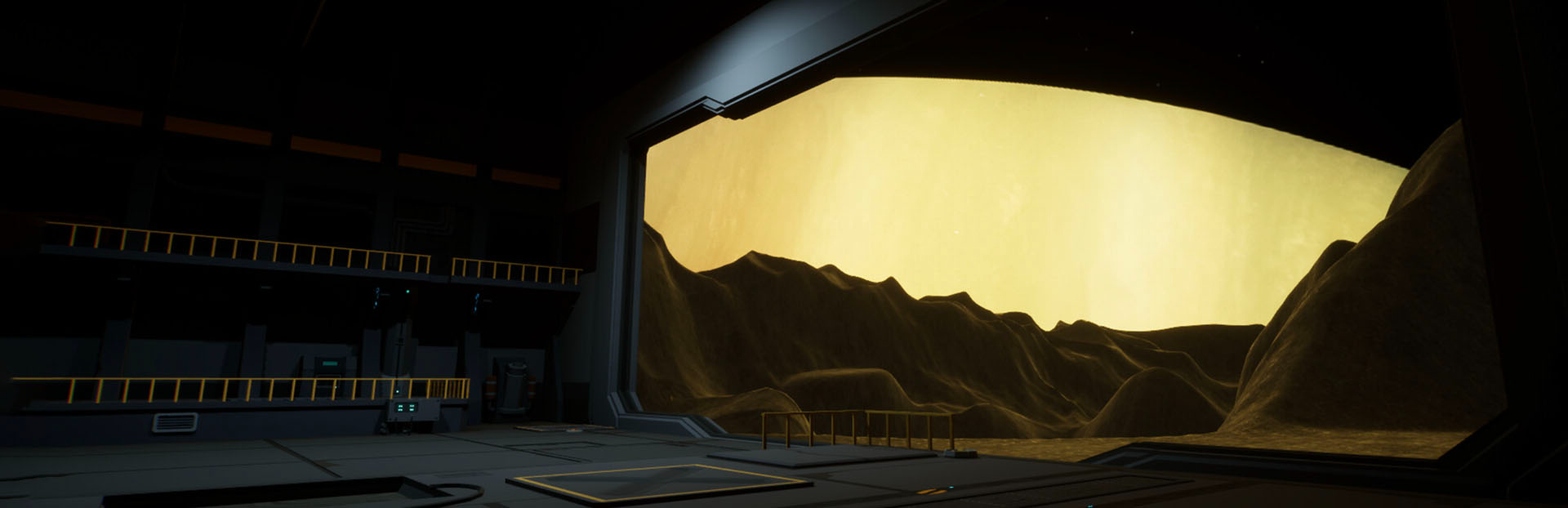
Atlas Station had to be built into the moon's equatorial ridge to take advantage of the slow-moving Debris Field, but this also means it sits at the furthest possible extent of Atlas's own Roche Limit. This requires the station to be anchored deep into the surface of the moon, kilometers below the dusty, icy surface.
Why build a station in such an impossible location? Atlas represents the ultimate deep space resource extraction operation - a stepping stone for humanity's expansion into the outer solar system. The constant flow of ring material provides water, rare minerals, and organic compounds that would cost billions to transport from Earth.
Steam post image Atlas Station embedded in the moon's equatorial ridge
But as players will discover through the station logs, previous missions have paid a heavy price. The extreme conditions, isolation, and constant equipment failures have broken crews and ended careers. Atlas Station represents both humanity's greatest achievement and its most dangerous gamble. As you explore Atlas Station's abandoned sections, you'll find personal logs from these crews - broken equipment, family photos tucked behind control panels, and maintenance schedules that end abruptly mid-sentence. The station's greatest enemy isn't equipment failure or resource scarcity (though those are pretty bad) - it's the crushing isolation of being on such a remote outpost, where there is no calling for help when something goes wrong.
Real Science, Real Consequences
Every detail we've shared here comes from research into real orbital mechanics, interplanetary physics, and mechanical engineering. We consulted NASA publications, Cassini mission data, arXiv papers, and current theories about ring dynamics to ensure scientific accuracy.
These aren't just atmospheric details - they directly drive Atlas Problem's core mechanics. Debris collection windows determine your resource income rates. Gravity fluctuations affect drone navigation. Eclipses and solar flares force you to make rebuild your entire power grid. Every system that breaks down becomes a life-or-death puzzle where you can't phone home for help (more on cascade failure in a future post).
In our next post, we'll explore how we translated these scientific realities into gameplay systems that challenge the player to think about tradeoffs, safety, and resource management.
Wishlist The Atlas Problem on Steam to experience these scientific challenges firsthand when Early Access launches. Join our Discord community where space enthusiasts and players can sign up for the playtest, discuss the real science behind our fiction, and help us make sure we get it all right!
Source
Changelog.gg summarizes and formats this update. How we read updates.