
Full notes
Full Tenjutsu update
Read the full published notes in a cleaner layout. The original post stays linked below.
What changed
- Balance
- Events
- Gameplay
The Origin Story
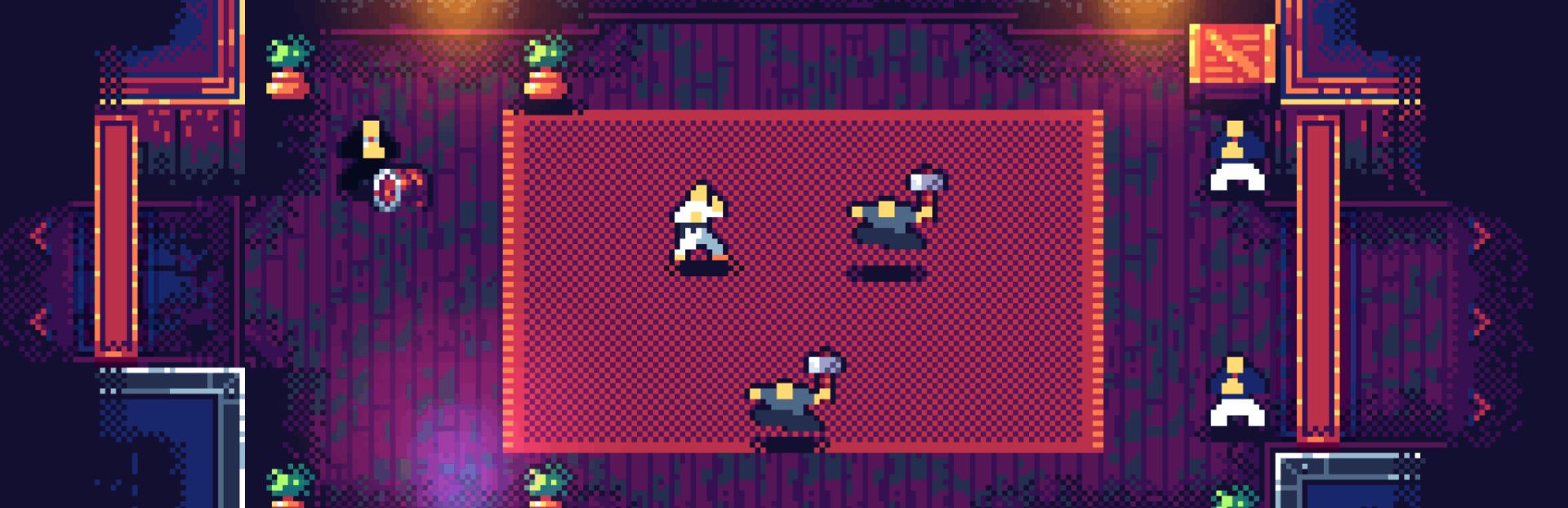
Tenjutsu is set in a sprawling open Japanese city where you punch and kick your way through gangs in any order. But it wasn’t always like that. It began life as a small, focused brawler. An extended version of my 48-hour Ludum Dare game.
In that first version, you had to hit enemies until their stamina was depleted. But unlike most games, this didn’t kill them or knock them down. Instead, you had to trigger a special finishing move that eliminated all depleted enemies in one go.
The mechanic was pretty fun, mainly because it came with a scoring system. The more enemies you took out in a single Finishing Move, the bigger your reward. It was way riskier than taking them out one by one, because depleted enemies kept fighting until you finished them. So going for the all-at-once kill meant you were surrounded by a bunch of angry and still-dangerous thugs.
A Little Kunai
The problem with the concept at that time was that it only really worked because of the score/reward system. It felt a bit artificial. It pushed you into chasing the perfect run, like stealth games that reward the flawless ghost approach. It made other playstyles feel less satisfying.
The direct consequence was that I found it difficult to add variety or new levels to that original game. The reason was obvious: its combat design was too narrow. The game basically only had one way to play it right, and therefore, the recipe for good level design was kind of repetitive.
Then, at some point, I had an idea – What if I added a special, powerful weapon that you could only use from time to time? Basically, my plan was to insert random opportunities during combat to add variety in players’ approach.
Enter the Kunai! A simple throwing blade that could one-shot any enemy, but was only usable once per level. It worked pretty well, as players had a new free Joker card to use in all levels to take down the most annoying enemy easily.
That tiny addition blew the doors wide open. A Pandora’s box for me, if you will.
Adding that tiny new weapon led me to the kind-of expected slippery slope. Maybe I should add more items? Like, different weapons that affect gameplay significantly. Oh, and maybe these weapons could drop randomly to make each playthrough a bit different? You can probably guess where that led.
After Dead Cells, I promised myself I wouldn’t make another rogue.
Yet here I was, again.
Going rogue
This new version started with three core concepts taken from that initial experiments, some of which I also learned during my time working on Dead Cells. I knew they were crucial for creating something memorable.
Embrace Variety – Each weapon should feel unique and play differently.
Master the Feel – The game should feel great, controls must be tight, and it should never be the game’s fault. If you die, that’s because you miscalculated some risk.
One vs Many – The thrill comes from being outnumbered. Battles should pit you against overwhelming odds, forcing you to outthink, outmaneuver, and outfight the swarm.
That was it. The plan was in place. All I needed now was to push the legacy of Dead Cells forward. How could its current combat design be developed into something new? Easy, right?
Obviously, it wasn’t that simple. But we’ll go down that rabbit hole next time.
A link to the past
I thought it would be
Source
Changelog.gg summarizes and formats this update. How we read updates.