
In this update2
Full notes
Full Tenjutsu update
Read the full published notes in a cleaner layout. The original post stays linked below.
What changed
- Gameplay
- Events
- Fixes
Tenjutsu changes
- Roguehero
It’s been a while since I last posted new content here. As you may already know, I’m hard at work on my second solo-dev title, Tenjutsu.
Well, not so solo actually, as I’m working with Daniel aka Dnilox, who helps me with the character animations and in-game chara-design, and with Devolver Digital, who take care of most of the marketing stunt work.
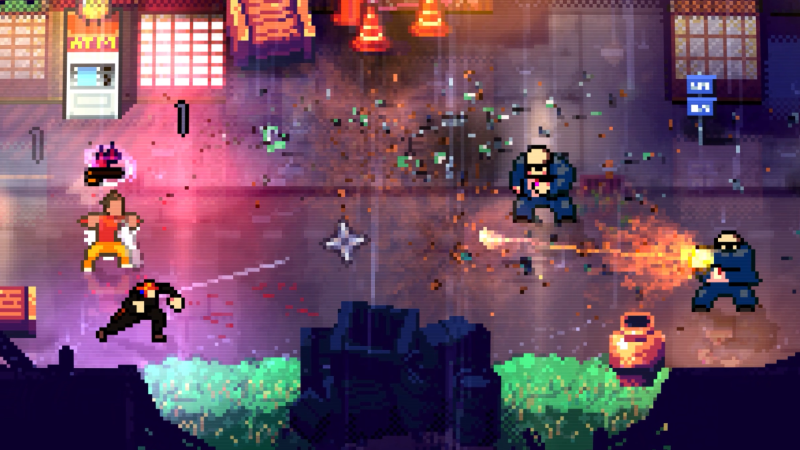
To sum it up, I like to call my game a rogue-fu. A mix of smooth martial arts combat in a roguelite structure, that takes place in a vast open Japanese city.
Like many indie developers, my game began as a game-jam entry in Ludum Dare. You know, those weird events that feel like 2000s LAN-parties, where a bunch (thousands, actually!) of people “gather” to create games in a super limited amount of time, with a theme constraint. It usually happens over the course of a weekend. It’s both super fun and super challenging. You promise yourself you’ll never do it again, then you do another one.
Anyway, long story short, the jam went great. I got lots of very positive feedback, and it encouraged me to push the concept a little bit further. You know, let’s make a short project, I mean the game’s already there right, what could possibly go wrong with a 6 months project? That was 3 years ago.
So Tenjutsu started as a linear beat-em up with a 10-second loop constraint, but it naturally evolved to a rogue as I added more weapons and some randomness to the mix.
That’s kind of surprising, as after working on Dead Cells, I basically thought I was done with this type of game… So I guess, never say never?
Core Pillars
If you’ve heard about game design before, there’s this general rule of thumb that says: define your game “pillars” early, print them on paper, and put them on display in front of you, so you never forget them. Pillars are 2-3 core concepts that really define a game. They can be anything, from a few words (eg. “ Thrill of the Unknown ” in Subnautica) or a piece of music that conveys a particular feeling.
In my case, it was a few scenes from the John Wick movies, and specifically the museum combat in John Wick 3: Parabellum.
TRIGGER WARNING: violence & blood
These scenes really captured what Tenjutsu is about:
Organic combat with opportunity as a key mechanic,
Dancing around instead of focusing on one foe,
A good variety of player actions again, based on opportunities and threats during combat.
I usually sum up that pillar with the “ one-vs-many combat ” concept.
Unforeseen consequences
Of course, these ideas all came with an awful lot of specific challenges:
How do you create an AI that creates such dynamic encounters in a procedural setting? I mean, that’s a thing to carefully design combat in a fixed setup (eg. Sifu, love that game) and that’s another topic to generate random encounters that are both interesting and non-repetitive.
How do you make a “one-vs-many” combat readable while being intense? Things can happen from any direction, and not all players share the same attention or split-second reflexes.
How do you let players progress in such a game? Should they level up and become more powerful through stats, or obtain new weapons and techniques, or just git-gud? And then, how do you keep the early game interesting once players have tasted more “advanced” combat situations?
That’s a lot of questions, right?
There are definitely many things
Source
Changelog.gg summarizes and formats this update. How we read updates.