
Full notes
Full Stop the Press! update
Read the full published notes in a cleaner layout. The original post stays linked below.
What changed
- Balance
- Events
- Gameplay
- Fixes
- Performance
Stop the Press! changes
In Dev Diary #9 I went into some detail about the way the story for the game would be laid out, and how I'd been trying to find the right balance between a story that's dynamic and one that's got a real immersive depth (whilst also not taking a million years to write).
This was the result - thinking about the story at different "resolutions". You'd have your main plot - a predetermined branching path that the player moves through.
Then you'd experience a selection of slightly less major events that would relate to that main plot but could happen anywhere in a small local "area" around where you are in the main plot (and were therefore somewhat dynamic but still rooted in the specifics of the main plot).
And finally you'd have minor events that could happen anywhere in a much larger area - things that aren't that involved with the main plot but which bring the world to life. Little scandals, Human interest stories, culture, sports, adverts.
This creates a reasonably good balance between dynamism and depth.
But I want to aim higher than reasonably good! After some insightful feedback and some more thinking, I've got an improved version of that model to share.
The main issue with the existing plan is that main plot. At the end of the day, even if it's got lots of branches and potential paths you could take through it, it's fixed. That makes it harder to organically respond to the player's input and to the simulation. I really want the player to feel like they're in an organically changing world that responds to what they do, not that they're on railroad tracks with only the occasional opportunity to flip a lever to go onto a different tracks. Part of the excitement for me of these stories about revolutions is the unpredictability and chaos of them, and this predetermined main plot just didn't quite cut it.
So, how can you make that main plot truly dynamic without losing all that juicy depth?
The answer actually partially existed in game already. In the game, there are things called "Debates". These are big topics that everyone in the country is talking about, which have stories that play out over several days. Normally you can print headlines that will support or undermine a particular faction, but when there's a debate going on, you can also print headlines that will influence your readers to support or oppose a particular person or idea.
Here's an example of an early game debate based on the story of the Diamond Necklace affair from the French revolution:
After a few days, the debate will reach its climax - often in a big dramatic event. What's happened during the debate (and, if you have enough influence, how you covered it in your newspaper) will result in one side coming out victorious. That can lead to massive changes in the polls, which originally would determine which path in the branching story you would go down. So in the railroad analogy, the debates were like the lever that you could pull at a fork to move onto a different track.
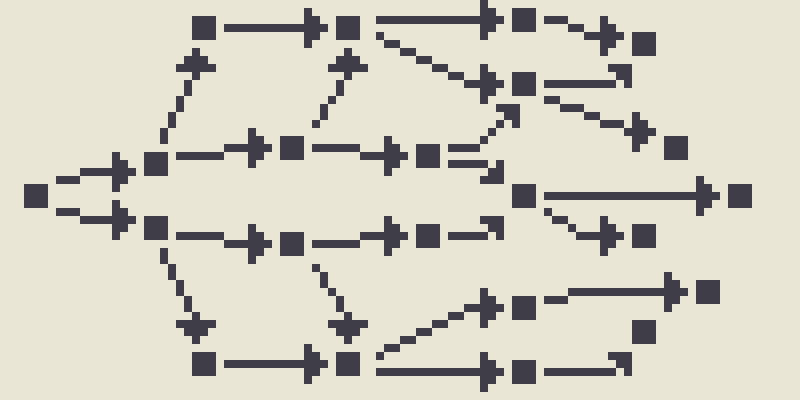
Now, imagine a chart. On one axis, we've got the stability of the current government. It goes from 5 - super entrenched after centuries of rule (that's our Royalists when the game begins), all the way down to 1 - in crisis and hanging on by a thread.
On the other axis you have each of the factions in the game. This creates a matrix of all of the possible scenarios you might be in at any point along the story. You start with Royalists at 5, but maybe soon they'll be worn down to 1, and after that you might find the Liberals have taken over and you're at Liberals 3.
Think of the game's story as not a linear chronological path, but as a movement around this matrix. And how do we move from one scenario to another? Debates!
Each debate is an opportunity to either strengthen the current government (move up the scale) or weaken it (move down the scale).
If the government is already at crisis level (level 1), then we have a special kind of debate - a Revolution. These will be the most dramatic moments in the game and will see another faction challenge the incumbents for power. If they win, they take over the country and we shift over to another column on the matrix.
(Note the red arrows are for illustration, you can also go in other directions after a revolution)
This means that the main plot is no longer a fixed branching story, but broken up into debate-sized segments. Every scenario will have a pool of suitable debates that make sense in that context that will move the story on to the next scenario.
So what does that look like to you as you're playing?
As you progress through the game, building your readership and responding to daily stories, people might come to you with scoops. Hints that some big scandal or crisis is brewing. If you choose to print these stories, they'll set off the chain reaction that leads to a debate.
Unlike most stories, however, you can decide to print these when you like - you don't have to print on the day you hear about them. That means you can wait for the right time to light the fuse, or wait for a few different debates to show up and choose the one that best suits your goals. Delay too long, though, and you might find that events start unfolding without you.
At the start, when your readership is small, your influence over a debate will be limited. But if you make good choices and grow your readership in the right demographics, soon you'll be able to tip the balance, or maybe even one day orchestrate the national conversation like a puppetmaster.
This means every player's path through the game will be unique, responding to events and choices, but keeping the story grounded in dramatic, handcrafted storylines that link to one another and fit the scenario you're in.
Source
Changelog.gg summarizes and formats this update. How we read updates.