
In this update10
Full notes
Full Slot Theory update
Read the full published notes in a cleaner layout. The original post stays linked below.
What changed
- Performance
- Fixes
- Maps
- UI and audio
- Gameplay
- Balance
Slot Theory changes
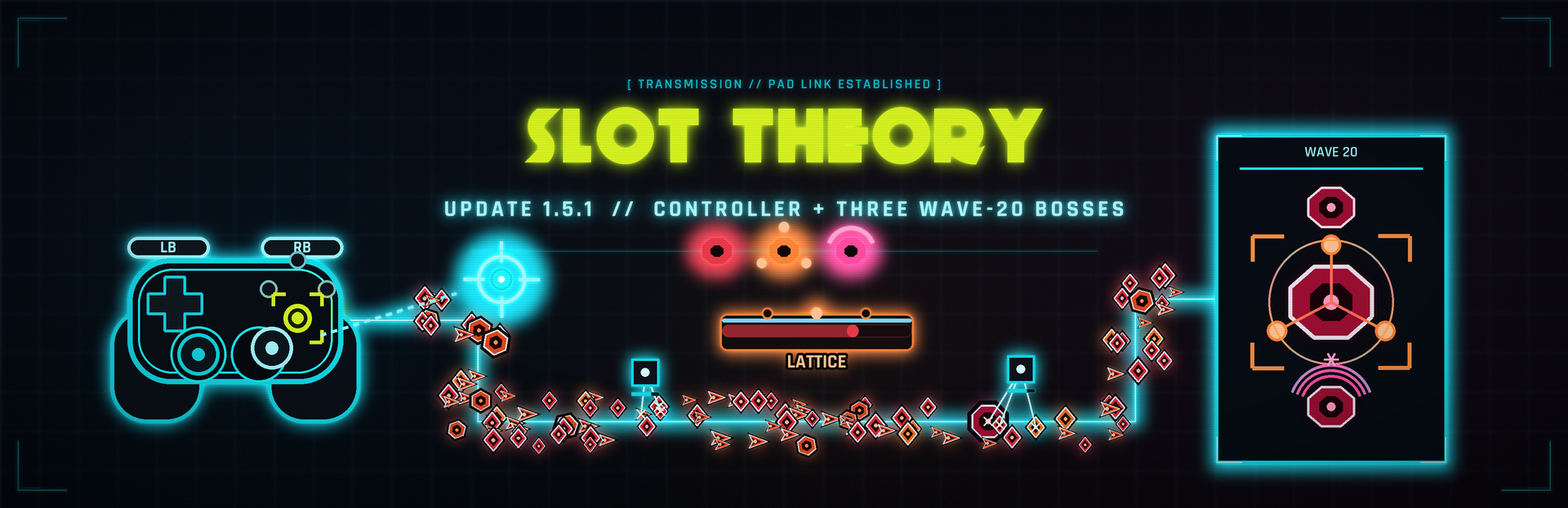
Full controller and Steam Deck support, and the wave-20 boss stops being the same fight on every map. On top of that: the player profile grows a run history and a most-used tab, the Daily Rift gains a mandate layer, and crash reports now find their way to us instead of dying on your machine.
Controller and Steam Deck support
The whole game is playable on a pad, front to back, aiming at Deck Verified. Xbox, PlayStation and Steam Deck controllers are auto-detected and the on-screen glyphs match the pad you are actually holding.
Treat this as experimental. It is a large surface, every screen and every in-wave interaction, and it has been tested across far fewer pads and window sizes than there are in the world. Expect rough edges: focus landing somewhere odd, a screen that does not scroll to where you are, a glyph set that guesses your pad wrong. If you hit one, please tell us, with your controller model and what you were doing. That is the fastest way to get it fixed. Post in the Steam discussions or come to Discord.
Every menu is focus-navigable. Main menu, mode select, map select, tower ban, campaign, custom game, operators, settings, hotkeys, codex, achievements, leaderboards, profile, how-to-play and the map editor. LB / RB cycle tabs on the tabbed screens; the right stick scrolls lists and panels.
In-wave: LB / RB and the D-pad cycle slots, A cycles the selected slot's targeting mode, Y pins a sticky tooltip on it, LT / RT step game speed, Start pauses.
Drafting on a pad snaps between valid slots with the same two-tap confirm the mouse uses, and free placement gets a stick-driven cursor clamped to the field.
Operator actives aim with the right stick, a reticle for all seven, driving the exact same gesture code the mouse does rather than a parallel pad-only path.
Touch input (tap, long-press for tooltips) now works on any touchscreen device, Steam Deck included. Text entry opens the Steam floating keyboard under Steam, or Godot's on-screen keyboard otherwise.
The layout is fixed and documented in-game on the Hotkeys screen with your pad's glyphs. Remapping goes through Steam Input, not an in-game rebind screen.
The wave-20 boss now varies by map
The Breach Colossus was the same duel on all seventeen maps. Two variants join it, each asking a different question of your board, and which one you face is a property of the map.
Breach Tribunal (Crossfire, Threshold, Switchback, Perimeter Lock, Trident). Its hull carries a quorum seal with three nodes. While any node is live it takes 75% less hull damage, and the hull only opens while all three are suppressed at once. An area effect suppresses all three; a single point hit suppresses one, rotating, so a point-hit board needs three inside the decay window to do what one splash does. Deliberately not a hard seal: a board with no area damage can still win, it just works harder.
Breach Aegis (Double Back, Ziggurat, Hourglass). Adaptive armour: it takes 50% damage unless it is under control. Slow it and the armour drops, with a short grace window so it cannot flicker between ticks of one slow source. The question is simply whether your board drafted any control at all. It keys on slow rather than Mark on purpose, because nearly every board marks something by accident and that would be a free pass.
Chapter 1 (Orbit, Crossroads, Pinch & Bleed, Ridgeback) keeps the baseline Colossus, along with Fault Lines and the Rift Zones. The finale should teach itself on the first maps you see before a variant gates it, and Fault Lines is already the hardest map in the game.
Map select names the wave-20 boss for the map you have highlighted, so a variant is never a surprise at wave 20.
The Slot Codex carries an entry for each boss, the Tribunal and the Aegis sitting next to the Colossus with what each one wants from your board.
The boss bar says why your damage is low. It reads `LATTICE` while the Tribunal's seal holds and `ARMOURED` while the Aegis's armour is up, with the hull bar dimming to match, so landing the slow that drops the armour is something you see happen rather than something you infer.
Leaderboard rows carry a boss chip when the run fielded a non-baseline boss. Baseline runs are not chipped: every map fielded the Colossus before this update, so marking it would badge nearly every row while saying nothing.
Custom Game gets a wave-20 boss selector, a four-way cycle: follow the map's own assignment, or pin any of the three.
The Daily Rift rolls its boss, uniformly across the three. Everyone gets the same one that day, and it outranks the map's own assignment. Skirmish deliberately does not roll: those leaderboards are all-time per map, so a rolled boss would put runs against different fights on one board.
The balance note. Both variants were measured on paired seeds against the baseline boss before shipping, and both do what they were built to do. The Tribunal costs a single-target board 18 points of win rate while costing a spread board an amount that does not resolve from zero, which flips single-target's advantage on those maps from +14 points to roughly nothing. The Aegis costs a board with no control 23 points, while two independent control answers each cost around 5 and neither resolves from zero. Which maps got which variant, though, is a progression decision, not a sweep result: the per-map difficulty sweep that would validate those eight assignments has not been run.
Deadzone answers the boss
Deadzone's floor trap has always been ignored by the Colossus, which made it dead weight in the fight that now sometimes checks for control. It gains a second half: a direct hit staggers a target too massive to trap for 0.6s, on a 6 second re-arm.
It applies only to targets that are immune to the zone pin, so ordinary waves are untouched. The re-arm gate matters more than it looks: without it, any tower firing faster than the stagger duration held the Colossus in place permanently, and a boss that cannot walk cannot lose you the run. At roughly 10% uptime it is a periodic control window, not a lock. Against the Aegis it reads as a partial answer, between a real slow board and no control at all.
The player profile grows two tabs
RUN HISTORY archives your last 20 runs, newest first. Each row expands to the full build, the score and the seed, drawn the same way the leaderboards draw a build. Endless continuations fold into their win row instead of stacking a second entry. Stored locally only, never cloud-synced.
MOST USED ranks your top 3 towers, modifiers, premium cards, operators and maps across your lifetime, each with its real icon. Returning players get a one-time seed from the archived run history, so the tab is not empty on first open.
Daily Rift
About 18% of days now carry one or two random Mandate Protocol mandates as spice, listed on the rules popup and in the HUD strip alongside the day's other layers. They never touch Protocol Rating: a daily grants no protocol badges, achievements or progress, it is just a different shape of day. Dailies also roll their wave-20 boss, as above.
Hard difficulty is retuned map by map
Hard was wildly uneven across the roster which meant picking a map mattered more than playing well. Every map's Hard wave adjustments were re-measured and retuned.
The maps that moved most: Orbit, Crossroads and Overdrive were the soft ones and are now genuinely Hard, Overdrive especially, whose speed pads buff your board and were never paying for it. Hourglass and Pinch & Bleed were the punishing ones and have come up. Blackout's fog bands were narrowed so a fifth of the path is untargetable rather than nearly a third. Fault Lines is deliberately left where it is, since it gates the Deadzone unlock.
Interface
FIRST CONTACT. The draft's next-wave footer now names the enemy types making their debut in the wave you are about to play, so a new threat is something you draft against rather than something you meet.
Monomania's tooltip names the dominant tower type it is counting, instead of leaving you to work out which one it means.
Crash reporting
If the game dies, it now tells us how. Crashes are captured locally (both the ordinary managed kind and the harder process-level kind, the latter rebuilt on the next boot from the previous session's log) and uploaded once. Reports are kept until the upload succeeds, so a crash during an outage still reaches us later.
A Send Crash Reports toggle in Settings gates the upload, and gates only the upload: turning it off never stops the game from recording a crash locally.
Fixes
Custom Game keeps its buttons on screen. At 1080p the Back button sat below the bottom edge of the window, and START RUN could scroll out of reach. The page is now anchored to the viewport with START RUN pinned below the scroll, so both hold their place at any window size.
Codex boss cards read like every other enemy card. The Tribunal and the Aegis were drawn by a parallel builder that had drifted, so they showed prose where their neighbours show HP, speed, leak cost and wave, and one of them carried the wrong name. All three wave-20 bosses now use the standard card with one extra line for what makes the variant different.
Map select no longer loses its START RUN button. A pre-parented scroll wiring path could throw during the screen's setup and abort the rest of it, leaving the screen half-built.
Held-stick slot cycling no longer runs away. Stick jitter fired one step per motion event, and cross-axis noise released the direction latch, so a held direction stepped repeatedly instead of once.
Ban Hammer is Skirmish-only. The Daily Rift's EMBARGO spice bans towers for you, which was quietly earning the badge for a choice you never made.
The one-time badge backfill runs at the main menu, never for the first time inside a run's end-of-run bookkeeping.
The Steam achievement repair pass now logs what it delivers, so a late toast on an unrelated end screen is attributable instead of mysterious.
Codex, achievements and leaderboards tab cycling on a pad follows the visual tab order and re-grabs focus on switch; the map editor no longer stacks modals on B; the hotkeys list scrolls when the controller section overflows a small window.
Found a bug?
Tell us. Tthe Steam discussions and Discord both reach us, and Discord is usually faster. What helps most: what you were doing, the map and difficulty, and your controller model if a pad was involved. Crash reports now upload on their own, so if the game hard-crashed we probably already have the stack, but we still will not know what you were trying to do when it happened.
Source
Changelog.gg summarizes and formats this update. How we read updates.