
In this update6
Full notes
Full Slot Theory update
Read the full published notes in a cleaner layout. The original post stays linked below.
What changed
- Performance
- Maps
- Gameplay
- Balance
- UI and audio
- Security
Slot Theory changes
A legibility, stability and deep-endless release. Enemies are easier to pick out at a glance, endless runs hold their shape hundreds of waves further in, a hard crash and a severe high-speed stutter are fixed, and a run of visual glitches with them.
Enemy legibility
Every enemy now has a crisp outline. Enemies are drawn in an ember-crimson family, which put them uncomfortably close in hue to the map's path glow on several chapters - the amber and magenta ones especially - so a walker crossing the lane could blend into the floor. At high enemy counts the problem compounded: overlapping bodies fused into a single mass with no readable edges. Each enemy type is now drawn with a thin two-tone rim - a near-neutral inner edge and a dark contact shadow - baked directly into its artwork. The result separates enemies from the path on every chapter palette and keeps individual bodies readable inside a dense pack. Because the rim is part of the artwork rather than something drawn on top, it costs nothing in performance and survives at the highest enemy counts, which is exactly where it matters most.
Marked, slowed, and shielded enemies read clearly again at high density. Once a wave gets busy the game simplifies its status indicators to keep the frame rate up, and these three had simplified so far that they were effectively invisible. They now stay legible in their collapsed form.
The Slot Codex shows real enemy artwork. The codex used to draw its own hand-made copy of each enemy, which had quietly fallen out of date - the basic walker's entry was still drawing the old teal-and-mint design long after the enemy family moved to ember-crimson. Codex entries are now generated from the same artwork used on the battlefield, so what you study is exactly what you fight.
Codex enemies are now sized relative to each other. Previously every entry was scaled to fill its card, so a splitter shard and the Breach Colossus looked identical in size. Entries now reflect how big each enemy actually is, so the roster reads at a glance.
Endless mode
Deep endless runs past roughly wave 150 had stopped working as a difficulty curve and turned into something else.
Enemy speed no longer runs away. Speed scaling had no ceiling at all. Past about 9x, enemies crossed the lane faster than towers could meaningfully engage them, so deep endless stopped being a defence problem and became a pure leak-rate race against a nearly empty board. Speed is now capped, and the board stays populated at every depth.
Enemy health and wave size no longer run away either. Both followed unbounded curves; by wave 400 a single wave was asking for over seventeen million enemies. Both curves are unchanged up to wave 150 and grow gently after it.
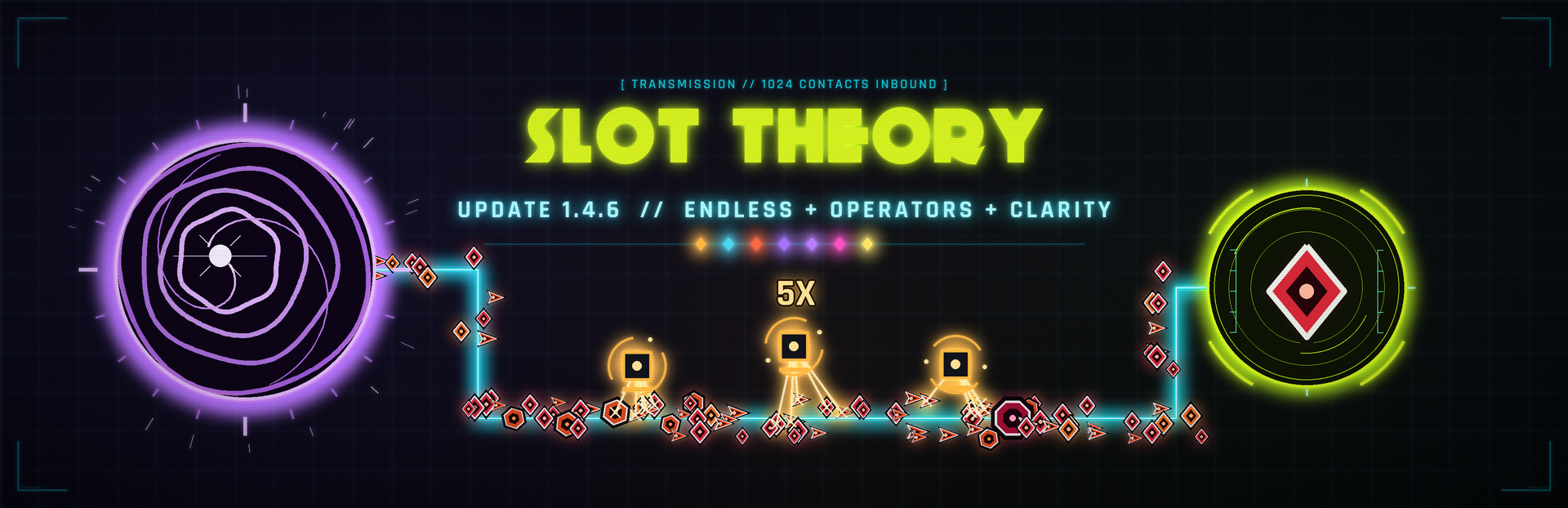
Far more enemies can be on screen at once. The internal limit rose from 300 to 1024, so the heaviest endless waves now play out in full instead of being silently throttled.
Breach Anchors are killable again deep into endless. The Anchor is a slow elite that parks in your kill zone, soaks the whole board's targeting, keeps trickling reinforcements while it lives, and costs three lives if it leaks. Its health was compounding on top of the normal endless curve, so past roughly wave 80 it stopped being a fight and became a scheduled tax every nine waves. Its health now tapers with depth, so it stays a threat you can actually answer rather than one you simply pay.
Operators
Overcharge now boosts every tower by the same multiple, and it is a smaller boost. The Overcharger's ability opens a frenzy window where your towers fire far faster than normal. Under the hood it did this by repeatedly clearing every tower's cooldown on a fixed schedule, which meant the frenzy had a fixed * ceiling * rather than being a multiple of what each tower already does. The effect was backwards: the slower a tower was, the more it gained. The Accordion Engine got a 16.7x boost while the Rapid Shooter - the tower the Overcharger's whole identity is built around - got only 7.1x. Slow, heavy-hitting towers were the best Overcharge targets, which is precisely the opposite of what the ability is meant to reward.
Overcharged towers now fire at 5x their own rate, whatever that rate is. Every tower gets the same multiple, so the ability rewards fast towers again instead of punishing them. This is a real reduction in total output - the frenzy was doing considerably more damage than intended, especially on boards built around Heavy Cannon, Voltspear and the Accordion Engine - but it remains the strongest operator active in the game, and the only one that scales with how well you have built your board.
Overcharge no longer performs differently depending on your frame rate or game speed. The frenzy was timed against real seconds rather than game time, so it quietly weakened at higher game speeds. Separately, the number of shots it produced depended on your monitor's refresh rate: above 60 fps the ability delivered progressively more, up to about a third more shots on a high-refresh display than on a 60 Hz one. Both are fixed - the window is now measured in game time, and the frenzy delivers exactly the same output at any frame rate and any speed setting.
The Overcharger's passive is back to +8% tower attack speed, down from +12%. That passive was raised to +12% a while ago to compensate for an ability we could not measure properly at the time. Having fixed the measurement, Overcharge turned out to be comfortably the strongest operator ability in the game, so the compensation was never warranted. This matters more than a normal tuning change because the Overcharger is the * starter *: it was outperforming every operator you unlock after it, which made each unlock feel like a sidegrade at best. It is still a strong, straightforward pick - just no longer the default answer.
Every other operator's ability has been retuned. Several of them were quietly underperforming, and a couple were failing for reasons that had nothing to do with their damage numbers.
Astra's Singularity pulls harder, holds longer, and collapses far wider. The gravity well's radius has nearly doubled and its collapse hits much harder. The old well was simply too small: on a lane where enemies are strung out in a line rather than bunched up, it frequently closed on almost nothing. Reach was the problem, not power.
Dynamo's Arc Discharge reaches much further, forks more, and hits harder. Its weakest discharges were the real issue - at a low charge the bolt's reach was short enough that the extra forks had nothing to find. The floor has been raised substantially, so even an early discharge does real work, and a full reservoir now spreads considerably wider.
Nyx-7's Bass Drop hits harder and echoes twice as many times - four follow-up pulses instead of two. Several smaller pulses land better than one large one, since damage spilling off an already-dead enemy is wasted.
Conductor's Chain Nova deals substantially more damage per arc. Lengthening the chain did nothing, because on a live board the arc runs out of enemies long before it runs out of jumps. Damage was the only lever that moved.
Warden's Lockdown vulnerability window is +100% damage taken, down from +150%. Lockdown holds the field still * and * multiplies everything your towers do to it for the duration, which made it the strongest ability in the game on a well-built board. It remains a heavy hitter.
Performance
Quality graphics mode got substantially faster at high density. It was re-drawing enemy status rings that the renderer was already able to produce for free. At the internal stress benchmark this roughly halved the draw-call count and lifted the frame rate from about 100 to around 155 fps, with the worst frames improving by a similar margin. Performance mode and gameplay are unchanged.
Fixed a severe stutter when an operator ability fires at high game speed. Triggering Overcharge on a crowded board at 20x speed could drop the game to a few frames per second for the entire five seconds the ability lasted, and the same stutter appeared with any board putting out very high attack speed. The simulation was queuing up to ten thousand floating damage numbers every frame while only about two hundred can ever be shown, and the game was doing the work for all of them. Deep endless runs at high speed were the worst affected, since they combine the most enemies with the most hits per second. At 20x with 330 enemies the average frame is now about 11 ms, with 99% of frames comfortably above 60 fps - previously frames ran 200 to 436 ms for the whole ability window. Nothing changes on screen: the same number of damage numbers is displayed.
Fixes
Fixed a hard crash in long, dense runs. The game could close outright - no error, no recovery - during heavy waves. Visual effects created by the combat simulation were being built on the wrong thread, which is normally harmless but occasionally corrupts the game at exactly the moment it is busiest. Deep endless runs and boards built around Deadzone, Wildfire, Rift Sapper, Undertow, Latch Nest or Astra's Singularity were the most exposed, since those produce the most effects per second. All such effects are now created safely. A related fault could quietly drop the simulation onto a slower path partway through a run after a heavy enemy died, costing frame rate for the rest of that run. Also fixed.
Fixed a crash during heavy surge and operator-ability activity. Under sustained surge chains the simulation could fail with an internal error and drop to a slower path for the rest of the run. Delayed impacts - the staggered hits that make a surge or an operator active feel like a cascade rather than a single flash - were landing while the simulation was mid-update. All such delayed effects now wait for a safe moment, including the operator actives that deal their damage in timed steps.
Fixed a crash when a visual effect was cleaned up twice. Certain effects with two owners could be released at the same moment from both, most often at high game speeds.
Deadzone fields and afterimages no longer linger through the draft screen. Expired effects stayed painted on the path for the whole draft and only vanished when the next wave began.
Fixed a slow leak of deadzone visuals. Repeatedly re-arming a deadzone could orphan one invisible leftover per trigger. Only noticeable over long, fast sessions.
A re-armed deadzone now visibly signals that it is live again, instead of silently resetting with no feedback.
Daily Rift
Daily runs now open with a briefing. A daily used to drop you straight into drafting with no explanation of the day's seeded ruleset. Fresh dailies now show the day's modifiers before the first pick, matching how campaign stages introduce their rules. Resumed dailies skip it. Seeds, roll order, and scoring are untouched.
Source
Changelog.gg summarizes and formats this update. How we read updates.