
In this update13
Full notes
Full SkyChart: Airline Executive update
Read the full published notes in a cleaner layout. The original post stays linked below.
What changed
- Gameplay
- Performance
- Events
- Store
- Balance
- Maps
SkyChart: Airline Executive changes
Casey Comes Up For Air
It has been a while, CEO! Casey put his head down, the studio went quiet, and a whole lot of airline turned over in the meantime. This is the catch-up post for everyone, and it is a big one. The short version: your rivals grew up, you can paint the fleet, every campaign is now its own little world, and the money got a great deal more interesting.
A quick word before we taxi. Every existing campaign loads cleanly. The deepest new systems are gated behind Realism mode, which you opt into at the start of a campaign. Casual play behaves exactly as it always has, and your books are never touched by anything you didn't choose.
The Competition Grew Up
The biggest change you'll feel. Your rivals now play by most of the same rules you do.
They borrow. A cash-strapped rival that's tapped out the bank can issue bonds to keep fighting. Good credit borrows cheap; a junk rating gets nothing. Over-borrow and they still end up in receivership, so watch who's loading up.
They insure, and they get sued. Each rival pays a premium that scales with the size and age of its fleet. A crash on their watch spikes their risk and starts the settlement bills.
They go public. In Realism, rivals start privately held and hold their own IPO once they're big enough. A private rival can't raid you and can't be raided.
They train crews and weather strikes. Picking up a new aircraft type costs them a type rating and a ramp-up window. Every few years, their unions renegotiate, and a bad deal grounds some of their routes.
They merge with each other. A cash-rich competitor will absorb a struggling one, folding routes, fleet, and debt under one flag. Fewer, bigger rivals late in a campaign means the survivors are tougher.
Casey ran every bit of this on a separate desk so none of it shifts a number on your own routes. The skies just got a lot more honest about who's flying in them.
Every Campaign Is Its Own World
Each new game now rolls an eight-character world seed, or you can type one in for a repeatable run you can share with a friend.
History bends with the seed. COVID, 9/11, the 1973 oil shock, and a dozen more events still happen on schedule, but how hard they hit shifts within a sane band based on your seed.
Some events fork outright. The A380 program might ship on time, ship late, or cancel before service. US deregulation might land in 1978, slip to 1985, or stall in Congress. The 787 might be grounded until 2014. The same seed always picks the same branch.
Manufacturers don't all survive. Two plane-makers hit exit windows where they might fold, get absorbed, or hang on as a niche shop. Your fleet keeps flying either way, but new orders dry up and dead-brand airframes lose a third of their resale value.
Era 5 — The Green Frontier (2025-2040). The clock now runs past 2020 into sustainable-fuel mandates, hydrogen demonstrators, and the electric regional wave. New goals: $5B company value, 80 routes, all seven regions.
Two players who start with two different seeds live in two genuinely different airline industries. That's the whole point.
Ordering Aircraft Is A Real Decision
Buying a plane is now a procurement conversation.
Engine catalog. Two or three engine options on dozens of widebodies and narrowbodies, each trading range against fuel burn, maintenance, and resale. Pick one and your orders use it.
Custom order specs. Weight variant, aux tanks, cargo door, avionics, IFE, crew rest, and combi vs passenger. The right picks unlock ultra-long-haul and ETOPS ratings. The wrong picks just cost you money.
Finite production slots. Manufacturers build only so many frames a year, and your rivals are booking the same line. Order a hot new type late, and you might wait two or three years for delivery. The Order Backlog panel shows the squeeze.
Standardize for savings. Run a fleet that's mostly one spec, and your maintenance bills drop up to 5%. Run a grab-bag of variants, and you pay up to 15% more.
When a brand-new type is two years out, the maker may also offer you Launch Customer status: an exclusive ordering window, 20% off your first five frames, and a say in the spec everyone else inherits. You get three months to decide.
Airports Stopped Being Dots
The world's big hubs are now real places with real constraints.
Real infrastructure. Runway counts and lengths, gate counts, slot caps, curfews, customs, and cargo ramps. Open the Airport Browser (Shift+X) to compare them.
Multi-airport metros. Tokyo has Haneda and Narita, New York has its three fields, and London and Paris have theirs. The runway gate walks the whole metro, so an A380 can use Narita even when Haneda's runways are short.
Curfews bite. Heathrow's night closure, Frankfurt's, Narita's, Orly's, and Sydney's all cut throughput 25 to 29 percent at those airports. Your rivals feel it too.
Build your own. Stand up a maintenance base at a hub for a 30% discount on heavy checks, or pour concrete on a brand-new greenfield airport where slots are then yours at half price forever.
Airports also grow over the campaign on their own historical schedule, and the Browser keeps a log of every expansion that fired in your world.
The Money Got Deeper
A whole finance wing opened up next to the route map.
Bonds. Raise cash without the bank. Issue bonds, pay a fixed coupon, refinance when rates fall, or buy them back early.
Fuel hedging. Lock tomorrow's fuel price today with a portfolio of contracts. Pick the term, the volume, and how much is sustainable fuel. When spot prices spike, your hedge rides through.
Subsidies and contracts. Local governments will pay you to fly underserved routes. Corporate and cargo clients will reserve seats for a steady monthly fee. Both have terms, and breaking them costs you.
A real used-aircraft lot. Listings come first, second, or third-hand at different prices, with gray-market metal out of sanctioned regions if you don't mind the reputation hit.
Going public and getting raided. Grow a private carrier into a listed one with an IPO, and defend against the hostile takeover bids that come for you when you're weak.
Casey personally inspects every subsidy check for forgery. He has found none. He looked very hard.
New Ways To Fly
Scheduled flights aren't the only game anymore.
Seasonal scheduling. Put a route on a summer-peak, winter-peak, holiday-burst, or fully custom 12-month profile, and its frequencies scale themselves through the year.
Charter. Lease a whole aircraft to a single client for fixed monthly money over a contract term. Steady cash, no competition, but the plane is committed.
Air-taxi. Run a small plane on demand at a premium fare per kilometer. Low volume, high margin, for the right aircraft on the right pair.
The Cabin And The Crew
Realism mode adds front-of-house and back-of-house depth.
Cabin Designer. Build what passengers actually sit in, per class: seat pitch, galleys, lavatories, entertainment, Wi-Fi, power, and meal service. Quick templates from No-Frills to Flagship, or tune it dimension by dimension.
Frequent-Flyer Program. Passengers earn miles and climb tiers, and every mile owed sits on your books as a real liability that comes due when members cash them in.
Partnerships. Shake hands with hotels, ground-transfer operators, and vacation-package agencies to lift demand in the cities they feed.
Crews and turn times. Aircraft need ground time between flights, crews need type ratings for new types, and positioning pilots away from their bases costs more than cabin crew. Run a tight, concentrated operation, and it pays off.
All of it Realism-gated. Casual campaigns keep the simple flat numbers exactly as before.
Career, Community, And The Casey Cup
Things that live above a single campaign.
Career profile. Earn experience across every campaign you fly and unlock starting bonuses that carry into the next one.
Ghost carriers. Opt in and your retired airlines come back as AI rivals in future games, complete with a founder bio. Beat the ghost of your own last empire.
Casey Cup. A monthly leaderboard challenge on a fixed seed and scenario, with your run auto-submitted at the deadline.
Custom alerts and scheduled actions. Set conditions that ping you (cash below a line, a route on a losing streak) and queue future moves to fire on a date you pick.
Career timeline. A wall of past lives — every campaign you've flown, charted by outcome.
Eight Themes, A Photo Mode, And A Bigger World
Eight UI themes in Settings, from the warm Sunset cockpit to Midnight, Daylight, Forest Cabin, Noir, Aurora, Tropical, and a high-contrast Pure Charts. Swap live; every open panel repaints.
Photo Mode on F12 for a clean shot of your network, plus an end-of-era recap screen.
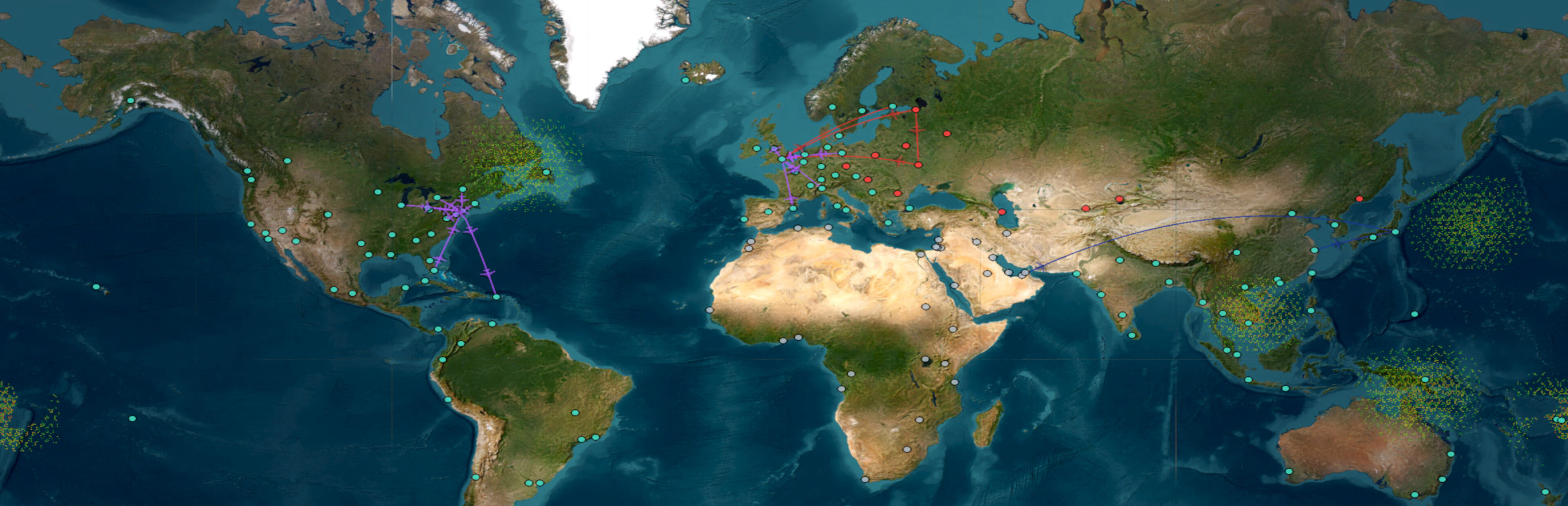
196 aircraft and 528 cities. The roster grew across regional turboprops, classic narrowbodies, Soviet and Eastern types, and modern freighters. The map gained 32 hubs, starting with the one Casey was most annoyed about missing: Newark.
Maintenance checks now arrive with the eras. Line checks formalize in the mid-1950s, heavy checks in 1970, so a Dawn-of-Flight campaign isn't paying jet-age overhaul bills.
Smooth At Scale
If you build a thousand-route empire, you've felt the late-game slowdown. Casey spent a long stretch under the floorboards on it.
The late-game frame-rate drop at two thousand-plus routes is gone. Autosave moved to a background thread, the monthly economics now run across every CPU core, and loading a giant save no longer freezes the screen.
The numbers are bit-for-bit identical to before. Same airline, same money, far fewer stutters.
The Recent Sweep
The latest builds closed out a run of player-reported items.
A frequent-flyer program in a long-haul Realism campaign was honoring miles at roughly ten times the right rate and quietly draining the bank. Fixed, and the fix lands the moment you load your save.
Post-1991 campaigns were still calling Moscow's airspace "the USSR" on subsidies and route blocks. The successor states now put their own names on the charts.
The Fuel Hedging panel's buttons wouldn't click because the desk was redrawing itself dozens of times a second. Bolted down, plus a new readout showing your reference fuel volume so you can size a hedge.
The quarterly report was counting aircraft leases twice. Your cash was always charged once; the report just read worse than reality. Struck the duplicate.
If your progress record ever got wiped, the game now reads your actual save files and unlocks the eras you really reached.
What We Want Feedback On
The AI parity systems: do late-game rivals feel like real competition now, or still pushovers?
Realism mode as a whole: is the depth worth the bookkeeping, or is any one system more fiddle than fun?
The finance wing: bonds, hedging, subsidies, contracts. Too much, too little, about right?
Performance at scale: if you run a huge network, tell us how the late game feels now.
Bug reports: F8 in-game opens the report form with diagnostics attached, or drop into the Discord. Casey reads everything and squawks at the rodents in the avionics bay until they stop chewing wires.
Blue skies, CEO. Go break something. -Casey
Source
Changelog.gg summarizes and formats this update. How we read updates.