
In this update1
Full notes
Full Salvation Denied update
Read the full published notes in a cleaner layout. The original post stays linked below.
What changed
- Performance
- Events
- Gameplay
- Balance
- Store
Salvation Denied changes
Since revealing Salvation Denied, one of the biggest questions we’ve seen is a simple one:
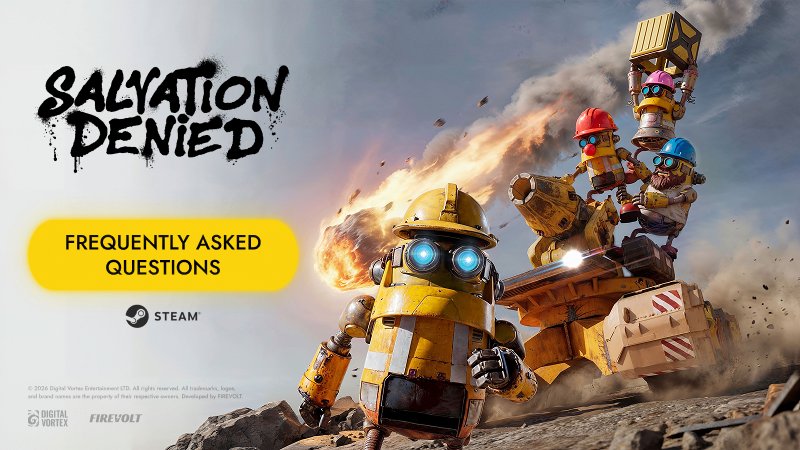
What do you actually do in the game? The short answer is: you build - but that is only part of it.
At its core, Salvation Denied is a co-op physics building game. You can play solo, but the game is built around teamwork, pressure, and shared problem-solving (so by playing solo, you do miss out on a lot of the fun). We are not trying to make a calm, optimization-heavy builder where everything goes according to plan. Instead, sessions are designed to be shorter, more intense, and a lot more chaotic. Things are very likely going to go wrong, that's something that you'll just need to live with!
Put together, this makes communication, improvisation, and learning how to recover together (as a team) matter far more than perfect planning.
Missions
Missions are built around different scenarios, each with its own challenges. Some examples include:
Tower Construction - the most straightforward scenario, and a good place to learn the basics
Lava Bridge - build across a volcanic canyon while dealing with constant danger from below.
Deep Escape - start at the bottom and build upward before a corrosive fog catches up with you.
Acid Rain Zone - the environment slowly destroys your Foam (the material that binds your objects together, think of it like cement/concrete), forcing repairs and smarter building decisions.
Mountain Peak Tower - limited space, strong winds, freezing temperatures, and low visibility make this a heavily environment-influenced mission.
Looking ahead, we are also planning additional content and modes, including:
Challenge Mode
Sandbox Mode
Seasonal/Event Modes
Experimental Competitive Modes
Chaotic, but not random
Another big question we see is whether the game is just pure chaos, or whether there is actual skill involved. The answer is that it's a mix of both.
There is a lot of chaos by design. The physics system (more on that in the building depth question), the environment, and other players can all create situations where things can very quickly go wrong.
But that does not mean the game is random. Over time, you start to understand how the game's physics system behaves, how parts interact and react with each other, how to make structures more sturdy, and how to recover when things start falling apart. There is always logic that dictates the chaos.
Failure is part of the experience.
In a game like this, collapses are going to happen. And yes, failure can sting, especially when it happens near the end of a run. But we want those moments to feel like part of the story of the session, not just a punishment.
Most of the time, failures in Salvation Denied do not happen quietly. They happen in dramatic, messy, and often funny ways. Something is placed badly. A support gives out. Someone takes a risk at the wrong time. People rush in to fix it. Then the whole situation spirals. That is part of the fun, but it is also part of the learning.
What's more, when something does inevitably collapse, we want players to be able to look back and ask:
Was the support too weak?
Was it a bad placement?
Did we take a risk at the wrong moment?
Could we have reinforced it (the structure) or approached it differently?
To make that process less punishing, the game also includes a save/load system and autosaves, so teams can retry difficult parts without needing to restart the entire mission every time.
Co-op is at the heart of it
You can play solo or with up to 4 players, but the game is designed mainly around co-op. Playing with friends is naturally the easiest way to get started, because communication is smoother and it is easier to coordinate when things start going wrong. Playing with random people can take a little more time, since everyone needs to find their rhythm, but that is also part of the experience.
You will be able to group up through Steam, and we are also working on an invite code system to make joining friends easier for you.
The building system has real depth
The building in Salvation Denied is not just visual, we use Havok Physics to simulate how structures behave. In simple terms, that means objects have weight, balance, and proper reactions to force. If something is poorly supported, it can bend, shift, or collapse. If it is built well, it can hold.
That means you really can learn how to create more stable and reliable structures over time. The way parts connect, the way support is distributed, and the way the whole structure is reinforced all matter.
There is no single “correct” solution to every problem, you just want to make sure that you're always aiming to build solid!
Tools matter too!
The tools in the game are not just small utilities. They have a major impact on how you approach problems and how your team works together. Current tools include:
Gravity Gun - move objects and position them with precision.
Foam Gun - connect objects together and create small platforms in its alternate mode.
Fatboy - part bulldozer, part shredder, part 3D printer; remove objects and create new ones on demand.
Gravity Tank - a super-scaled version of the Gravity Gun that can move entire structures or floors, catch meteorites, or even send teammates flying.
A lot of the fun comes from combining these tools in creative ways and figuring out how to solve each problem together.
Collapse can come from players, the environment, or both
What usually causes a collapse? In many cases, a collapse starts with player mistakes. Weak supports, risky placement, or a rushed decision can create a weak point that causes the whole structure to fail sooner or later.
Environmental threats also play an important role, but they are generally something players can prepare for and react to. They are not always immediate, and in some cases, player actions may even be what trigger them.
We are also planning to expand the experience over time with:
new tools
new construction objects
heavy machinery
more experimental and fun mechanics
The goal is to keep giving players new ways to play and new ways to think about each challenge.
What about competitive play?
Right now, the game is primarily focused on friendly co-op. That is where the heart of the game lies, and as a team, we want to make sure that part is as strong as possible first. That said, we do like the idea of friendly and constructive competition, so we are exploring concepts for an experimental competitive mode in the future.
Character customization
We are also working on ways for players to personalize their characters. You will be able to customize parts such as:
headgear
body
boots
color palette choices
And over time, we plan to expand those customization options even further.
Playtests, platforms, and release plans
That’s right, we’re running playtests, so stay tuned on updates. After that, we are planning additional focused playtests and a demo version of the game.
As for platforms, the current plan is:
PC via Steam in 2026
Consoles after that
We will share more details as development continues.
Price-wise, nothing has been decided yet. That is something we will settle closer to release, once development is further along and we can make sure the price fairly reflects what the game offers.
Wishlist the game on Steam!
https://store.steampowered.com/app/4193590/Salvation_Denied/ Join on Discord → https://discord.gg/salvdeniedgame Follow on X → https://x.com/SalvDeniedGame Watch on TikTok → https://www.tiktok.com/@salvdeniedgame Explore on Instagram → https://www.instagram.com/salvdeniedgame
Source
Changelog.gg summarizes and formats this update. How we read updates.