
In this update12
Full notes
Full Rocket Science update
Read the full published notes in a cleaner layout. The original post stays linked below.
What changed
- Performance
- Gameplay
- Maps
- Balance
- UI and audio
Rocket Science changes
Welcome, fellow rocket scientists and pilots, to the update v0.25.7 “Radian Veil”!
At the beginning of April, I realized that the best way to continue developing the game was to fork the HDRP rendering pipeline and start making all the necessary changes directly to it. Since then, I’ve implemented several new features that I could only dream of before. This will lead to huge graphics improvements.
Volumetric Clouds
You’ve been asking for this for a long time. This was an unbelievably hard task, especially considering that Unity does not, and will not, support space simulators properly. To implement it, along with several other changes, I forked HDRP and rewrote large parts of it. And now, you can enjoy clouds from the ground.
Steam post image After playing with the clouds for some time, going back to previous versions of the game felt very empty and strange.
In the air.
Steam post image Flying on a plane is 2x more satisfying now.
And from space.
Steam post image There are a lot of artifacts at those distances. It is very hard to make clouds stable on real-scale planets, but future iterations will gradually improve this.
And most importantly, it is integrated into the lighting pipeline, so cloudy areas will properly dim the light:
Steam post image There are many areas on Earth completely covered by clouds.
This is the first iteration of clouds. There are a lot of artifacts, the clouds are mostly static, and they are very performance-heavy. They are also enabled only for Earth for now (Venus, I’m looking at you). But I am planning to iterate on this system, improving it with each update, just like I did with planet rendering itself.
Note: if you have performance problems, try disabling clouds or using lower cloud settings. Volumetric clouds are very expensive for game performance!
Ocean
I completely reworked cean system and water rendering. It has physically based scattering and refraction:
Steam post imageIt is funny, that I wrote a post more than 7 years ago, where promised a good water rendering. Well, promise fulfilled!
Underwater rendering:
Steam post image Camera can finally go underwater.
Caustics:
Steam post image Those light patterns on ocean floor.
I can also change the water surface geometry in any way I like now, for example by suppressing waves near shores:
I also tried to make shore waves, but I couldn’t come up with a stable solution at real scale. I will try again next time.
And it can even reflect the clouds:
The most important thing is that every systems interacts with the other one.
Buoyancy
As I told you about it in the previous dev update, spacecrafts can finally float in the water:
A lot of flights end up in the ocean, so this is an improtant part of the simulation.
And also they can also react to waves:
Here I am drawing a debug view of waves displacement, to calculate how it will affect the floating rocket.
There is also a foundation prepared for reacting to water currents, which is a very important feature for possible future rivers.
Space
Atmosphere rendering has been improved, and many artifacts are gone.
Those black lines on the right image were a pain for many years, but they were finally defeated.
Star rendering has been reworked. Improved stars brightness, shape and size. Also more than 128 000 stars from HIG database are now displayed:
Previosly game supported only 65536.
Milky way now uses a high resolution imagery from ESA/Gaia/DPAC.
It is not that bright in reality, but consider this an artist's vision. It makes the space a bit less boring.
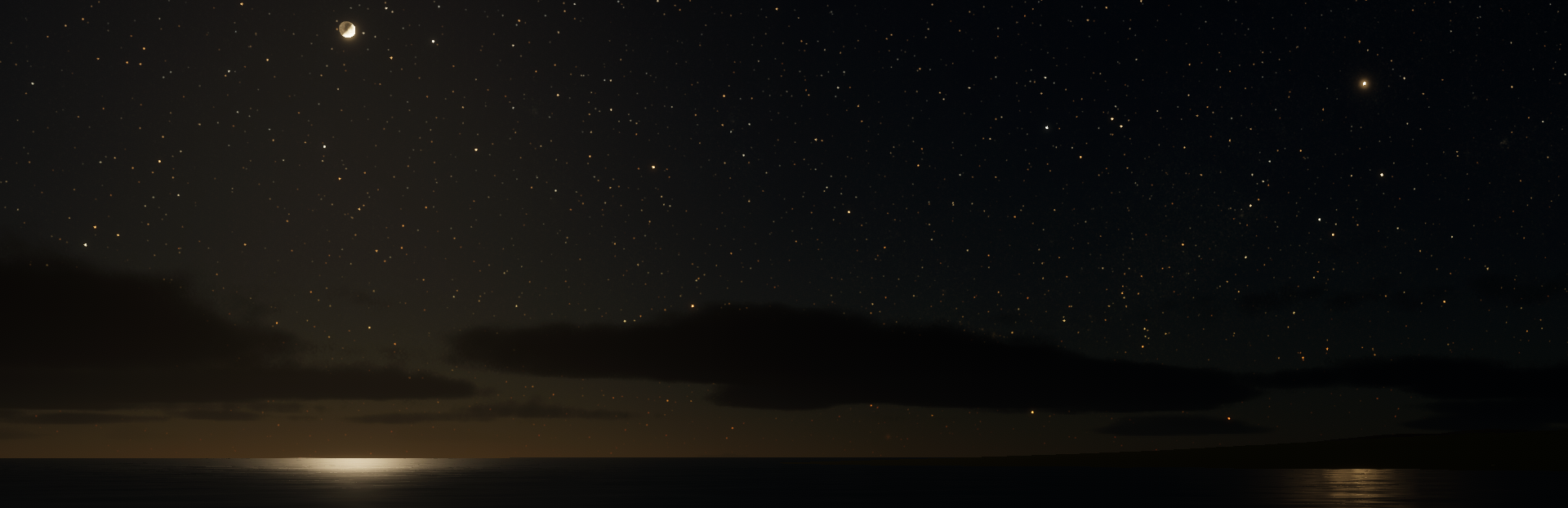
Satellites now cast light reflected from the Sun, which interacts with the atmosphere if the planet has one:
Nights would not be as dark as before at full Moon
It also reflects from the water:
You can even see somre reflections of stars and milky way on the water, but they are less stable currently, but this is a Unity-side issue. Maybe adding the raytracing support would improve it a lot.
Which is also visible from the orbit:
I never would have thought that making the bodies reflect sunlight would create a scenes with such stunning view. I also found a photo taken from the space station showing moonlight reflecting off the ocean's surface, and it looked very similar.
It is also worth noting that you will be able to find and see all major celestial bodies among the stars from Earth.
And finally, scaled-space and local-space atmospheric models and rendering have been unified. You can now see the atmospheres of Mars and Venus on the solar system map. Venus looks strange righjt now, because there are no clouds, but this will not be that big of a problem I hope to add in the future.
A bluish atmospheric scattering can be seen at the planet's edges. It also gives the entire surface a slight tint.
Rocket Assembly
I’ve added an offset mode. You can offset any part in this mode. While static attachments can adjust a part’s position slightly, parts with dynamic attachments can be moved anywhere on the rocket surface where they could initially be attached.
This is very usefull especially for planes to balance center of lift perfectly.
Parts can also be slid inside other parts. This is less realistic, but it opens up much more design space. But be careful: you can’t reduce drag this way, otherwise it would become the only correct way to build rockets.
More design freedom to the players!
Flight
This is another feature players have been requesting for a long time. Auto-stabilization systems can now use RCS. They also try to save as much fuel as possible. For example, if reaction wheels are loaded less than 20%, RCS will not be used. Auto-stabilization will also not use RCS if time warp is above 10x, because it needs to move a spacecraft into the physics simulation to do that.
It is always a good idea to attach even the smallest reaction wheel. This way a lot of monopropellant would be saved.
Because of the extended bug-fixing period, I was not able to finish many new parts in time. For now, only two of them are ready. But I am planning to spend next month working on incoming bug reports and finishing most of those parts, so they will arrive in one of the next patches.
Full patch notes, as always, below. Thank you for playing the game and for your support. Until the next update!
v0.25.7 release notes
Features:
🔸 added volumetric clouds; 🔸 new ocean rendering; 🔸 implemented buyoancy; 🔸 new stars rendering + all 119613 stars form HIG database now rendered; 🔸 new milky way; 🔸 updated atmosphere model; 🔸 other celestial bodies now interact with atmosphere and cast reflected light; 🔸 scaled space planets received atmospheres; 🔸 [Assembly] added part offset tool; 🔸 improved exposure and antialiasing; 🔸 returned SSGI and made it available in the game settings; 🔸 implemented RCS autostabilisation; 🔸 added FOV slider for the flight camera.
New rocket parts:
🔸 "Traveler" Probe Core; 🔸 Spherical Transfer Compartment;
Changes:
🔸 Updated game engine to Unity 6.0; 🔸 game stores keymaps now in settings.json instead of registry, and could fallback to defualt mappings when such will be added in the future (previously they remain empty); 🔸 RCS now respects resource groups and don't consume monopropellant from the whole craft ignoring pass resources state on docking ports / decouplers; 🔸 when enabling resource transfer on one docking port, it automatically stops on attached docking port to prevent race conditions; 🔸 [Assembly] part and symmetry selection no longer reset when switching between assembly modes; 🔸 removed unneccesary custom passes that were previously used for rendering stars and distant planets; 🔸 scaled and local space atmosphere models were unififed; 🔸 navball no longer switches off target state when there is more than 30 km distance to the target and flight state changed; 🔸 when main menu is opened, most of input actions will be ignored; 🔸 corrected thermo conductivity calculations by fixing mistakes in formulas; 🔸 part volume, area and voxels are automatically calculated on startup, which should make importing custom parts easier; 🔸 Controls Settings are now seaved in the Settings.json instead of registry, this allows to migrate controls in the future as well as keeps registry clean. 🔸 added new part category — space stations. 🔸 improved perfromance of UI rendering where many icons or images is used.
Part changes:
🔸 FT-8000 Fuel Tank, FT-7990 Fuel Tank and Side Fuel Block fuel volume approximately to 5-10% to match part volume. 🔸 deprecated "Azimuth" and "Axis" Station Branching Modules 🔸 docking port 0: changed shape; 🔸 updated model of "Energia-C8.95" Liquid Fuel Engine (thanks to @valzay)
Settings:
🔸 reset focus on map was changed from backquote to alt+backquote to be consistent with alt+c for reseting camera focus during the flight; 🔸 because of above pause now is just backquote without alt modifier; 🔸 added cloud settings.
Fixes:
🔸 probe core lose "control from here" flag when pass resrouces is changed on docking port; 🔸 resources still being consumed though two attached docking ports when one of them has pass resources off; 🔸 exception when trying to change something on engine before attaching to the rocket; 🔸 sync rotation hande on undo and redo; 🔸 reflection-like artifacts on planet surface when enabled SSAO; 🔸 Assembly: exception when reseting newly created rocket; 🔸 planet loose atmosphere when changing game settings; 🔸 skycrane hole and floating disk after separationg; 🔸 exception when switching between rocket and rover in flight; 🔸 one of spacecrafts disappears on docking if another is not has instrument not present on current one 🔸 ocean quads flickering when moving fast to the side on 50km altitude; 🔸 exception when loading debree into flight mode and then switching to any other active craft; 🔸 exception when detaching cryocoolers, when several of them are present on the rocket 🔸 rotation undo commands could fail when several similar parts are attached to the one parent; 🔸 spacecraft is not loading when rocket have more than 5 heat shields (and probably also crashing saved game); 🔸 infinite exceptions when trying to rotate part in some specific attachment configurations 🔸 quadruple symmetry not working on some attachments 🔸 Steam workshop mods can't be disabled; 🔸 "SaHO" Probe Core module: incorrect visual bottom sockets.
Known issues:
🔸 some spacecrafts could crash the game after falling into water (please send me rocket files for them).
Source
Changelog.gg summarizes and formats this update. How we read updates.