
Full notes
Full Red Dust Colony update
Read the full published notes in a cleaner layout. The original post stays linked below.
Repeated intro
Hello and welcome to our third devlog for Red Dust Colony
What changed
- Server
- Gameplay
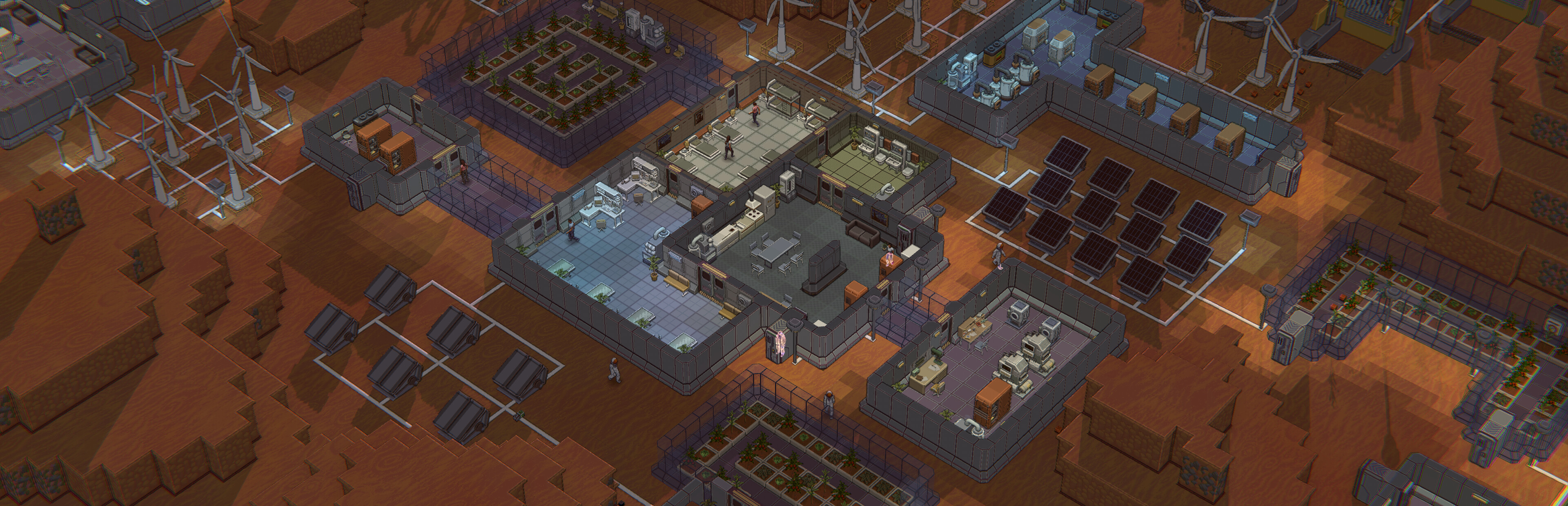
Last time I wrote, I spoke about our plans for the game and the playable demo. We realized that to be an engaging game, more content is needed. To address this, the entire content was redesigned and we set a comprehensive plan in place. Since then, things have been going smoothly and we've been tackling the required changes one by one. There's still a fair bit to do before we can release anything, but until then, I'd like to walk you through what we've worked on.
First, all the data had to be moved from paper, or in our case Figma and Google Sheets, to the game engine. For the buildings, build menu items, research entries, and categories, there's no other way but to manually go over each and set up everything. It's a tedious task, but it will only have to be done once. For some of the balancing data, however, the preferred editing mode is in Google Sheets because all data is visible at once, and formulas, graphs, and charts make the process smoother. There's some amount of back and forth between the game engine and sheets, so doing this manually is very error-prone. To overcome this, I've developed a system to automatically sync the data with essentially one click, communicating directly with the Google servers. Just to clarify, the system only runs on our own machines and is not included as part of the game in any way.
The next area that needed some attention is botany, but for that to work, first, plant plots needed to be further implemented. Water and fertilizer consumption have been modeled, as well as decay and rot, which, along with the botany skill of the colonist, all have an impact on the yield, or in some cases, the lack of it.
One thing that is still missing here is how light affects plant growth and yields, but this will have to wait for the Grow Lights to be implemented. Something I'd like to add here is either a spectrum or a "light quality" mechanic. The light system already supports a blend between the sunlight, which requires greenhouses to use, and the colored artificial light, which spreads around on a per-tile basis, so the bulk of this is already done.
Going along with the plant plots is the botany station, which is how the colony will learn to grow Earth plants using the limited resources of Mars and also to get better at it. When the game starts, players will typically only have access to a small selection of plants with problematic yields. Using the botany station, they'll have access to a number of projects, each requiring different degrees of involvement from colonists. If the project is successful, new plants will then be available or existing ones will be improved with better yields, shorter growth cycles, or reduced water and fertilizer consumption. The outcome of projects depends on the botany skill of the colonists. P.S: Note how the light system can be applied to any building. We expect to see more of this in the future.
Carbon will play a key element in the game, so it will first have to be captured from the air. While the CO2 Scrubber, which cleans up the air inside the base, does collect usable carbon, it won't be enough for the more industrial demands. For this, a Carbon Extractor is needed. Unlike the other one, this one uses significantly more energy and needs to be placed outside where it can directly interact with the CO2-rich Martian atmosphere. In exchange for this, the yield is not limited by the amount of CO2 exhaled by colonists. The visuals here are not final yet, but the logic is implemented and works fine.
As always, with every new mechanic added, extensive automated tests have been written to make sure everything is as expected. The satisfying thing here is that unlike when playing the game regularly, these tests can easily target edge cases that would be hard to reproduce otherwise. Also, as the coverage increases, I'm sometimes stumbling on various generic but hard-to-spot issues while playing the game, so the payoff for going through this trouble seems to be more than worth it. As more tests are added, though, the time it takes to run them keeps increasing, so I've started looking into how to improve things. With a few low-hanging fruit changes, the total time went down by around 60%. I still have a few ideas left, but this will have to do for now.
That's about it for today. Up next, food preparation needs some attention, so we'll start working on that. I hope you've enjoyed reading about the development of Red Dust Colony and we'll see you next time.
Source
Changelog.gg summarizes and formats this update. How we read updates.