
In this update5
Full notes
Full Observe update
Read the full published notes in a cleaner layout. The original post stays linked below.
What changed
- Gameplay
- Maps
Observe changes
We have gotten a lot of new players over the past few days. Welcome, all of you. Let's get into it.
Scenario Editor
Rulesets
Until now every scenario played by the same rules. From this update, you choose them.
Open Settings in the Scenario Editor and pick a preset: Classic for the game as it has always played, Realistic for a slower, more deliberate world, One-Shot for a map that resolves in minutes, or Chaos if you would rather it did not make sense.
If a preset is close but not right, open the foldout and set the rules yourself. How long the world stays at peace before anyone can declare war. How much more expensive war gets as more of the world fights, so peace is cheap and chaos costs. How many wars one country may hold at once. How long truces last. Income and starting armies.
Two of them change how empires hold together rather than how they fight. Conquest unrest decides whether swallowing land destabilises you, so you can build a world where conquerors administer what they take, or one where they never have to. And you can switch civil wars and independence uprisings off entirely, if you want empires that only ever fall from outside.
Scenarios that do not name a ruleset now play as Realistic.
Alliances before the first turn
You can build pacts in the editor and have them exist from turn one, rather than waiting to see whether the AI happens to form them.
You can also lock a pact, and then nobody leaves it. No betrayal, no drifting apart when one member gets too large. If you want a bloc that holds for the whole game, you can simply say so.
In Game
The god controls got the largest expansion in the game's history.
Found new nations mid-game
Click regions on the map to give a country its territory, then name it, colour it, choose its ideology and set its army and technology. It arrives with figures drawn from the world average.
Aim a country's nukes yourself
Mark targets on the map, watch which silo is assigned to what, and launch the whole salvo at once. Every silo fires once per turn, so the size of a strike is the size of the arsenal that country built.
Take a country's decisions off its AI
Switch its diplomacy or its nuclear policy to You, and it stops acting there. Useful when you want to aim an arsenal without the AI spending it first, or hold a war open that the AI would have ended.
Plus make peace between any two nations, incite a rebellion inside one, and add warheads, missile silos or money.
Reading the world
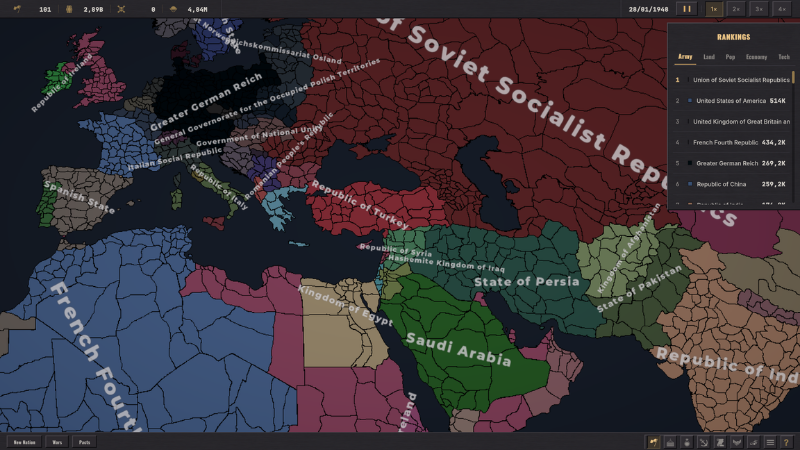
A command bar now runs along the bottom of the screen, and the map modes live on it with everything else.
War rankings list every war being fought, ordered by the dead on both sides, so the conflicts actually deciding the map sit at the top. Click one for its full report.
Pact rankings do the same for alliances, ordered by combined strength. Open one and you see its members, what each of them is worth, and everyone they are fighting.
There is also a fourth game speed, for when you want to skip ahead rather than watch.
Fixes
Buildings are visible on the map. They only ever appeared during development, so no released version had them.
The AI invades its neighbours. It used to pick overseas targets by who it could beat, which meant fleets sailing past a dozen closer nations to attack whoever happened to be weakest. It now chooses from the countries actually near it, with the occasional long-range expedition kept in because those make for good stories.
The speed settings do different things again. Every step above the first used to run at much the same pace. The game also starts at 1x now.
The Alliance map mode greys out unaligned nations, so blocs stand out instead of blending into the political map.
Breakaway states survive. A nation that won its independence used to treat its own homeland as occupied territory and slide straight back toward collapse.
Thanks for supporting Observe.
Source
Changelog.gg summarizes and formats this update. How we read updates.