
In this update2
Full notes
Full Noble's Life: Kingdom Reborn update
Read the full published notes in a cleaner layout. The original post stays linked below.
What changed
- Gameplay
- Compatibility
Noble's Life: Kingdom Reborn changes
- Ancientmap
Dear nobles,
in order not to build up tension, we will write right away - a free Noble's Life Prologue will launch on 16 December!
It will include not only the previously presented game fragments, but also battle mechanics. We will write more about it in the next news before the prologue's premiere itself, at the beginning of next month.
In the meanwhile, we are fixing bugs, making the graphics more interesting, improving the animations and adding voice acting, all so that you can see how much progress we have made since the beginning of this year! Just to point out that although this will be a beta version already, so the quality will be higher, it's still not the final version, because the most polishing will be done at the very end.
So much for the announcements, and now on to the subject of the Dev Diary. Some of the mechanics described here will be available to try in the prologue.
Judge, jury and executioner
An aristocrat, a landowner, had great power over commoners, ordinary peasants and townspeople under him. In comparison to nobles, clergy or even guild members, they didn’t have any real possibility to appeal to their Lord’s decisions. What’s more, other aristocrats would defend such a state of things.
It’s worth mentioning that France was unique in a way because in the 11th century a so-called feudal revolution happened, breaking or fragmentation of authority, whose effects would be going on for several centuries. As a result, in numerous parts of the kingdom minor feudal lords would claim rights to many areas of life, including lawmaking, judging according to it, and punishing.
And the player’s character is noble exactly like that. Even though he answers to his senior, he has a lot of liberty of action towards the representatives of the lowest status.
Punishment
Especially since the baron we play as, like many others similar to him, has his own, initially very modest, personal army. In other words, people trained to fight, ready to fulfil his orders and enforce his will by force.
Noble’s Life offers numerous options of punishing those that the baron considers guilty. For example by fining. Maybe not the most impressive, but a quite effective solution. It can also be useful for improving the budget, although, obviously, stealing from one's own subjects in different ways may not be the perfect method of ruling in the long run.
Another common punishment was putting in the stocks, one of many available corporal punishments known already in ancient Greece. Criminals confined in them suffer not only from being outside in one position and usually without food, but also because of other people. There are many mentions of name calling, spitting, kicking and even tickling those put in stocks.
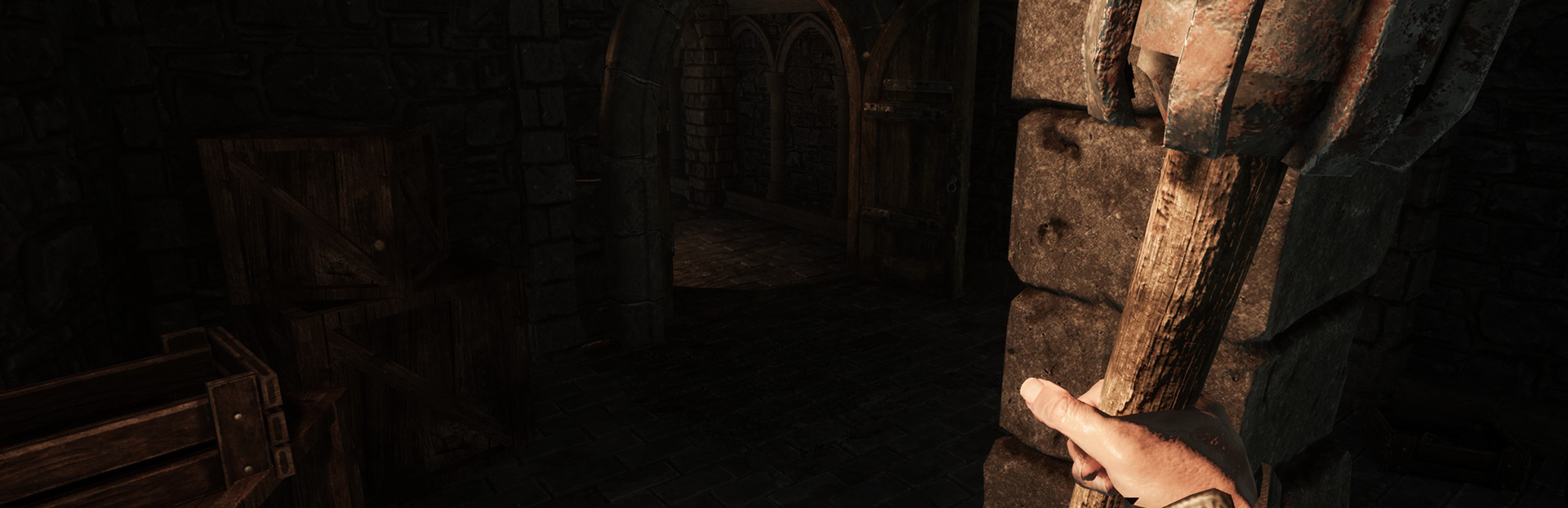
But this punishment, if it didn't last too long and one didn't come across a sadist among their fellow residents, wasn't as bad as being put in a dungeon. It being the place where you waited for your sentence or torture was not the only reason for that.
A complete or almost complete lack of sunlight, cold, moisture and stench could break almost everyone, and some prisoners were locked for many years or even for life. This, however, was not that common since providing for a captive cost a lot. Hence, as some mediaeval documents phrase it, the wardens would sometimes forget to feed the prisoners and in this terrible way their fate was fulfilled.
The player’s character can visit the convicts in the dungeon, although he should expect to hear mostly pleas for mercy that, if the player wants to, can show.
There were also mutilation punishments. The convicted had a part of their body related to the crime removed. Hence, for example the tongue was ripped out for lying or the hand was cut off for theft.
Lastly, the most severe punishment - death. Such execution could be a real bloody spectacle for the entire community, and it was often carried out by an executioner (who would also perform aforementioned mutilation or torture). In the beginning of the game in the player’s character’s city there is no such specialist, but the baron can simply put the convict in the dungeon so he can wait for a wandering executioner to take care of him.
Apart from punishing the guilty, the baron can use the public interest to build a narration favourable for himself.
Punishing someone with death can help to show that the ruler doesn’t tolerate some behaviours. Ultimately the player decides what kind of noble they want to be, hence, if they want to rule by the use of fear, this may be a proper solution.
However, a reputation of a brutal ruler can make certain problems invisible until they explode with full force. For example, peasants, after their representative is hanged, can pretend that everything is fine until the situation becomes so bad for them that an armed revolt begins to seem like the only way out. Ultimately, the quintessence of the game is the decisions and their consequences.
That’s all for today. Next Dev Diary coming soon, with more about the military!
Source
Changelog.gg summarizes and formats this update. How we read updates.