
Update log
Full Neverseas update
The complete published notes, normalized for clean reading and source attribution.
Extracted changes
- Performance
- Gameplay
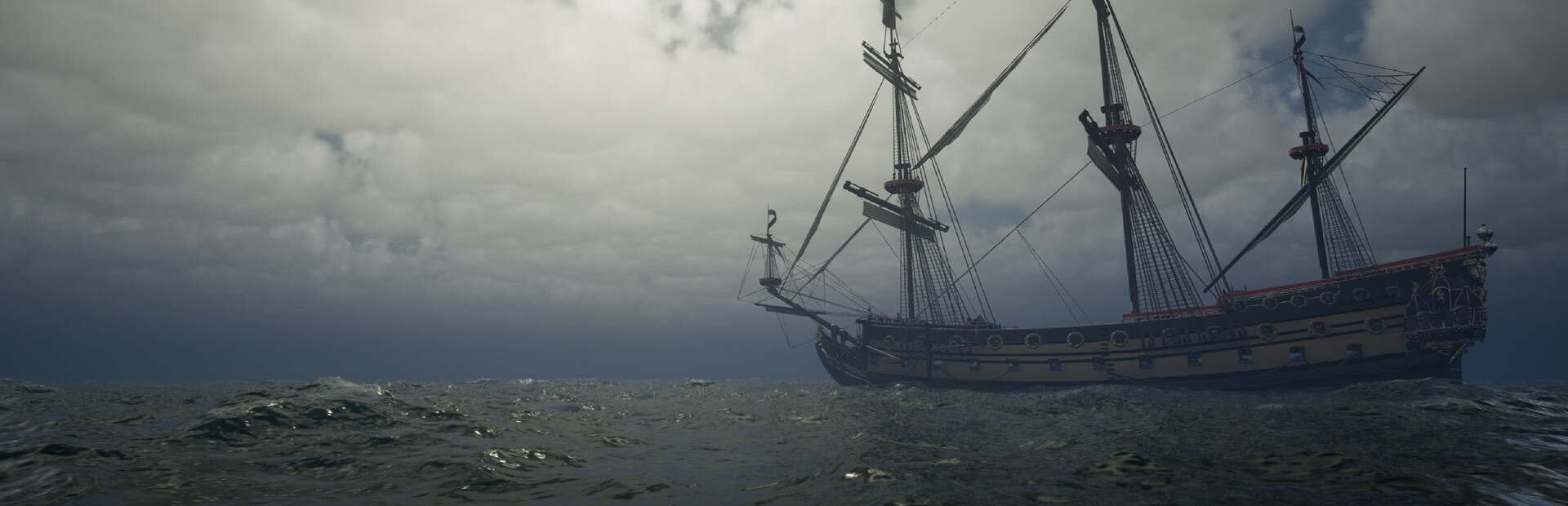
Galleon — the Glory of the Neverseas
Galleon — a large multi-deck sailing ship of the 16th–18th centuries with substantial artillery armament, used both as a warship and a merchant vessel. The origin of the word “galleon” goes back to the Spanish “galeón”, which is an augmentative form of the Latin “galea” — “galley.” In other words, a galleon is essentially a “large galley.”
The galleon was the most advanced type of sailing vessel that appeared in the 16th century. This type of sailing ship emerged through the evolution of the caravel and was intended for long ocean voyages. Combining a full-rigged setup (three masts) and a large hold, the galleon became one of the most sought-after ships of its time.
The reduction of the forecastle superstructure and the elongation of the hull led to an increase in stability (a measure of a ship’s steadiness on the water — in fact, it was due to problems with stability that the Swedish Vasa sank on her maiden voyage upon leaving port), as well as to a reduction in wave resistance. As a result, the galleon turned into a faster and more maneuverable seagoing vessel. The galleon differed from earlier ships in that it was longer, lower, and straighter, with a square stern instead of a rounded one.
Once upon a time, we could not even think that we would get together and create such a concept for you. We read books about sea voyages to the holes, watched the same movies hundreds of times, and still didn't even know each other. But, as the morning salty breeze refreshes, so we were introduced and united by the craving for the sea, its dark depths and the treasures of uninhabited islands, the trials of which are amenable only to the brave.
Our creator, Alexey "AVG" Vasiliev, created another work of art for us.:
[carousel][/carousel]
He is the ruler of the seas and oceans. He is impeccable both in the port, which has assembled the rigging, and at the zero meridian in complete calm. An aggressive conqueror of the waves flaps the sails in anticipation of a tailwind:
- The galleon becomes the basis of the fleets of the Spaniards and the British. The stem, strongly curved and elongated forward, had decorations and resembled those of galleys in shape. The long bowsprit carried a blind sail. The forward superstructure was pushed back and did not hang over the stem, as in the karakka.
[carousel][/carousel]
- The aft superstructure, tall and narrow, was located on the cut-off stern. The superstructure had several tiers, which housed the living quarters of officers and passengers. The heavily sloped stern had a transom above the cargo waterline. The stern was decorated with carvings and balconies.
- Depending on the displacement, galleons were built with a number of decks from two to seven. The side of the vessel from the keel to the cargo waterline had a large collapse, and to the upper deck there was a blockage. At the same time, several tasks were solved: the load capacity increased, the transition from ship to ship during boarding became more difficult, the overall strength increased; the force of the waves hitting the side was softened, since the wave was reflected upward, and the hull did not experience its direct impact.
- The galleon was armed with up to 30 guns of caliber from 3-pounders (6 cm) to 50-pounders (19 cm) and a significant number (up to 100) portable blunderbusses for firing through loopholes
Source