
Full notes
Full Never's End update
Read the full published notes in a cleaner layout. The original post stays linked below.
What changed
- Balance
- UI and audio
- Gameplay
- Store
Hi everyone, welcome to our new Dev Diary for Never's End!
I'm Ryan, the game director, and this time I'll be talking about the game's art direction and the reasoning behind our design and artistic choices.
When shaping the world of Never’s End, it has been important to find the right balance between cute and dangerous. It's a deep tactics game with several dark themes, and I wanted the aesthetic to have an element of maturity while also being more inviting than most tactics games of this complexity. We have placed a strong focus on creating a game with deep systems that's also accessible to a wider audience, and the visual design is an integral part of this goal. One of our earliest guiding references was imagining what “Chibi Bloodborne” might look like. This is most apparent in some of our earliest concepts for weapons and outfits. Steam post image
Practical Armor
A core principle of our outfit design is practicality. Armor and clothing should look functional and defensive rather than ornamental or revealing. We avoid designs that expose unnecessary skin or lean into a “sexy” fantasy style. Instead, every outfit should immediately communicate protection, weight, and material. This visual clarity is especially important in combat. Attacks can strike either the head or the body, which are respectively protected by your clothing or hat, and damage is affected by the material of those items. A club is going to do more damage to metal armor than to cloth, and thus it needs to be obvious whether a piece of gear is made from linen, leather, or iron. For example, pairing a leather shirt with metal boots would create confusion about what the body is protected by because you equip your shirt, pants, and boots as one item. In contrast, metal armor with leather boots is more clearly a metal item because the largest visual element (the torso) is also the heavier weight material.
Steam post image
A Blend of East and West
While Never’s End is set in a medieval world, we’ve worked hard to avoid falling into a “generic fantasy” look. I wanted the designs to feel familiar yet distinct to our world. We draw inspiration from a mix of European and East Asian influences, creating a world that naturally echoes the atmosphere of classic JRPGs, which take place in European-inspired settings while still retaining hints of cultural influence from where they were developed.
Magic and Mystics
Magic in Never’s End doesn’t take the form of flashy spellcasting. Instead, it reflects a connection with the laws of nature. A practitioner might manipulate heat or influence currents by modifying nature itself. Instead of casting fireball spells, you manifest the conditions for fire. To better communicate this distinction, I wanted to pull our magical outfit designs away from traditional high-fantasy robes. Instead, we focus on designs that feel more connected to mysticism and occult symbolism. They create a more grounded look to match our science-based supernatural powers. Steam post image
Outfits of the Golden Age
Before humanity lost its war against the Never, the world wasn’t as bleak. In its golden age, society was more cultured, powerful, and filled with artisans. Players get to see some glimpses of the past world through flashbacks, and the outfits from this era reflect that past sophistication in their style and patterns. Steam post imageSteam post image
Designing for the Grid
Our grid-based combat system requires clarity in design. Creatures and enemies are stylized with chunkier proportions to ensure they read well from above and at small scales. This works well with our goal to mix the cute and creepy. Designs often have unsettling details within cute proportions. You might want to hold them, but on closer inspection, there is something a little off...
Temples
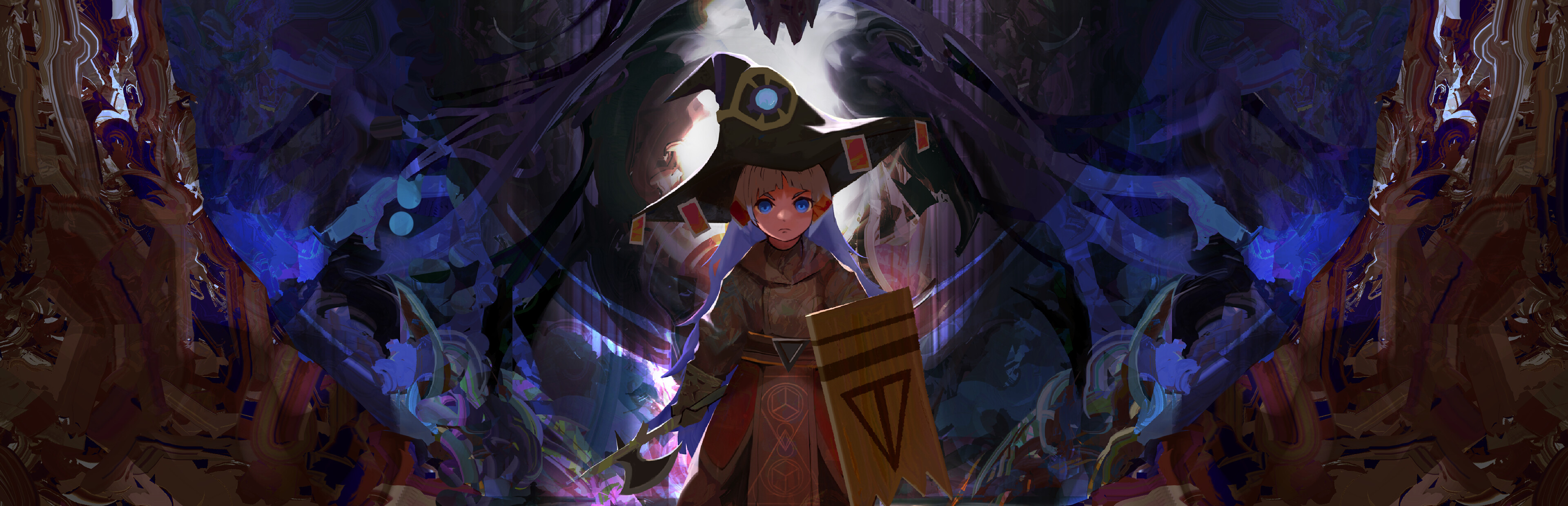
Temples are focal points in the game world. The game begins at the last surviving human town near the Fire Temple, and you will hunt down the other temples to acquire more magic and uncover what happened when the world lost its battle to the Never. The designs of each temple combine details of European churches with the elemental symbolism of the Godai from Japan. The Fire Temple, for instance, takes the form of a pyramid and features triangular design throughout the structure and as part of its followers’ outfits.
Form and Function
We aren’t just designing a world that looks cool. We want a world that not only captures the eye but also serves our narrative and game design needs in a cohesive fashion. It needs to be visually clear what material every object is made from. If something looks like it can be picked up, we let players pick it up. If clothing provides protection, it needs to look protective. If an object blocks movement through the grid, it should appear large enough to do so. And the list goes on. Through this balance, we’re building a world that feels readable, unique, inviting, dangerous, and unsettling.
And that wraps up our dive into the art direction of Never's End! We're very excited about how our world is coming together, and I hope this gave you all a better sense of what we're working on.
We still have plenty more to share, but in the meantime, we'd love to hear your thoughts. Which designs do you find the most appealing? How would you describe our art style? What would you like to see next?
Thank you so much for always following along. We're really grateful to share our journey with you all!
Be sure to hop onto our Discord, subscribe to our newsletter, drop a comment below, and follow us on our socials for more updates and fun content!
See you next time,
Ryan
Source
Changelog.gg summarizes and formats this update. How we read updates.