
In this update7
Full notes
Full Master of Piece update
Read the full published notes in a cleaner layout. The original post stays linked below.
Repeated intro
Hello, Commanders,
What changed
- Gameplay
- Maps
- Balance
- Events
Master of Piece changes
This is I M GAME.
In today’s Developer’s Note, rather than introducing newly updated content, we would like to look back on the journey of how Master of Piece has been developed so far.
Master of Piece was not a game that began development with every part of its design already finalized. Rather, it is a game that has gradually taken shape over the course of about three years, through countless revisions and experiments in many different directions.
So in this post, instead of simply listing changes, we wanted to first talk about the thoughts, decisions, and turning points that led us to where the game is today.
For us, this record is not only a way of organizing the path we have taken so far, but also a way of showing what kind of mindset we have as we continue working toward completing Master of Piece.
By sharing the long process of trial and error, the many changes we made along the way, and the direction we held onto throughout it all, we hoped to convey our sincere desire to make this game into something even better.
It was around three years ago that Master of Piece truly began development in earnest.
At the time, we were planning to make a mobile game rather than a PC game, and the genre we had in mind was also far more casual than it is now.
In the early stages, with only a small team, we tried out many different ideas and gradually refined the direction around the ones we believed were fun.
As that process continued, both the platform and the genre changed as well, and the current Master of Piece was built through the accumulation of those decisions.
Now, let us take a look back at the major versions in chronological order and talk through the changes one by one.
1. Validating the Core Idea
(March 2023)
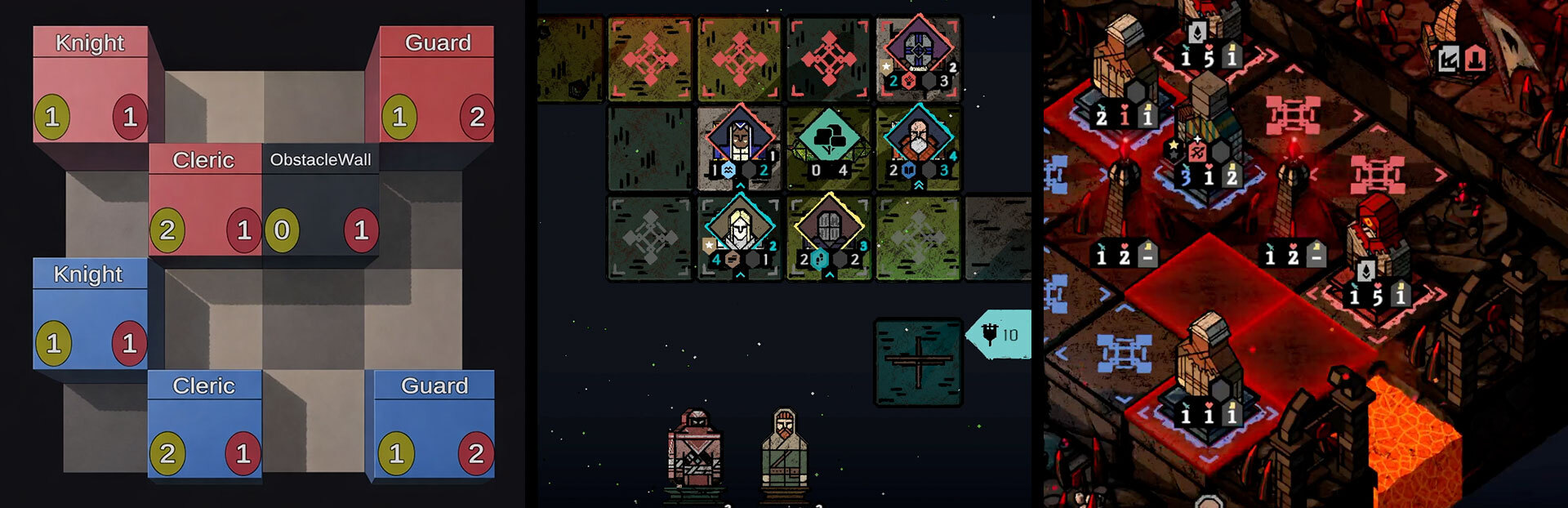
The version from this period was being developed under the name Swipe Match.
There was also an even earlier Swipe Match prototype before the one shown here—a casual game where, much like 2048, you would swipe blocks left and right to build up strength and consume red enemy blocks.
At that stage, we set aside the game’s worldbuilding and detailed setting for later, and focused instead on verifying whether the core structure itself was fun.
So, with only left-and-right movement and the bare minimum of stats implemented, we first tested a system where blocks were placed and then fought against other blocks in the same row.
Once we felt that this structure had potential, we began gradually adding elements such as obstacles and special abilities.
Looking back from today’s perspective, those special abilities can be seen as the earliest form of what would later become the mercenary traits in the current game.
2. Masterpiece: Mobile
(2023년 5월 ~ 2024년 4월)
This version was the stage where we took the framework of the prototype introduced earlier and began building on it in earnest by adding a medieval fantasy setting and the premise of hiring mercenaries to embark on an expedition.
From the footage alone, it may not look drastically different aside from the improved visuals, but in reality, many of its systems were quite different from those of the current Master of Piece.
At the time, we had come up with the title Masterpiece, inspired by the idea of leading pieces on a journey, while also carrying layered meanings such as “master of the pieces,” “the final piece,” and “a masterpiece.”
Combat
The basic rule—destroy the enemy flag to win—was the same as it is now.
However, back then every battle had an 8-turn limit, and if neither flag had been destroyed by the end of turn 8, the side with the higher remaining flag HP would be declared the winner.
Expedition Resources
At the time, there were three expedition resources: Fame, Morale and Silver.
These resources could be gained or spent through content similar to the current building events and card events, and they always had to be maintained above a certain level. If even one of the three dropped to 0, the expedition would fail.
Camera Perspective
As shown in the footage, during this period the game switched between a top-down view during preparation phases and a quarter view during battle.
Looking back now, it was quite an inconvenient choice.
At the time, we believed that a top-down view would feel more comfortable during deployment, much like when playing chess or janggi, while a quarter view during combat would better showcase the field and the design of the pieces, adding more visual appeal than a flat top-down presentation.
It sounded reasonable at the planning stage, but in practice it turned out to be a poor decision both from the player experience side and from the development side.
From the gameplay perspective, constantly switching perspectives during battle made the experience more confusing and harder to focus on.
If we had to compare it to something, it felt a bit like trying to play chess while someone next to you keeps grabbing the board and changing the view angle every ten seconds.
From the development side, it was also a major issue.
Whenever we added combat effects such as attacks, hit reactions, or death animations, we had to make them work for both perspectives at once. And the overlap between “visually interesting” and “natural from both angles” was far smaller than we had expected.
In the end, we decided to keep only the quarter view, and the top-down view remains only as a record in this Developer’s Note.
From Mobile to PC
(May 2024)
After about a year of development, once we had a playable build ready, we ran a CBT with volunteers from the gaming community.
Many of the improvements mentioned above were refined through the feedback we received during this period.
Around this time, there was also a tile effect system in the game, separate from the current obstacle system, designed to introduce additional variables into combat.
Steam post image(Tornadoes on the tiles were the tile effects back then.)
This system was mostly designed around negative effects for the player, and not only was the tile on which it activated random, but the tile it moved to over time was random as well.
However, through CBT we received a great deal of feedback that this heavy RNG element created frustration. We continued revising and trying to improve it even into the demo stage, but ultimately the system was removed.
For example, it included effects such as:
Fog: Mercenaries affected by Fog lose 1 Speed.
Sandstorm: Mercenaries affected by Sandstorm become Vulnerable.
Lightning Strike: At the start of the round, lightning strikes the tile and Stuns the mercenary on it for 1 turn.
(This idea was later reworked in a different direction into the Terrain system, a gimmick that players can actively make use of. We will be sharing more details on this in next week’s update preview.)
The most important conclusion we gained through the CBT was that this game fit PC far better than mobile.
Internally, we had already been concerned that on mobile it would be difficult to design a business model around free-to-play monetization, while at the same time we did not believe the game had strong market potential as a premium mobile title.
On top of that, many CBT participants also told us that the game seemed much better suited to PC than to mobile.
We also believed that deckbuilding strategy was a genre with clear demand on PC, while the supply remained relatively limited, and with that in mind, we made the bold decision to shift the platform to PC.
Toward Its Current Form
In this post, we first looked back on how Master of Piece began and what changes it went through before becoming the game it is today.
Looking back, this stage of development was not only about building something up, but also about learning what needed to be removed and which direction we should choose.
By today’s standards, many of those earlier elements may feel unfamiliar or unfinished. But we believe that it was precisely because of those experiments and failures that our current direction was able to become clearer little by little.
In the next Developer’s Note, we will continue from the point where the game transitioned to PC, and talk about how the structure that more closely resembles the current Master of Piece gradually came into place.
Source
Changelog.gg summarizes and formats this update. How we read updates.