
Full notes
Full Magic Thief update
Read the full published notes in a cleaner layout. The original post stays linked below.
What changed
- Gameplay
- Maps
- Compatibility
- UI and audio
The history of work on the game began in early 2021. The original idea and the first prototypes involved: a secret scientific laboratory, experiments with biological weapons and mutant beetles. As the development progressed, it became clear that the quality level of the resulting product leaves much to be desired, and the setting is quite specific. Based on these and other reasons, it was decided to restart the development.
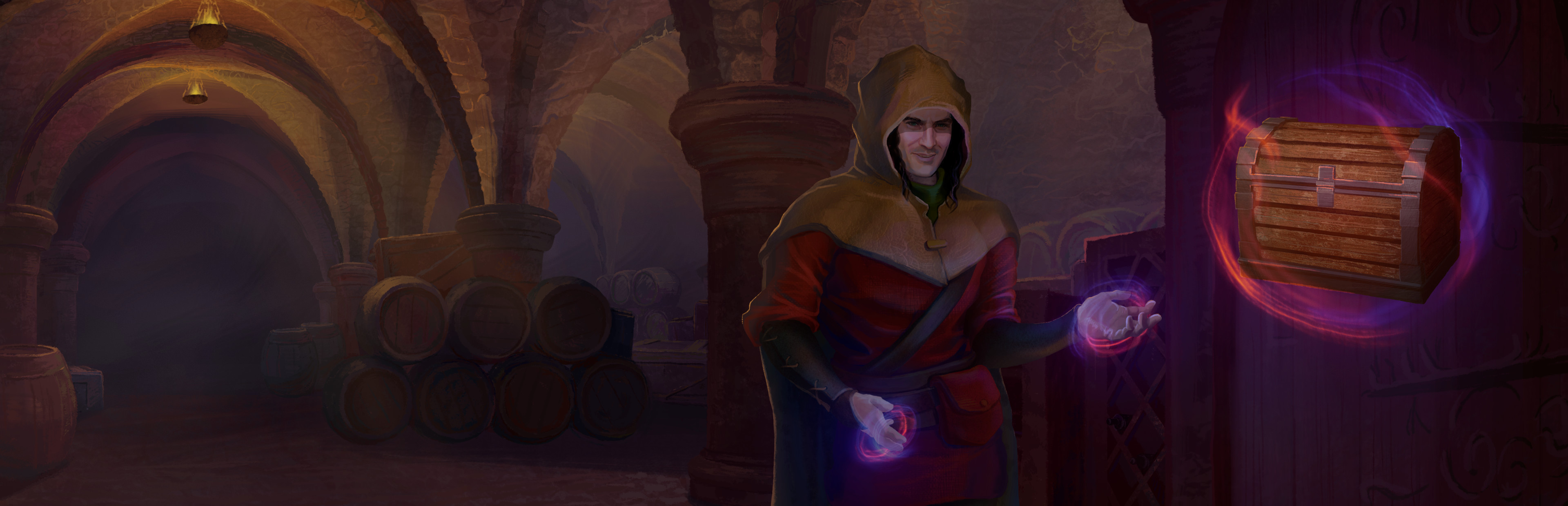
By the summer of 2021, ideas were formed about the basement of the tavern, where barrels and chests were the cells that the player would click on. Gradually, overgrown with details, the setting of the magical Middle Ages was formed. The usual bombs in the game have been replaced by magic crystals. Tools for interacting with the playing field have been added — magic.
It was decided that the player's adventure would take place in the following locations: tavern storeroom, dungeons, caves, crypts and the void. The terrain around the player changes every 5 levels, while each level is unique in terms of the location of crystals, although it is within its environment. Locations differ in appearance and, mainly, in the size of the playing field. If at the beginning of the game the field is a simple square matrix, in the future both voids and, in principle, areas separated from each other appear in it. Taken together all this changes the usual rules of the game quite well and adds variety.
Unlike the main team of two people, the 3d environment artist who joined at the beginning of development had almost no experience and studied during the development of the project. The first versions of the tavern, still without materials and textures, the chest and other game objects of the location are shown in the figures below.
When the 3d artist sent ready-made models from which it was possible to start building a tavern pantry, we faced the question of lighting. Previously, our games usually used a single light source. Here, the task was to illuminate a large location, while not losing the overall atmosphere. Torches and lamps hung on the walls were not enough — they illuminated the level at the edges, but not its central and main part for the gameplay, so levitating crystals were invented that move over the playing field and are additional sources of illumination.
When the work began, we almost immediately showed the first frame of the game - a staged scene that is not directly related to the game and does not demonstrate the gameplay at all, where we simply placed all the game objects we created at that time. After receiving the first reviews, they immediately fixed the walls, making them "more wooden". Subsequently, as the development progressed, the skills of our 3d artist increased, and we returned to previously created models, remaking them in one form or another, improving the overall quality.
After the completion of work on the tavern, we began to work out the dungeons. Here, a "clickable" object, along with a chest common to all levels, became a box "with good": gold, shield and sword, jewelry. The level itself was a dungeon, in the truest sense of the word. In the dungeons there were various types of cages that served as a prison, chains and iron maidens.
The next location visited by the player is the goblin caves. Probably the most magical and mysterious. It is a space with stone vaults and boulders, where magic mushrooms grow, which serve as sources of illumination in the location. The unique cells are dragon eggs.
Royal Crypts is the fourth of five locations. Among the objects on the level there are sarcophagi and flags of royal families. The cells on the level are bowls with gold and silver.
The last location is a mystical space - void, where the main character of the game gets during his journey, finding himself in his native magic school. The level zones are disparate, but they are a common playing field. The biome is based on the magical alma mater of the main character, where you, in his person, will meet a large number of objects inherent in any educational institution - cabinets, books, chairs, paintings and other interior items.
Gameplay - crystals and wizardry
As already mentioned, the bombs in our game are magic crystals. They are different and each performs its own function. Simple classical ones, of course, are also present, so that the player can gradually get involved first in an ordinary minesweeper (recall or learn), and then immerse himself in unusual conditions for the genre.
As the game progresses, the player will encounter:
The classic crystal - is a simple bomb, clicking on which leads to defeat.
Mimic - is an analogue of the classic, masquerading as other objects and blocking the use of a certain type of magic.
Invisible - is a bomb, like a mimic, on which one of the types of magic does not work.
Teleporter- moving from cell to cell. And when this happens, the numbers around her become replaced with questions.
Antimagic - blocking any interactions with the area around.
Anomaly - when interacting creates a wave of energy that activates neighboring cells.
Now more about charms and magic. From the name of the game it is clear that our game is about a thief-wizard. Therefore, it was logical to make the magic of theft his main tool. The use of this kind magic allows you to steal whole cells, regardless of whether there is a crystal inside it or not. Theft has several purposes. The first is to safely open the cage and update the information about the number of bombs around. The second is quests, which we will return to later. Theft magic cannot be used on mimics - it activates.
The second magic - "Sensitive Powder" - is used for exploration. Magic particles are created that show whether there is a crystal in the cell or not. This spell doesn't work against invisibles.
The third magic works in conjunction with the fourth. When the one allows you to freeze the time in the cell in order to open it safely, the other allows you to turn back time if there is still a crystal inside.
In total, 30 levels and 6 quests have been developed which include: 25 campaign missions with a through plot and 5 classic levels - i.e., an ordinary minesweeper with a simple bomb and a gradation of the field size. Since the game is based on procedural generation, each level in it is unique.
Quests are needed to get upgrades. Different types of containers are presented in the game as cells that the player will click on. Their diversity, in addition to visual, has a functional purpose.
First
by the type of cell, the player can assume whether it is a mimic or an anomaly, because mimics are always chests, and anomalies can only be found in magic boxes. The second is to make them an analogue of game currencies that you can earn by stealing and giving away on a quest. For example, to give 20 chests or 10 barrels of wine to get a reward - an upgrade of magic or something functional.
For example
reduce the price or get additional free points for use of magic, or the game will help with the first move and automatically place 3 flags. Quests, as well as the game plot, are represented by a small passage of text telling a story from the world of the game.
User interface
There is no artist in the team, so all our interfaces consist mainly of primitives, with styles applied to them. Colorful transitions, brushes and any artistic effects are not for us. Nevertheless, in all games we try to get the most decent result that will suit the whole team. We decided to make the Magic Thief interface in the style of letters on parchments or sheets of paper. Materials from Kingdom Rush Frontiers, Fable were used as examples and references.
Steam post image Steam post image
The first versions of the buttons for using magic, like the interface, were made in a “paper” version. There were experiments with both form and appearance.
Having brought the development to the stage when we were able to share the first screenshots, we received the opinion of the players that the color of the numbers we chose on the playing field (a smooth transition from pink to red, as the number increases and the danger to the player increases) is no good. They assured us that they did not see magic, the effect of which we were trying to achieve, but the neon effect. After methodically ignoring the problem, the game designer gave up and still decided to make adjustments. Initially, the numbers were "flat", with a post-processing effect on them. The new versions of the numbers have changed their color, font, and also have become voluminous.
After the numbers acquired a new look, the changes also affected the flag. The old one, although it was minimalistic, tended to get lost against the background of fairly highly detailed cells. After making a decision on the replacement and testing various options, the choice was made in favor of a flag in a circle on a black background, distinguishing it from game objects.
Source
Changelog.gg summarizes and formats this update. How we read updates.