
In this update2
Full notes
Full LTA: Light-years! Thrusters! Action! update
Read the full published notes in a cleaner layout. The original post stays linked below.
What changed
- Gameplay
- Maps
LTA: Light-years! Thrusters! Action! changes
What is the game about?
In very short terms, I draw inspiration from the games that influenced me the most: FTL, RimWorld, Dwarf Fortress, and Sid Meier’s Pirates!
The core idea is this:
You start by generating a galaxy with its own history — civilizations, states, factions, conflicts. Then you choose a scenario (for example, delivering cargo across the galaxy), build a spaceship (either manually from parts or randomly), generate a crew (RimWorld-style), and head into space.
From there:
You can travel through space
Land on planets
Fight ship-to-ship battles
Trade
Manage your crew (food, clothes, medical care, salaries — or they might revolt)
Some resources only exist in space, others only on planets. For example, you can’t upgrade a ship while in space — you need planetary infrastructure.
Or… you can ignore objectives entirely and just play it as a sandbox.
That’s the concept. I honestly don’t know exactly what it will become in the end — but I have a direction now.
How it started vs where it ended up
Originally, I just wanted to make a small space flying game in a couple of evenings, using AI-generated art.
Then I thought:
“What if it’s like FTL, but with physics-based space flight?”
Then I didn’t like the visuals and redid the graphics
Some assets I drew myself, some I bought
Then I saw a cool mechanic somewhere and thought: “I want this in my game”
And so, step by step, the project grew far beyond “just flying and space combat”.
Eventually, a proper game concept emerged, and that’s what I’m building toward now.
What’s already implemented
I’ll try to list everything without forgetting anything
Galaxy & World Generation
A galaxy is procedurally generated using configurable parameters
The galaxy consists of sectors connected by major hyperspace routes
Each sector contains star systems
Each star has parameters:
Mass
Luminosity
Energy output
Star type
Planets orbit stars, each with their own parameters
Asteroid belts and other space objects can appear in systems
Historical Simulation
After world generation, a historical simulation runs:
Hundreds of years are fast-forwarded
Civilizations rise and fall
Fleets are built and destroyed
Factions fight over sectors
Settlements are founded and abandoned
All of this history is stored as data and later affects gameplay.
Examples:
If a battle happened long ago in a system, you might find fleet wreckage
If a settlement once existed, you may discover ruins on the planet
For now, this mostly exists as data — but it will increasingly shape environments and encounters.
Ship & Crew
You create a ship manually from parts or generate one randomly
Crew members are procedurally generated (RimWorld-style)
Each crew member has strengths, weaknesses, and skills
Scenarios
Currently only one scenario is playable: Free Play
More are planned
Space Gameplay
Full freedom of movement in space
Sector map with star system travel
Hyperspace gates allow travel between sectors
Galaxy map shows which factions control which sectors
Friendly and hostile factions exist
Hostile ships can attack
Ships can be equipped with weapons and shields
Resources can be mined in asteroid belts
Planetary Gameplay
You can land on planets
When landing, a schematic planetary map is shown where you choose a landing zone
Planet parameters affect surface generation
Each planet has:
Its own atmosphere
Its own day/night cycle (not Earth-like)
Unique atmospheric color affecting ambient lighting
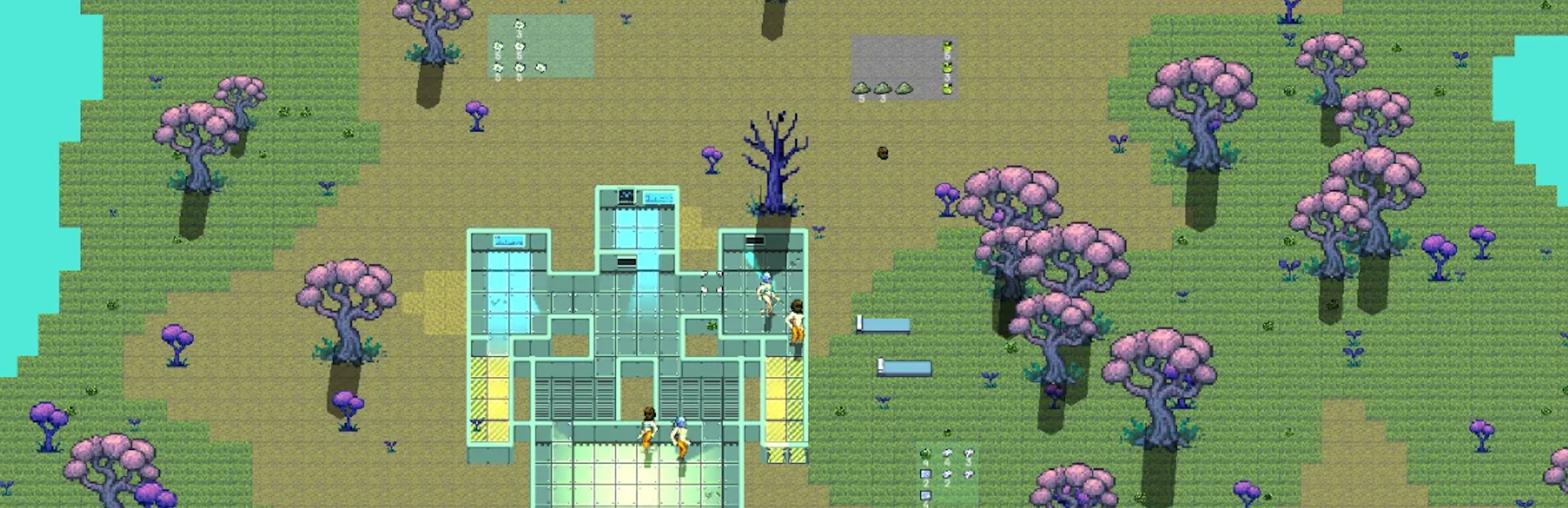
On the surface:
Vegetation and animals exist
Large objects cast shadows depending on the planet’s time of day
Plants grow and wither
Source
Changelog.gg summarizes and formats this update. How we read updates.