
Full notes
Full Line Go Up update
Read the full published notes in a cleaner layout. The original post stays linked below.
What changed
- Gameplay
- Balance
- Events
Line Go Up changes
Welcome back! The past week was busy with work and then a nasty head cold (which is lingering), but it is time to get back to developing a new “nightmare” market condition. At the end of the prior diary, we settled on an approach for the average change:
current stock price * (0.10 - (stock dividend) ^ (100 / current stock price))
with the general intent of favoring stocks with lower dividends unless their price was too high (or a high dividend stock had too low of a price).
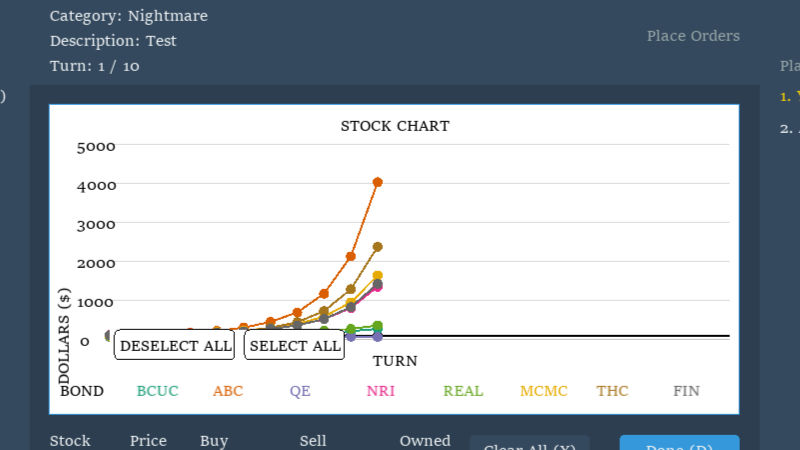
At this point, we will start testing the market condition in the game. This was my first attempt at implementation after the week off.
It was wrong. The issue was raising (0.10 - stock dividend) ^ (100 / current stock price) rather than only stock dividend, which is always positive. After correcting this issue, we observe a more reasonable and expected stock behavior. This iteration emphasizes the importance of continually sanity checking yourself throughout development.
Developing an optimal trading strategy for this scenario would be difficult, but it would be possible and likely align more with the “Advanced” scenarios. However, we want something more difficult. Thus, we will change the behavior through the use of “bull” and “bear” markets. This type of dichotomous and, as we will see, uncertain behavior will likely induce a different optimal trading strategy.
In our situation, the bull market will use the above approach for determining the average changes. The bear market will have an average 40% decrease for all stocks above $110, and the stocks below $90 will remain in the “bull” market condition. For stocks between $90 and $110, they have a probability of a 40% decrease proportional to the stock price’s proximity to $110:
Probability of remaining in bull market = 1 - (stock price - 90) / 20
In other words, stocks closer to $110 are more likely to experience a bear market (~40% decrease), and stocks closer to $90 are more likely to remain in the bull market. This behavior will essentially provide lower priced stocks more potential value in situations likely to result in a bear market.
The next step is defining the start of a bear market. Conceptually, we want the bear market to occur when too many stocks achieve a high stock price. In practice, we set the target price to $145 and then increase the probability of a bear market as the number of stocks at or above $145 increases:
Probability of bear market = 1 / (1 + exp(-(-4 + 9 x (number of stocks at $145 or higher) / 8)))
This is a logistic-type function in which the probability of a bear market is relatively small for the first couple of stocks above $145 but increases dramatically as more stocks reach $145.
With that, we have developed the core of an underlying truth that will likely provide a complex approach to identifying and implementing an optimal trading strategy. In the next diary, we will work on developing a market-specific AI, which could lead to further iteration on the underlying truth. More real life events will push the diary out to two weeks. See you then.
Source
Changelog.gg summarizes and formats this update. How we read updates.