
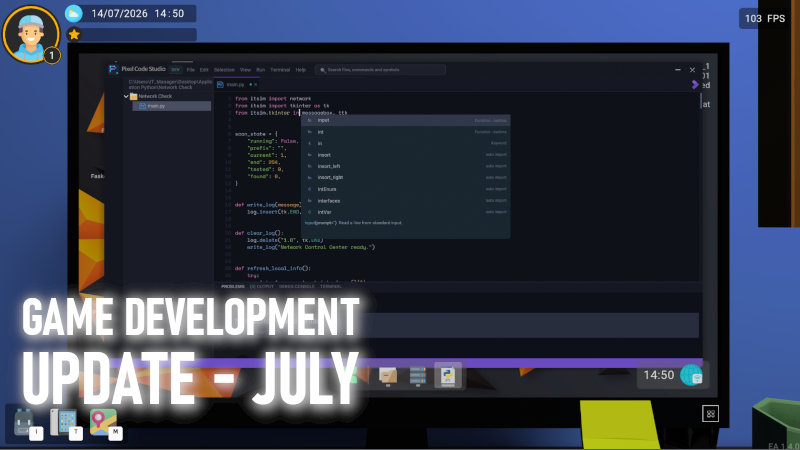
In this update8
Full notes
Full IT Specialist Simulator update
Read the full published notes in a cleaner layout. The original post stays linked below.
What changed
- Gameplay
- Server
- UI and audio
IT Specialist Simulator changes
Hello everyone,
Another month of work on Early Access 1.4.0 is behind us. We already know this update will introduce a huge amount of new content (and probably even more bugs... just kidding). We would also really appreciate it if you added our new game to your wishlist—it helps us a lot.
What is the goal of this update?
Of course, we've added new server-related features, fixed a number of bugs, and we'll continue improving the game based on your reports. But our main goal is to introduce something similar to REDSTONE in Minecraft. We want to give players a tool—a tool that will allow them to create countless interesting and useful web and desktop applications.
When will the update be available?
The new update is currently scheduled for September 7, 2026. We still need to finish a few features, such as the Azure page that will allow you to manage application and service licenses. In addition, at the beginning of August you'll receive a smaller patch that fixes the tutorial issue affecting a large number of players.
Which programming language will be available?
As many of you already know, the game is built in Unity, so the game itself is programmed in C# (by the way, we recently passed the 300,000 lines of code milestone). So naturally, you'll be programming in... Python. Yes, Python.
Some of you may be wondering why we made this decision. Several members of our team previously specialized in Python and worked extensively with frameworks such as Flask and Django. Developing Python-based projects with these frameworks was part of our everyday work. We also relied on PostgreSQL databases. Yes, we've added databases too—actually two of them. Alongside PostgreSQL, we've also implemented SQLite3.
In addition, we've introduced support for HTML, CSS, and JavaScript, allowing you to create web applications directly inside the game.
Python applications also come with two dedicated modules:
itsim.filesystem for working with files and folders within the game's file system.
itsim.network for connecting player-created code with the simulated network infrastructure.
What does this change in the game?
We've also introduced additional server-side improvements, fixed numerous bugs, and continue working on even more enhancements. The biggest addition in this update is a system where Python plays a role similar to Redstone in Minecraft. Players can use it to build their own desktop applications that interact with the game's infrastructure, including the simulated LAN network.
The update will also introduce new programming-related tasks. However, we understand that not everyone enjoys writing code, so when starting a new save—or loading an existing one for the first time—you'll be able to decide whether programming tasks should be enabled.
Players will be able to create their own tools, including both web applications and applications compiled into standalone .exe files.
Regardless of the application type, its files can be stored on an in-game server using a Git-like version control system. In the future, we also plan to integrate Steam Workshop, allowing players to share their tools with the community.
Web Applications
Web applications will run across the entire LAN. What does that mean? You create your application and launch its main Python file on a computer—for example, the one in the IT office. Pixel Code Studio, the development environment, will display an IP address after launching the application. Enter that address into any browser, and your own website will open. Even better, as long as the application is running, every computer on the network can access and use it.
Steam post imageSteam post image
Executable (.exe) Applications
Players will also be able to compile their applications into standalone .exe files. These executables can be copied onto a USB flash drive and permanently installed on a specific computer within the game.
Examples of what you can build
A network diagnostics tool may sound simple, but it can make life much easier for every player. Such an application can analyze the network and communicate using UDP, TCP, WebSocket, and HTTP.
Steam post imageSteam post image
Source
Changelog.gg summarizes and formats this update. How we read updates.