
In this update7
Full notes
Full Hotel Paraíso update
Read the full published notes in a cleaner layout. The original post stays linked below.
What changed
- Gameplay
- UI and audio
- Events
- Security
Hotel Paraíso changes
First things first, thank you to everyone who keeps supporting this project every day, whether by adding the game to your wishlist, reading updates on social media, or playing the demo. Your interest and curiosity about Hotel Paraíso are incredible, and they make a huge difference in helping me through the challenges of game development.
I want to start a series of devblogs to share behind-the-scenes details about the development of Hotel Paraíso that I think you'll find interesting. I may be a little late to the party, since I'll be talking about features that have actually been finished for months, but little by little I'll catch up with the current state of development. Above all, I want these posts to be enjoyable to read and, at the very least, spark your curiosity about the game.
Why a Hotel for Spirits?
Hotel Paraíso isn't just a setting that I thought would be original for this game. It's also a place that reflects my own experiences.
I spent a significant part of my childhood living in a hotel owned by my family. Every day I watched guests come and go, stop for coffee at the bar, or celebrate banquets in the large hall on the first floor.
Living in a hotel without actually being a guest is a curious experience. Sometimes it's full of activity, while at other times it's completely quiet. Everyone is just passing through except you. You don't just walk down a hallway to reach your room. You know every hallway, and you have access to every room. You also get to see what lies beyond the areas guests never visit: the laundry rooms where the sheets are washed, the restaurant's enormous kitchen, and certain "special" rooms that are never rented out.
Hotel Paraíso began with the goal of capturing that feeling for the player. I wanted you to own a hotel without making the game about managing one. This was an idea I'd had floating around in my head for many years, but I wasn't sure how to turn it into a game.
Most games set in hotels, such as Fobia St. Dinfna Hotel or Luigi's Mansion 3, lean into horror or suspense as you gradually uncover the building's secrets. I wanted to take a different approach.
Enter the Ducks
I started writing a story where, right from the beginning, everyone knows there are spirits living in the hotel. I thought it was a refreshing idea. The supernatural isn't a mystery waiting to be uncovered. It's simply part of the hotel's identity.
Room service caters to flesh-and-blood guests, but also to spirits, the souls of the deceased who may have died in the hotel, or perhaps somewhere nearby. Only the hotel's owners know about this, and that's how the Vinz Vision came to be.
If you've played the demo, you'll know this concept is explained within the first five minutes. The Vinz Vision allows members of the Vinz family to see the spirits inhabiting the hotel, while everyone else remains oblivious to them. Nobody knows why the family possesses this gift, and they keep it a secret for obvious reasons. Running a hotel and supernatural phenomena don't exactly go hand in hand, do they? On top of that, introducing the idea of life after death opened up a lot of interesting storytelling possibilities.
This was also the point where I decided the characters would all be animals, with the Vinz family being ducks. I've always found animal characters more fun and original than humans. They also make it much easier to give each character a distinct personality and visual identity. In this case, every duck could have its own color and its own role within the hotel.
The Beginning of It All: Specters
In a world where the supernatural is already an accepted part of everyday life because spirits are known to exist, it felt natural to explore not only its friendly side but also its dangerous one. That's how Specters came to life, and fortunately they fit perfectly with the gameplay I'd been developing alongside the story.
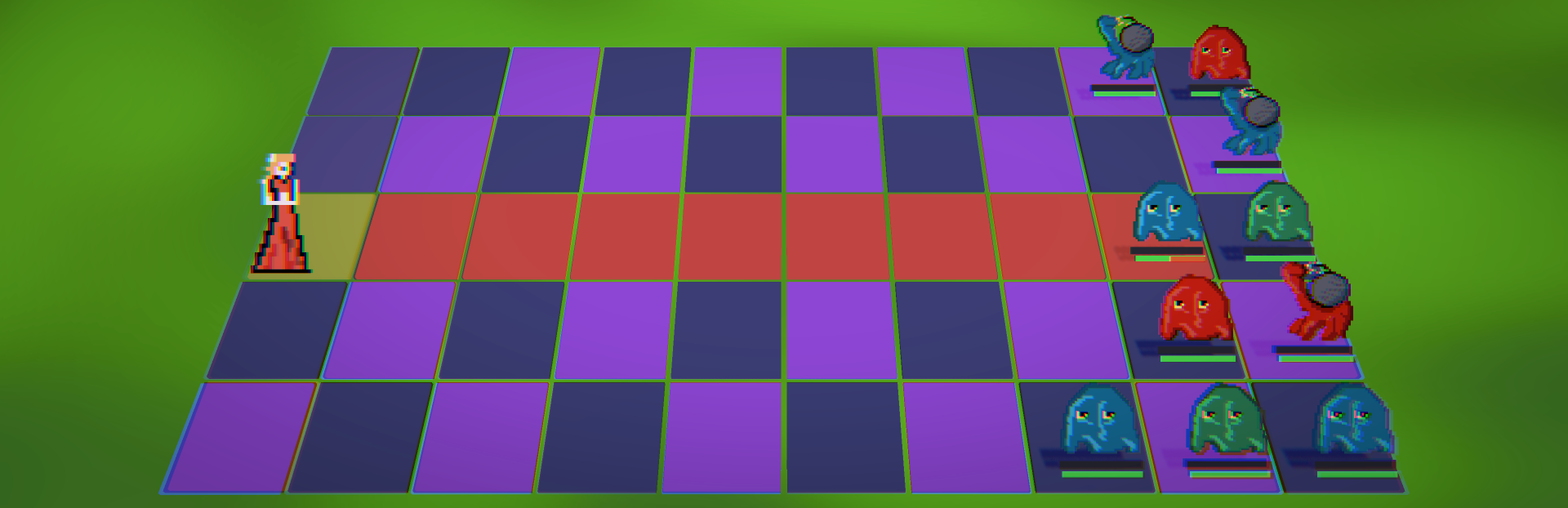
I'd wanted to make a puzzle game for quite some time, and I'd already built two prototypes while searching for an interesting formula. Making Specters the "pieces" of the puzzle, with each room acting as a level to clear, turned out to be a perfect fit.
The idea of having your character fire projectiles came from Magical Drop, a classic puzzle game I've played a lot. However, I didn't want to make a straightforward puzzle game, so I decided to incorporate RPG elements. That's why battles feature up to three characters who can tag in and out, and why your main command is "Attack," just like in a traditional turn-based RPG, even though you're actually solving a puzzle underneath it all. The puzzle is still there. Your goal is to clear the board of pieces, much like in Tetris or Meteos.
In my original prototype, the puzzle already included a leveling system that upgraded your shots, but there weren't different types of pieces. Once Specters entered the picture, I realized they could each belong to different classes and react differently to your attacks. Once again, this made the game feel much more like a traditional RPG, where new enemy types appear as you progress, each with their own strengths, weaknesses, and unique mechanics.
The boomsaur was the Specter that convinced me the system really worked.
It's the first special Specter to appear in the demo after the basic ones that don't do anything. When defeated, it destroys adjacent Specters, introducing meaningful decisions into the gameplay. Should I shoot the Boomsaur now? Or should I wait until more Specters gather around it? From there, I kept adding new Specter types. Some made your life easier, like the gastroid, while others made things more challenging, such as the Mimic or the Blockasma.
When Everything Clicked: The Color Chain
There was still one missing ingredient to make the combat truly engaging. If all you had to do was shoot whichever Specter was the most useful or the most dangerous, each turn offered very few meaningful choices. But what if I added one more puzzle mechanic? The Color Chain was the feature that tied the entire system together.
It's introduced during the demo's third battle, after you've become familiar with the basics. The game explains that you should try to combine the best possible attack with the shot that advances your chain: blue, green, and red in any order to complete one full sequence.
This mechanic adds a layer of long-term strategy that's much closer to an RPG than to a traditional puzzle game. Monster Hunter Stories has a somewhat similar idea, but it doesn't ask you to think several turns ahead in the same way. It also gave each playable character a very clear role. Green beats Blue, Blue beats Red, and Red beats Green, so coordinating your team requires careful planning.
Building chains allows you to strengthen each character, but how far should that go? It quickly became clear that the current upgrades are extremely powerful, and balancing every level around them would be nearly impossible. To solve this, I introduced two limitations. Each level requires more progress than the previous one, and repeating a color breaks your chain. As a result, every battle can be approached in different ways while rewarding consistent planning.
Wrapping Up Floor 10
The hotel's first floor had to serve as a tutorial, but I didn't want it to feel trivial either. That's why I tried to introduce new mechanics at a steady pace. If you've played the demo, you've probably noticed that every room presents something new to deal with. Each battle follows the same structure: introduce the mechanic, put it into practice, and then make sure you've understood it over the course of several rounds. The goal was to let players spend as much time actually playing as possible, without constantly interrupting them.
Adding sound and visual effects elevated the experience considerably. A distinctive sound plays every time you successfully extend your Color Chain, while the background music features a strong, steady beat that the characters dance along to. Although Hotel Paraíso isn't a rhythm game, I always knew that satisfying music and responsive sound effects would be essential to making combat feel enjoyable.
The first Specters you encounter are designed to help you, either by triggering explosions or multiplying your attacks. Two Amulets are also introduced early on to make clearing rooms even easier. Later, the challenge ramps up with the first boss in the fourth battle, followed by a time attack section at the end of the floor. I initially worried that I might have made the game too difficult, but it turned out the real problem wasn't the difficulty at all. It was something much more serious.
The Tutorial Problem
After watching several players, including streamers, play through the demo, I identified what I believe is its biggest issue.
The Color Chain mechanic is introduced at exactly the same time as the rock-paper-scissors color triangle. The two systems are related, but they're ultimately independent. You can build your Color Chain without taking advantage of the color triangle, just as you can exploit the color triangle without paying much attention to the chain itself.
This overlap ended up confusing some players, and it's something I'll need to redesign for the full game.
Part of the issue also comes from how many concepts are introduced in such a short amount of time. Colors, enemies, chains, turns, swapping characters, skipping turns, explosions, upgrades... all of that is presented within roughly five minutes. Players who are paying close attention and enjoy experimenting tend to understand it right away, but anyone who's slightly distracted, or who prefers to learn by doing instead of reading, is likely to struggle.
A Reward After Every Room
Even before reaching Floor 9, I decided that every room should be followed by some kind of reward, whether that's a conversation, a new Amulet, or an unexpected surprise.
The idea is to keep the game moving and make the hotel feel alive. There's always something new waiting around the corner or something interesting about to happen next. Otherwise, the game would boil down to walking from one door to the next, and that would quickly become repetitive. This philosophy has shaped every section of the game that followed.
Finally, I'd like to mention the music.
For this first floor, I wanted a relaxed, lighthearted atmosphere. I remembered the bar in Machinarium, where a beautiful bossa nova-inspired track plays, and that became my main source of inspiration while composing this floor's melody. Each subsequent floor would feature its own musical style, helping the journey through the hotel feel fresh and varied.
The first real touch of mystery comes in Room 904, where a cutscene suddenly interrupts the very beginning of a battle. There's no setup and no explanation. The scene introduces a character we've never seen before, and they don't say a single word.
This was a deliberate storytelling choice. I wanted moments like this to make the game feel dreamlike and mysterious, as though strange things were happening just beneath the surface. Hotel Paraíso isn't just a puzzle game disguised as an adventure. It has a story it wants to tell.
Source
Changelog.gg summarizes and formats this update. How we read updates.