
In this update6
Full notes
Full Hostile Mars update
Read the full published notes in a cleaner layout. The original post stays linked below.
What changed
- Gameplay
- Maps
- Performance
- UI and audio
- Balance
- Server
Hostile Mars changes
📝 November Devlog: New Regions, Smarter Scrap, More Bots On Screen
November was about three things:
Giving you a way to push into new regions that feels like an actual mission
Making Yield the clearest expression of turning broken bots into progress
Letting us pack more robots into the simulation without turning your PC into slag
Plus, Facility Research Centers and new concept art to glue it all together.
🚚 Core Delivery Vehicle: Bringing The Fight Somewhere New
** Yes, the transport is placeholder. Please mentally replace it with the most overbuilt, beautifully engineered convoy you can imagine and pretend we already finished it.
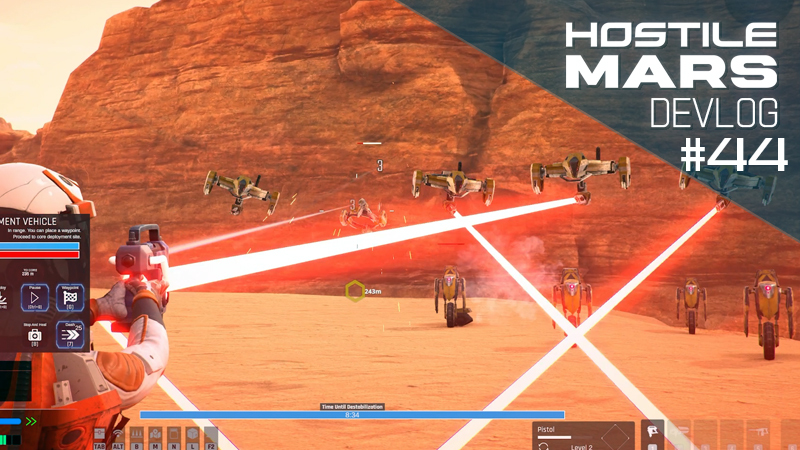
The Core Delivery Vehicle is how you expand into new regions of Mars. You load a region core onto it, then escort it across the map to a socket in a new area.
The route is dangerous, with a lot of enemies along the way, and every deployment runs on a strict stability timer. If you keep it alive and reach the destination in time, that region powers up with new waves, new defenses, new resources, and a fresh zone to fortify and automate.
Each launch is meant to feel like a focused push into enemy territory, not just clicking a button to unlock another area.
📊 Yield: Turning Bots Into Progress
The main progression driver in Hostile Mars is resources. The core loop is simple. You destroy huge numbers of bots, grab their scraps, and use those to build bigger bases so you can destroy even more bots.
At the end of each wave, you see a summary that shows how well you did at capturing Yield from enemies. Yield is just the usable scrap and material you managed to pull out of the mess.
Some tools lean into this more than others. There are options that do massive damage but waste a lot of potential Yield, and there are slower options that protect more of the material.
We are now refining this system so you have more control over how that Yield is generated. A new global Yield channel lets you choose perks that boost scrap and materials in different ways, depending on how you like to play.
Over time, destruction itself becomes part of the processing chain. The damage type and the enemy type act like inputs to a crafting machine, and the output is the scrap you take home.
🧊 Collision Performance: More Bots, Better Frames
A key part of the game is physically simulating every enemy as a rigidbody. This lets us read the contact forces from the physics solver and use them to apply damage or other effects as a byproduct.
This is difficult to do at scale. Even around one thousand bots grouped up usually means multiple contact events for each bot as they hit one another and the ground all the time. That can turn into many thousands of events to process every physics frame.
When we profiled large waves, contact processing often used a significant portion of the frame budget.
This system was revamped to use multithreading much more effectively, reaching roughly double the performance in the worst case and around three to four times faster in most situations.
On top of that, it has been tuned to return much less noisy data by calculating the forces in a more custom way. Impact damage is now more reliable and more predictable than when we used raw output from the physics solver.
In practice, this lets us put roughly thirty to fifty percent more bots in one place while still maintaining a better frame rate than before.
🧪 Facility Research Centers: Turning Regions Into Mars Labs
Across Mars, each region has its own Facility Research Center. This is a physical station you discover, bring online, and then permanently dedicate to a single tech branch.
It is not just a menu. It is a real structure in the world that you can feed with resources.
When you activate one, you make a one-way choice. You decide that this center is now a Defense blueprint lab, or an Automation technology hub, or a Weapons research facility. Each facility becomes a concrete commitment to that specific tech fantasy.
Under the hood, these centers plug into a tiered research system. The first center you assign to a branch unlocks its early technologies. Every additional center you point at that same branch pushes you deeper into that tech tree and reveals more specialized traps, turrets, automation tools, or weapon upgrades.
How you spread and specialize your research centers across regions directly shapes your long-term build. Over time, your logistics network turns into a planetary web of Mars labs, slowly grinding out power.
🎨 Concept Art: Filling Out The World
We have also been pushing further on the visual side of Hostile Mars. This month’s concept art explores environment updates and facility blockouts.
That wraps up November.
We are getting closer to the version of Hostile Mars where combat, factory planning, and research all feed into each other in a tight loop. Core delivery runs open new regions, facilities shape your tech identity, and the Yield system turns every destroyed bot into a real decision about how you want to progress.
As always, thank you for following along and for being patient while we keep tearing this thing apart and rebuilding it stronger. More updates soon.
-HM Team
Source
Changelog.gg summarizes and formats this update. How we read updates.