
In this update15
Full notes
Full Frosthaven update
Read the full published notes in a cleaner layout. The original post stays linked below.
What changed
- Balance
- Gameplay
- Maps
- Events
- Store
- Security
Frosthaven changes
In Frosthaven, you’ll be testing your skills against an array of menacing enemies. It’s time to shine the spotlight on them, so you can learn more about them and increase your chances of survival out there in the cold!
Meet the Beasts of the Northern Range
The lands north of the Copperneck and Imperial Mountains are home to an astonishing variety of creatures - some found nowhere else in the known world, others familiar species that have adapted with remarkable tenacity to the brutal conditions of the far North. Those beasts that do endure here tend to be among the hardiest and most aggressive of their kind; survival in this climate demands nothing less.
Unfortunately, these same unforgiving conditions make the proper study of northern fauna exceptionally difficult. Extreme cold, erratic weather, and the scarcity of safe observation sites mean that our knowledge remains fragmentary at best. Many species have yet to be catalogued, and the behavior, life cycles, and ecological roles of even the more commonly sighted creatures remain only partially understood.
Nevertheless, what little has been recorded paints a picture of an ecosystem shaped by relentless competition, scarce resources, and the constant pressure of predation. Continued study may one day allow us to classify and comprehend these remarkable beasts fully - provided, of course, that the researchers survive their encounters long enough to write them down.
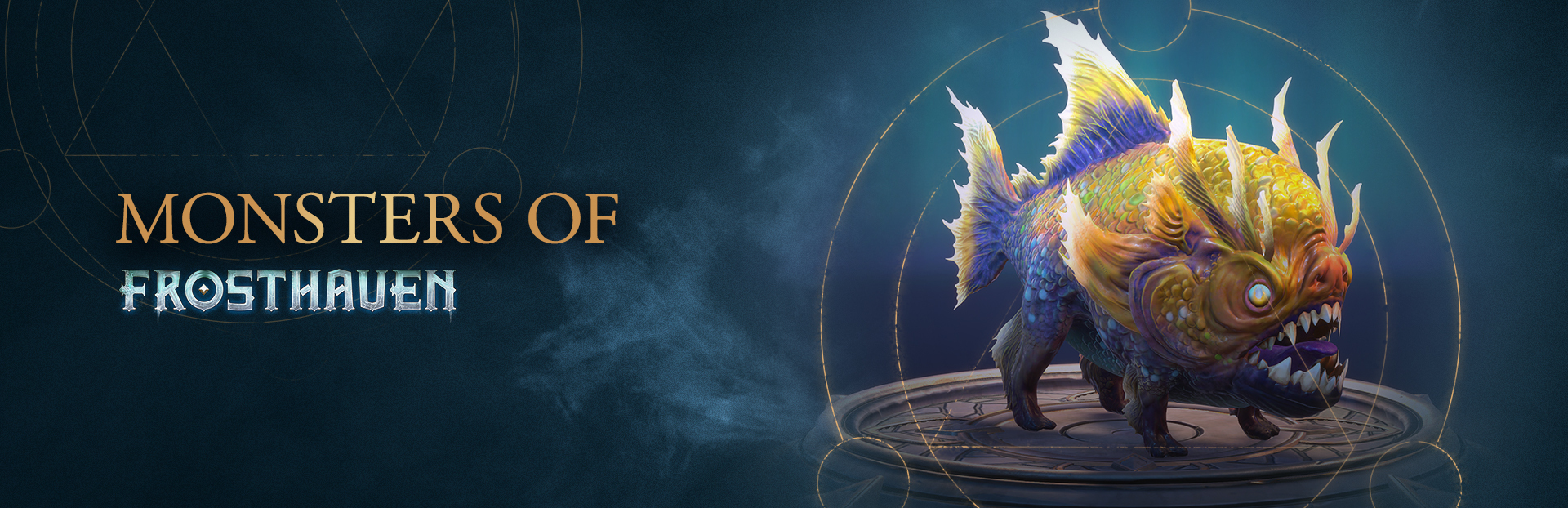
Piranha Pig (Porcifera vorax)
Among the most well-known inhabitants of the Biting Sea, Porcifera vorax - colloquially called the Piranha Pig - holds a place of unusual prominence. This notoriety is due not only to its aggressive temperament but, more importantly, to its remarkable culinary value. The meat of the Piranha Pig, rich in omega-3 oils and uniquely flavored by the mineral composition of the Biting Sea and the creature’s mixed marine-terrestrial diet, is considered a delicacy across the Empire. Its trade forms a substantial portion of Frosthaven’s commerce. Few visitors leave without trying a cut, and fewer still can afford more than one.
Habitat and Physiology
Piranha Pigs are amphibious predators, capable of surviving on land for up to a week depending on subspecies. On land, they locomote using four short but powerfully muscled limbs. These legs may look comically short, but they allow for surprisingly strong leaps, and combined with their elongated, streamlined bodies - well suited for aquatic life - they can cover distance faster than most people expect.
In the water they are even more dangerous - quick, agile, and hard to trap. Traditional nets work only if the timing is perfect, and bait lines rarely last long before being shredded.
The species possesses 24 knife-like teeth, all designed for rending flesh. Wounds inflicted by a Piranha Pig are typically deep, ragged, and slow to close - even with skilled medical attention - posing significant danger to both prey and careless fishermen.
Behavior and Hunting Patterns
Piranha Pigs are schooling animals, and their hunts are typically coordinated affairs. Members of a school work in rapid succession, overwhelming prey with a flurry of bites that prevent escape and induce rapid blood loss. The collective frenzy of a feeding school is considered one of the more dangerous natural phenomena in the Biting Sea.
On the rare occasions a lone Piranha Pig hunts alone, it shows a different sort of patience: it will wound a larger creature, then shadow it from a distance, waiting for it to weaken before moving in for the final strike. Hunters who have seen this behavior firsthand insist the creature knows exactly what it’s doing.
Notes for Those Who Wish to Catch One
Your best chance of capturing a Piranha Pig is during one of its trips onto land, when it wanders ashore to search for shoreline prey. However, even on land, caution is required; their speed and ferocity remain considerable.
Lightning Eel (Electrophorus glacialis)
Another highly valued - and just as dangerous - inhabitant of the Biting Sea is Electrophorus glacialis, commonly known as the Lightning Eel. While less prominent in trade than the Piranha Pig, it is nonetheless prized for its meat and oil, and feared for the difficulty and risk involved in harvesting it.
The Lightning Eel’s name is entirely literal. While these eels are capable of extremely rapid movement in water, their most notable trait is their ability to generate powerful electrical discharges. These are used both to incapacitate prey and to defend against larger predators. Such discharges are far from minor deterrents; recorded encounters suggest shocks strong enough to leave even a fully grown Algox stunned and helpless.
Habitat and Physiology
Lightning Eels possess long, smooth bodies that are exceptionally difficult to grip, making physical capture hazardous even before their electrical defenses are considered. Fishermen report that traditional nets and lines can be used, but only with exceptional care and extensive preparation.
Though fully aquatic by preference, Lightning Eels demonstrate a surprising tolerance for time spent out of water. While their movement on dry land is slow and awkward, they can survive for extended periods and are capable of short, sudden lunges by violently flexing their elongated bodies. Given access to another pool of water - even a shallow one - they regain full mobility almost immediately.
Behavior and Defensive Traits
What distinguishes the Lightning Eel from other dangerous marine fauna is its apparent ability to discharge ambient lightning elemental energy into the surrounding water. When threatened or hunting, the eel seems capable of drawing this dispersed energy back into itself and releasing it in a concentrated, stunning electrical burst.
This process is often preceded by a low, rising hum or buzzing in the water - a warning sign that experienced hunters treat as an immediate signal to withdraw.
Once released, the electrical shock radiates through the surrounding water, stunning prey and potential threats alike. This makes any engagement in confined or flooded environments especially dangerous.
Unusual Encounters
Under ordinary circumstances, Lightning Eels would remain a concern primarily for fishermen and coastal patrols. However, sightings far from the shoreline have been reliably linked to Lurker Wavethrowers, who are known to hurl large volumes of seawater across the battlefield - sometimes with Lightning Eels carried within.
While stranded eels are slow and vulnerable, their ability to leap or wriggle into nearby pools means they should never be dismissed as harmless.
Notes for Those Who Wish to Catch One
Any attempt to harvest a Lightning Eel should be treated as a contest of speed and awareness. Keep all senses alert - and if you hear the rising hum, retreat immediately and put as much distance between yourself and the water as possible.
Polar Bear (Ursus glacialis)
Of all the creatures that roam the frozen reaches, the Polar Bear is perhaps the most iconic. Closely related to the Cave Bears found further south, this northern variant has adapted completely to life amid ice, snow, and freezing seas - and that adaptation is evident in every aspect of its physiology and behavior.
Habitat and Physiology
Polar Bears are massive, long-limbed hunters, though slightly leaner than their cave-dwelling cousins. This reduced bulk comes at the cost of raw endurance, but what they lack in sheer staying power they more than make up for in efficiency and brutality. Their white to pale-yellow fur provides near-perfect camouflage against snow and ice, while a thick layer of fat insulates them from the brutal cold. Beneath the fur, their skin is black, aiding in heat absorption.
Unlike Cave Bears, Polar Bears possess narrower skulls, longer necks, and sharper teeth - adaptations better suited for slicing flesh than crushing bone. Their oversized paws allow them to traverse slick ice with ease and paddle powerfully through freezing waters.
Behavior and Hunting Patterns
Polar Bears are relentless carnivores, specializing in ambush predation. They are patient hunters, capable of remaining motionless for long stretches before erupting into sudden, explosive violence. Their attacks are precise and vicious, often leaving deep, bleeding wounds that continue to sap their prey’s strength long after the initial strike.
What makes them especially dangerous in combat is their utter refusal to be restrained. Polar Bears are notoriously unfazed by attempts to stun or immobilize them; ensnaring tactics that would stop other beasts simply do not work. Once committed, they advance without hesitation, swatting aside resistance and mauling anything that strays too close. Their blows can even leave foes impaired, struggling to react as the bear presses its advantage.
Notes for Those Who Encounter One
Though less enduring than Cave Bears, Polar Bears are far more punishing in prolonged engagements. Every wound they inflict matters, and allowing one to remain active for long is a swift path to exhaustion and death. Do not rely on control tactics - they will fail. Instead, focus fire, maintain distance, and end the fight quickly.
If you see one stalking you across the ice, understand this: it has already decided you are prey.
Hound (Canis lupus vulgaris)
One of the few predators to thrive across nearly every climate of the Empire, Canis lupus vulgaris, commonly known as the Hound, has required remarkably little adaptation to survive in the frozen North. This lack of specialization is not a weakness, but rather a testament to the species’ greatest strength: intelligence refined for cooperative hunting in almost any environment. The name “Hound” remains a matter of some debate. Many naturalists, and more than a few trappers, insist the creature should more accurately be called a ‘wolf.’ The distinction is largely academic, and most who have faced one are content to use whichever name comes to mind while running.
Habitat and Social Structure
Hounds are highly social animals, living and hunting in tight-knit packs typically formed around a mated pair and their offspring. These family groups are stable, disciplined, and extremely coordinated. Every member knows its role, and hesitation is rare; survival in harsh climates leaves little room for error or mercy.
Though capable of hunting alone or in pairs, Hounds are at their most dangerous when operating as a pack, particularly when multiple members can attack the same target from close proximity.
Behavior and Hunting Patterns
Hounds are among the fastest terrestrial predators encountered in the North. They excel at closing distance with alarming speed and are capable of sustaining long pursuits until their prey collapses from exhaustion. Once engaged, they react with near-instant retaliation to any perceived threat, making careless strikes costly.
Their cooperative tactics are brutally efficient. When attacking together, Hounds show a marked increase in aggression and precision, overwhelming prey through coordination rather than raw strength.
A distinctive feature of the species is its use of vocalization. Individual and group howling serves both as communication and as a psychological weapon. Prey subjected to sustained howling frequently shows signs of panic, disorientation, and poor decision-making long before the first bite lands.
Notes on Domestication and Threat Assessment
Their expressive behavior and social intelligence have led many cultures to attempt domestication. Some succeed, and trained Hounds have been used as hunting companions and guards. These cases, however, are exceptions. Wild Hounds remain dangerous, territorial, and fiercely loyal to their pack above all else.
A lone Hound (or even a pair) may not pose a severe threat to a prepared mercenary group. A full pack is another matter entirely. When facing one, coordination is essential. Just as the Hounds fight as a unit, so must you. Any party that allows gaps in formation or fails to cover one another’s weaknesses will not last long.
Burrowing Blade (Ferramandibula terranea)
One of the most unusual creatures to inhabit the lands north of the Copperneck Mountains is Ferramandibula terranea, known to locals as the Burrowing Blade. This immense arthropod spends the majority of its life beneath the frozen earth, carving vast tunnel networks with its six pairs of blade-like legs. The Burrowing Blade surfaces for only one reason: to hunt.
If you ever find yourself facing one eye to eye, know that it is absolutely in the mood to kill. “Eye to eye”, of course, is a figure of speech - Ferramandibula terranea possesses no eyes. Instead, it relies on the so-called Organ of Tömösváry, named after a now-deceased Inox ethologist who studied the creature in great detail, right up until it studied him back.
The Burrowing Blade is the largest known arthropod species documented within the Empire and remains the second most common cause of death among professional ethologists. Exact measurements are difficult to confirm, as very few living specimens have ever been captured or restrained long enough for proper study. Most estimates place the average adult at roughly four meters in length from head to tail, not including the telson.
This rear appendage bears an additional pair of legs not used for locomotion or digging. Instead, they appear to serve a threatening or distracting function. Some scholars speculate they are involved in mating displays, though no formal confirmation exists - largely because all recorded attempts to catalog this behavior ended with the researcher being reduced to several separately catalogued body parts.
The longest specimen ever partially measured reached at least 4.7 meters. The qualifier “at least” became necessary when the observing researcher lost both forearms to a sudden awakening specimen. Measurement ceased shortly thereafter.
Behavior and Hunting Patterns
Due to their subterranean lifestyle, Burrowing Blades remain among the most enigmatic predators of the North. Most reliable behavioral observations occur during surface hunts, when they emerge to attack large herd animals such as kivaks and, on occasion, entire Algox settlements.
Unlike most apex predators, Burrowing Blades do not attempt to isolate individuals. Their tactics are instead designed to attack and annihilate entire groups at once. When hunting, the creature tunnels frantically just beneath the frozen surface, moving through soil and ice at a speed more commonly associated with sprinting than excavation.
Burrowing Blades favor uneven, cluttered, or broken terrain, where obstacles above ground hinder their prey while posing no impediment to the creature moving swiftly beneath it.
This shallow tunneling serves two purposes. First, the creature’s blade-like limbs slice upward through ice, stone, and flesh alike, inflicting deep, open wounds on anything above. Second, the violently displaced earth and ice erupt across the surface, causing confusion, injury, and panic among the victims.
To change direction, the Burrowing Blade frequently breaches the surface in explosive ascents, damaging everything nearby. These moments are when the creature is theoretically most vulnerable - though this term should be used cautiously. Just as suddenly, it may plunge back underground, vanishing entirely and leaving its enemies guessing where the next attack will come from.
Notes on Survival
Defending against a Burrowing Blade is extraordinarily difficult. Its exoskeleton is extremely tough, capable of deflecting most conventional weapons. Meaningful harm requires specialized tools, overwhelming force, or the clever harnessing of elemental power.
If the ground beneath your feet begins to move, run. And even if your ambition is to be an ethologist who has a Burrowing Blade body part named after them posthumously, keep this in mind: all 12,378 currently identified organs and appendages are already named after such now-deceased brave souls. Even should you discover something new, the waiting list is long.
Rending Drake (Draco lacerator)
Under normal circumstances, encountering a drake in Frosthaven would seem all but impossible. Drakes are cold-blooded creatures, and even at the height of summer the northern climate offers only a handful of days warm enough to support such fauna. For the most part, this assumption holds true.
However, west of Frosthaven lies an anomaly known as the Radiant Forest - a region where temperatures remain comparable to the Hakrah Savannah throughout the year, accompanied by unusually high humidity. The prevailing theory attributes this phenomenon to intense and persistent seismic activity beneath the region, which warms the land from below. These conditions are ideal for drakes, and particularly so for Draco lacerator, the Rending Drake.
Competition within the Radiant Forest is fierce, and in recent years Rending Drakes have begun venturing beyond its borders during the warmest summer days. Small groups have been observed establishing lairs in abandoned ruins, forgotten dungeons, and vast underground cavern systems, where residual warmth allows them to survive even when surface conditions deteriorate.
Habitat and Physiology
Rending Drakes are long, sinewy creatures with scaled bodies, four powerful climbing limbs, and exceptionally sharp claws from which they take their name. Their bodies are built for speed rather than endurance, favoring explosive movement over prolonged combat. Though formidable, they are less heavily built than many apex predators, relying instead on agility, precision, and venom to bring down prey.
Along the lower jaw sit paired venom glands that secrete a complex mixture of toxic proteins. Rather than killing outright, this venom functions primarily as a powerful anticoagulant, dramatically worsening bleeding caused by the drake’s claws and bite. Victims often succumb to rapid blood loss, collapsing into shock even after relatively short engagements.
Behavior and Hunting Patterns
Rending Drakes are vicious ambush predators. They are capable of going from complete stillness to full attack in less time than it takes most creatures to blink. Distances that appear safely out of reach are closed in seconds.
Verified field reports describe Rending Drakes striking two adjacent targets in rapid succession before the second has time to process what occurred - a feat made possible by their exceptional speed and tactical precision. More commonly, however, they focus their full attention on a single large target, delivering multiple rending blows before the prey can react effectively.
Notes for Those Who Wish to Capture One
The toxic proteins secreted by Draco lacerator are in high demand, whether for academic research or more practical (and often less ethical) applications.
If you ever intend to capture a Rending Drake, do not under any circumstances attempt it alone. At minimum, one individual must be prepared to absorb the initial assault - and ideally survive it - while others attempt to immobilize, stun, or otherwise subdue the drake through alternative means.
Even then, success is uncertain. Failure is usually fatal.
Spitting Drake (Draco corrosivus)
Draco corrosivus, also known as the Spitting Drake, is another drake species that has found refuge within the Radiant Forest and, by extension, in the warmed caverns and abandoned structures buried beneath the surrounding terrain.
Prior to adulthood, juvenile Spitting Drakes are nearly indistinguishable from young Rending Drakes. The only reliable early marker is the size and density of their ridge scales, which are broader and more closely packed along the spine. This resemblance has led to more than a few unfortunate misclassifications.
Habitat and Physiology
Upon reaching adulthood, Spitting Drakes undergo a pronounced metamorphosis. Most notable is the rapid development of a pair of membranous wings. These are not true limbs, but evolved extensions of reinforced rib and shoulder structures, supported by elongated bone spurs and dense connective tissue. Once fully developed, these wings are capable of sustained flight over considerable distances.
Internally, Spitting Drakes possess a heavily modified version of the venom glands common to all drake species. In Draco corrosivus, these glands produce a highly corrosive acidic compound rather than a traditional venom. The substance is stored within layered, mineralized sacs lined with resistant keratin and trace elemental residues, preventing harm to the drake itself. Specialized muscular ducts allow the acid to be expelled with force through the mouth, granting the creature its infamous “spit.”
Behavior and Offensive Traits
When engaged near ground level, a Spitting Drake can project its acidic secretion to distances of up to eight meters. The compound itself appears highly variable in effect. Field observations suggest the drake can alter the properties of the substance during production - a process not yet fully understood and the subject of ongoing study.
Some discharges detonate on impact, splashing corrosive matter across a small area and injuring nearby targets. Others appear less acidic but far more insidious, carrying compounds that violently disrupt the nervous system. Victims struck by these are often stunned outright, suffering sudden loss of coordination, muscular failure, and sensory overload. In this state, prey is left unable to act or defend itself- an opportunity the drake exploits immediately.
How the Spitting Drake achieves such variation without poisoning itself remains unclear.
Notes for Those Who Wish to Capture One
Compared to Rending Drakes, Spitting Drakes are generally less overtly aggressive. They prefer to remain airborne or at range, relying on acidic attacks rather than direct engagement. As such, capturing one is less a test of endurance and more a problem of closing distance.
Most successful hunts rely on immobilization or forcing the drake to the ground, followed by swift engagement before it can free itself or take flight again. Hunters should be warned, however: Spitting Drakes are noticeably sturdier than their rending cousins and capable of absorbing significant punishment.
Deep Terror (Abyssoculus ruber)
Despite their grotesque appearance, often mistaken for something mystical or extra-planar, Deep Terrors are not aberrations of other realms, but one of nature’s premier marine predators.
Originating in the lightless depths of the sea floor, they are superbly adapted to cold, low-visibility environments. The nutrient-rich waters of the Biting Sea provide ideal hunting conditions, allowing them to lurk in near-perfect stillness before striking unsuspecting prey.
While primarily aquatic, Deep Terrors are capable of surviving and even reproducing on land. Small groups have been observed near water sources yet resting on completely dry ground. Though just as dangerous outside the sea, their specialized physiology prevents them from truly thriving far from coastal environments.
Morphology and Adaptations
Deep Terrors are largely sessile creatures. Though capable of limited repositioning, they prefer to anchor themselves to a surface before engaging prey. Curiously, they show no preference in this regard - attaching with equal ease to stone, sand, submerged debris, vegetation, or even animal remains. If forcibly detached, they can reanchor themselves within seconds.
Their most distinctive feature is a single, massive eye. This organ is extraordinarily sensitive - estimated to be nearly one hundred times more light-sensitive than that of a typical daytime land animal. It detects even the faintest bioluminescent traces in the abyss.
However, vision alone is not their primary hunting mechanism. Deep Terrors rely heavily on vibration detection, sensing subtle disturbances in water or along solid surfaces with remarkable precision.
Through controlled chemiluminescent reactions, the eye can generate and eject small quantities of red, luminous fluid. This substance varies in effect depending on its composition at the moment of expulsion.
Some discharges cause immediate open wounds upon impact. Others carry compounds that immobilize or severely impair muscular function, leaving victims unable to escape. In rare but well-documented instances, the substance is expelled in a concentrated, coherent stream resembling a narrow beam of crimson light, reaching distances of up to ten meters.
The eye is not the Deep Terror’s only weapon.
Its tentacles are lined with rigid, sharpened spines used both defensively and offensively. These can lash out in retaliation against any who attempt to engage Abyssoculus ruber in close combat, injecting potent toxins that induce progressive physiological collapse. Wounds delivered in this manner are not immediately fatal, but resistance steadily drains from the victim until escape becomes impossible.
Reproductive Anomaly
Most curious of all is the Deep Terror’s method of reproduction.
Using the same luminescent secretion expelled from the eye, individuals have been observed initiating a rapid growth process that results, within seconds, in the emergence of a fully formed adult Deep Terror. This typically occurs when prey attempts to retreat beyond immediate reach, creating an additional predator between escape and safety. The two individuals then share the meal.
The exact mechanism behind this rapid generation remains unknown. Current speculation suggests the expelled fluid may contain highly compressed biological matrices capable of near-instantaneous cellular expansion. Some more radical Quatryl scientists have proposed controversial theories involving localized distortions in temporal progression, though such claims remain unverified and widely disputed.
No study has yet produced a definitive conclusion.
Survival Notes
If you encounter a Deep Terror, ensure you are at a safe distance. “Safe,” in this context, means no less than ten meters.
If you find yourself closer than that, you have two options: Strike first, before it fully stabilizes and anchors itself. Or retreat immediately and put as much distance between you and it as possible. Deep Terrors are not fast, but they do not need to be.
Ooze (Gelatina vorax)
The lands surrounding Frosthaven contain no shortage of damp ruins, flooded cellars, and subterranean chambers where temperatures remain stubbornly above freezing. And as many of us have learned when returning to a cellar four years after last visiting it - finally determined to retrieve one of the three thousand screws carefully stored “just in case” - where there is moisture and even the faintest trace of organic residue, oozes will eventually appear.
Oozes are not singular organisms, but mobile colonies of simple, acid-producing microorganisms functioning as a unified mass. An ooze consists of semi-viscous acidic protoplasm bound together by a loose membrane-like surface tension. Within this gelatinous body, countless microscopic entities cooperate instinctively, sharing nutrients and reacting collectively to external stimuli.
They possess only the barest degree of sentience, just enough to detect organic matter and move toward it. They do not exhibit fear, anger, territoriality, or malice. If an ooze could form a thought, it would likely be little more than:
“It is organic. It’s edible.”
Offensive Properties
Oozes feed by enveloping organic material and dissolving it externally through powerful acids. The resulting slurry is absorbed directly into the colony, fueling growth and repair.
Though lacking limbs or defined anatomy, they are capable of surprisingly effective ranged attacks. By contracting portions of their mass, an ooze can expel concentrated globules of acidic matter over short distances. These projectiles can burst on impact, splashing corrosive material across exposed surfaces.
What adventurers commonly describe as “poison” is in fact chemical degradation. The acids compromise tissue integrity and metabolic stability, weakening the victim and accelerating further dissolution. Armor pits. Cloth smolders. Wounds refuse to close.
Left unchecked, the ooze persists.
Replication
The most distinctive - and dangerous - trait of Gelatina vorax is its method of reproduction.
When subjected to sufficient stress or damage, the colony may divide. The mass splits into two semi-independent bodies, each capable of continued movement and feeding. This process consumes internal reserves and significantly weakens the original colony.
If an ooze attempts to divide while already critically depleted, the act may destroy it entirely. It will attempt the divide anyway.
Replication is not a strategy. It is an instinct. Long-term viability is irrelevant. Immediate propagation is sufficient.
Regeneration and Variability
Oozes recover lost mass by absorbing nearby organic matter (along with anything attached to it). Given sufficient sustenance, they rebuild rapidly, restoring density and acidity. For this reason, leaving even a damaged ooze unattended is unwise.
For organisms so biologically simple, oozes display a frustrating degree of unpredictability. Some divide repeatedly until they exhaust themselves into useless residue. Others advance with surprising aggression, projecting acid relentlessly before splitting at precisely the most inconvenient moment.
At times they appear slow and almost inert. At others, alarmingly efficient.
Their behavior is not malicious, merely reactive to environmental thresholds beyond our easy measurement. Nevertheless, the effect on those attempting to clear them from a cellar is much the same.
Notes for Those Who Wish to Capture One
Capturing an ooze is, in principle, simple. Surviving the attempt is less so.
The most reliable method is to provoke the primary mass into dividing and secure one of the newly formed colonies. These secondary bodies are typically smaller and less stable, making containment more feasible.
However, inadequate environmental control can rapidly escalate the situation. If granted access to sufficient organic matter, or repeatedly stressed without containment, an ooze may multiply faster than anticipated. What begins as a single specimen can become a spreading mass in moments.
More than one would-be researcher has found themselves gradually incorporated into the very colony they sought to study.
And unlike the screws in your cellar, an ooze will always find a use for you.
Shrike Fiend (Laniocaecus vociferum)
Laniocaecus vociferum, commonly referred to as the Shrike Fiend, is regarded as one of the most enigmatic and dangerous apex predators of the Radiant Forest. It is believed to be endemic to that region. All confirmed sightings originate within the forest itself, with only rare and uncertain reports coming from the surrounding tundra.
The Shrike Fiend is not a single organism in the conventional sense, but a composite entity made up of two distinct species acting in close biological unity: a humanoid primary body (hereafter referred to as the primebody) and a flock of approximately twenty carrion birds.
The name “Shrike Fiend” comes from the intense, continuous shrieking heard during activity. The name does not suggest any true relation to shrikes.
Local accounts occasionally claim that fragments of recognizable words can be distinguished within the shrieking. No formal study has confirmed this, and most scholars attribute such impressions to stress and heightened fear during encounters.
Primebody
The primebody appears as a gaunt, humanoid figure with gray, wax-like skin, elongated legs, clawed hands, and disproportionately formed feet. Its proportions are consistently described as unnatural, and its movements as abrupt and unnervingly precise.
No living or dead specimen of the primebody has been recovered. All current descriptions are based solely on field observations.
Avian Component (Corvornis radicans)
The flock typically roosts along the shoulders, arms, and back of the primebody, often obscuring its outline when at rest.
Captured members of the flock have been identified as a distinct species, designated Corvornis radicans. Anatomically, they appear closely related to the genus Corvus. Plumage, skeletal structure, and most internal organs differ only slightly from those of common corvids.
Individual birds of C. radicans have been observed in the wild without a primebody. In such cases, their behavior appears indistinguishable from ordinary crows. However, no confirmed nests of the species have ever been documented.
Captured birds display extreme and persistent aggression, attacking continuously without clear response to injury or exhaustion until death.
Behavioral Coordination
The exact relationship between the primebody and C. radicans remains unclear. Field reports consistently describe highly coordinated behavior during hunts, suggesting some form of shared signaling or unified control.
In all encounters where observers survived, the Shrike Fiend was engaged in predatory activity. Reported tactics include the entire flock rising into the canopy before descending in synchronized dives on multiple targets, or circling tightly around the advancing primebody in a storm of wings while it advances on the ground, striking at anything within reach.
Simultaneous attacks on more than one prey have been repeatedly observed, possibly reflecting the considerable nutritional demands of the composite organism. Once prey is incapacitated, both primebody and flock feed on the carcasses together.
Field accounts also describe apparent resistance to toxins and a limited reaction to injuries that would disable similar-sized predators. Attempts to disorient or muddle it yield no observable effect.
Research Status
The continued failure to obtain a specimen of the primebody has limited further study. Current knowledge is based entirely on observation and examination of captured avian individuals.
Further investigation is widely regarded as extreme risk.
---
Learn all about the Algox here: [dynamiclink href="https://store.steampowered.com/news/app/2347080/view/814696363551884313"] Missed our series about the Unfettered? Here it is: [dynamiclink href="https://store.steampowered.com/news/app/2347080/view/514084814784038598"] Take a peek across the planes and read about the Demons: [dynamiclink href="https://store.steampowered.com/news/app/2347080/view/514087985507992284"] Prepare to face off against the Lurkers: [dynamiclink href="https://store.steampowered.com/news/app/2347080/view/516344319031902988"] Don't be scared of the Undead: [dynamiclink href="https://store.steampowered.com/news/app/2347080/view/541117194298198388"] Get to know the Abael: [dynamiclink href="https://store.steampowered.com/news/app/2347080/view/580527495080574979"] Don't underestimate the Vermlings: [dynamiclink href="https://store.steampowered.com/news/app/2347080/view/573772733446358436"] The Savvas will give you a hard time: [dynamiclink href="https://store.steampowered.com/news/app/2347080/view/601921507213445017"]
FOLLOW FROSTHAVEN’S SOCIAL MEDIA CHANNELS
YouTube: [dynamiclink href="https://www.youtube.com/@PlayFrosthaven"] X: https://x.com/PlayFrosthaven Facebook: https://www.facebook.com/FrosthavenGame Discord: https://discord.gg/FUNmzWVfz2
Source
Changelog.gg summarizes and formats this update. How we read updates.