
In this update7
Full notes
Full FOUNDRY update
Read the full published notes in a cleaner layout. The original post stays linked below.
Repeated intro
Hello everyone!
What changed
- Gameplay
- Balance
- Store
FOUNDRY changes
This is episode 100 of FOUNDRY Fridays! Time flies when you’re building the factory (game). Looking back, it’s incredible how the game has progressed over the years. Quite an improvement over our first version on itch, but also over the Early Access launch version from two years ago. From the bottom of my heart, thank you for your support through this journey. There’s a lot more to be done, so stay tuned!
Soon, on April 28th, Update 4 will officially launch and today we’re looking at the new Xeno Power Plant and a few upcoming long distance transport changes.
The Xeno Power Plant
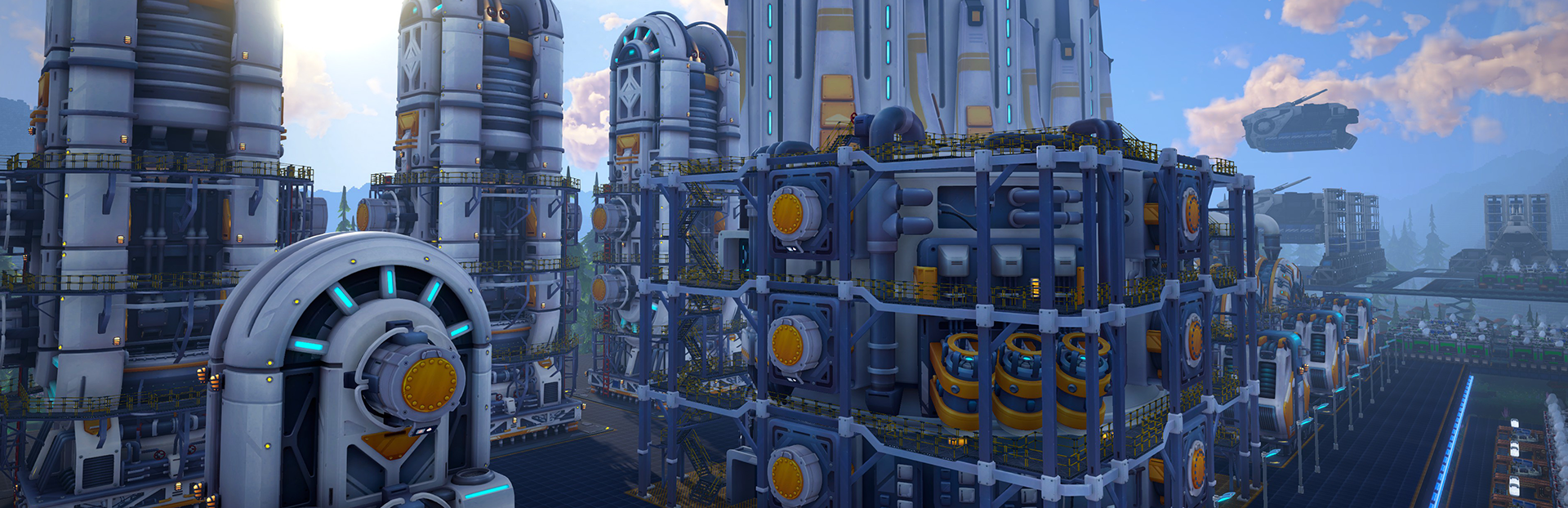
Our new power plant, made out of multiple modular buildings, will unlock new heights of power generation. The whole complex is made up of five different buildings, it can generate up to 360MW of power and it is fueled by new items derived from Xeno-Crystals.
Let's have a look at each of the five new buildings.
The Fuel Mixer
The building that creates the liquid reactor fuel from precursor items and liquids you’ll have to manufacture.
The Xeno Reactor
The central piece of the plant, the reactor burns the fuel and generates Energized Reactor Compound (another liquid).
The Steam Generator
A giant heat exchanger that takes the Energized Reactor Compound from the Reactor, and together with Water, it generates High-Pressure Steam and Depleted Reactor Compound. The Steam goes to the next building, while the Depleted Reactor Compound needs to be looped back to the Reactor.
The High Pressure Turbine
It works just like the regular Turbine, but it is much larger and produces ten times the amount of power. It needs High-Pressure Steam to generate power and produces Exhaust Steam as a byproduct.
The Cooling Tower
And finally, to disperse the Exhaust Steam from the High Pressure Turbine you need the Cooling Tower.
Except for the Reactor and the Steam Generator, which need to be connected in a loop, all buildings are to be connected sequentially. We initially thought about going for a more complex mechanic, but ultimately felt that this would be enough to achieve our goals. Those of you familiar with real life nuclear power plants will certainly see the parallels in the design approach, although in reality you’d have up to three loops instead of just one.
Let’s talk about the configurability of the modular buildings next. One of the key features our modular buildings support, is the ability to make buildings with different properties, depending on which or how many modules you use. However, for the power plant we have kept it straight forward, and there is no module tinkering on any of those buildings. The reason is simple: To modify a building, it needs to be shut down and construction can take several minutes. If the power plant is your main source of power, it is just too frustrating to be forced to shut it down as your factory might spiral into a power blackout. If your construction industry runs out of power, you can’t even finish the construction to get the power back up. We do not want to introduce any catastrophic pitfalls like that.
However we went with a different approach: The reactor can be throttled up or down, in steps of 10%, and this affects both power generation and fuel consumption respectively. For each 10% of reactor utilization, you’ll need exactly one Turbine. This allows you to start with a small power plant of, for example, just one or two turbines, which should be enough at the point where it is unlocked. After that you can gradually expand the generation capacity of the plant by building more turbines without the need to shut down the other parts of the plant.
Long Distance Transport Changes
We are going to make changes to the behavior of the shipping pads (planet to station ships). Specifically we’ll remove the ability to abuse them as long distance transport, you’ll only be able to either move items up or down, but not in both directions at the same time. They were never intended that way, and in all honesty it was an oversight on Update 2.
The most important information first: For existing saves, you’ll be prompted at savegame load if you want to switch to the new ruleset or not. So your factories won’t break if you heavily rely on it. For new games the new rules will be active.
Why are we doing this? We never wanted a free and ultra high throughput long distance transport. It made our cargo shuttles completely obsolete and no other logistics solution will ever be able to compete with it. While we’re adding Trains with Update 4, this is a change long overdue even if we wouldn’t add trains. I know this might be a little controversial, and I’m looking forward to reading your feedback on the topic.
Additionally we’ll also adjust the cargo shuttles so that they are more distinct from trains. They will get a speed increase, but at the cost of a storage capacity decrease. That means they’ll be even stronger for low to medium throughput, but they’ll be worse for moving massive amounts of items. Ultimately, this change does not force you to use trains, but it’s an incentive for certain goods. I think that different logistics systems should have different strong suits. Again, we’re looking forward to hearing your thoughts on that.
And finally before we conclude this blog post, I’d like to share one of the videos from our train stress tests:
And one more video, showing off another new building: The heavy caster, a replacement for the 96 Casting Machines needed for the largest Blast Furnace:
Thank you for reading and see you in two weeks, -mrmcd
Follow us on socials:
Stay tuned for more news! https://store.steampowered.com/app/983870/FOUNDRY/
Source
Changelog.gg summarizes and formats this update. How we read updates.