
In this update10
Full notes
Full Factory Town 2: Paradise update
Read the full published notes in a cleaner layout. The original post stays linked below.
What changed
- Gameplay
- Store
- Maps
- Events
- Balance
- Performance
Factory Town 2: Paradise changes
This month I wanted to share more specific details about exactly how Factory Town 2 is different (and hopefully better!) than the original Factory Town.
My goal for this sequel is that it will feel comfortable and familiar to everyone who played the first game, but with new content, deeper tech trees, more meaningful goals, and a generally more polished and intuitive set of gameplay systems. Check out below for a detailed description of what the major changes are!
~~~
Workers
The basic nature of worker units is completely changed from Factory Town 1 (FT1). For those who played the original, workers were placed manually and every task had to be assigned ("Pick up item X from building Y and deliver to building Z"). It gave a lot of control, but it was cumbersome. And eventually, all worker units could be replaced with conveyor belts and trains. All of the 'Town' behavior like happiness and purchasing from markets was performed abstractly and enforced with tricky concepts like road distance and town center links.
For the sequel, villagers are intelligent and autonomous. They show up to your island if there is space to live, and if your town is happy enough. They will identify buildings that have jobs available, and will perform the task as needed. They'll seek out a tool they might need to perform the job better. They get tired over time, and will go back to a specific house to sleep. They'll automatically switch houses, or jobs, if a more optimal placement opens up. They have several stats they will try to maintain by eating food in the wild, or purchasing items from nearby Markets.
These changes mean that I was able to remove all constraints on placement of buildings. You can put a house or market in the middle of the woods if you want. There are no official 'Town Center' buildings. You don't NEED to put roads anywhere. However - it will quickly become clear if your workers are spending their entire day trying to find a drink of water. So the layout of your town is determined by what makes real, logical sense and what enables villagers to be productive and happy.
You can still massively automate production, and most buildings themselves do not necessarily require a worker. But many tasks like harvesting, cultivation, fishing, and mining can only be done by villagers. This means that even in the end game, you'll have lots of little villagers running around performing tasks, which keeps the world feeling lively without micromangement.
I did maintain a few units like boats, wagons, and now trains (see below) that allow you to specify commands for picking up and dropping off specific items. So you'll still have that layer of control when you need it, but most item delivery within a town can be handled just by the workers doing what ever needs to be done.
Avatar
All of FT1 was operated from a 3rd person overhead view. Since the player did not have a presence within the game, there was no easy way to move a small number of items across the map, or to manually boost production temporarily. This also created some awkward inventory problems - to build anything on the map, items had to first be delivered to a building that provided shared storage, and items that were refunded basically went to a random town hall.
To fix these issues, FT2 gives you a controllable and customizable character that you can freely move around the map. You can directly harvest resources, cultivate crops, pick up items and drop them off to other buildings. There are various upgrades you can unlock that increase your capabilities.
However, the overhead view is still absolutely a part of the game. Whenever you need to build something, it automatically switches to the overhead view. You can also toggle views whenever you like. All construction costs are spent directly from the avatar inventory, so from time to time your character will need to collect building materials. But the avatar inventory will be very large (if not infinite), and fairly quickly you will unlock a special building that automatically deposits items directly to the avatar inventory. For players that strongly prefer the overhead view, the Avatar character is basically optional from early on. Still, I think players will find it's a convenient option to have and hopefully makes people feel more connected to the world.
New Items, Tech and Resources
There are several new technologies to master in Factory Town 2: Windmills, Water Wheels, and Steam Turbines generate Rotational Power, which can be transmitted between buildings via Drive Shafts. Rotational Power can be used to pump water and boost production speed of most buildings, and it can also generate Electricity. Electricity can be transmitted around the map via Power Lines, which itself can be turned back into Rotational Power via Motors. Electricity is also used to generate some special items like Ice, which you will need to make refreshing drinks and frozen treats.
Pastures no longer just spit out items like a factory. You can create pastures of any size by placing tiles, then you also need to place animals within those tiles. You need to supply animal feed and water to a place the animals can reach it. Then workers will harvest items from the animal and bring to nearby storage or production building.
There are tons of new resources: Coconuts, Limes, Lemons, Coffee, Cocoa, Vanilla, Tea, Bananas, Rice, Honey, Pineapples, Oranges, Silver, and Copper - in addition to many returning resources from FT1. These allow a wider variety of foods and drinks to be produced like Ice Cream Sundaes, Pizza, Banana Bread, Key Lime Pie, Cookies, Donuts, Lemonade, Iced Tea, Burgers, Dough, Pastry, Spaghetti, Mayonnaise, Sushi, and Waffles. New construction, tool and clothing options are available like Fishing Poles, Pillows, Towels, Copper Wire, Sandals, Backpacks, Steel, Scythes, Hats, and yes - Pants!
These new items allow for more complex production chains to make. Here's an example for how to make Coconut Cream Pie:
These longer production chains should challenge players to develop very large factories that stretch across multiple islands, and the need to maintain worker happiness and fulfill volcano requests should give the player nice rewards for exploring the full width of the tech tree.
As a side note, I'm not actually sure how much Magic power I'll include in this game. I think Mana Crystals will play a role in generating some tier of magical items, but the idea of Elemental Power will probably go away. I'm honestly not sure! I haven't been able to spend much development time on the late game stuff like that. If you feel strongly one way or the other, please let me know.
Underground Paths
FT1 had a series of 2D layers that let you build pipes on a grid. This was a bit awkward when connecting the 2D to the 3D world. It also meant that certain pipe types would often run out of space to build.
FT2 completely ditches the concept of 2D building layers - everything is built in the 3D world. Pipes can seamlessly flow between above and below the ground with no special connectors needed. You can connect pipes to buildings from underneath as well. There are many layers of depth so running out of space shouldn't be a problem, and the removal of multiple mana power types should help avoid that issue as well.
It's likely that conveyor belts and train tracks will be available to build underground as well, but that needs more development and testing.
Water Trenches
One of my big goals for FT1 was to have water flowing around the map, and a lot of development time was spent on that idea but ultimately it was scrapped for performance reasons. But in FT2 I have found a way to make this work. I am using special tiles called Water Trenches that allow water to flow between tiles, and it's done in a 'volumetric' way that means the water level can rise or fall and even run out if there's not enough new water flowing into the tile.
Digging water trenches will be important to make sure your villagers have access to drinkable water, and water is also used in making Paper, which is a key ingredient in many production recipes. Flowing water can also be used to turn a Water Wheel, which generates rotational power.
I may introduce dry and rainy weather which encourages players to build reservoirs of water so they don't run out.
Day/Night Cycle
FT2 has an environmental timer that smoothly transitions between day and nighttime. Besides creating pretty sunrises and sunsets, this also affects villagers - they get more tired at nighttime and this makes them go home to sleep. I might add some effect that decorative torches and lamps allow them to stay awake longer, but I haven't finalized this yet.
Trains
In FT1, trains would follow whatever path was in front of them, turning onto separate tracks based on gates or signals on the track immediately in front of them. If they moved past a building, they'd pick up or drop off whatever they could. This had some benefits, but it seems that most players would have preferred smarter trains that had a programmable set of destinations and items. So that is how trains have been built to work in FT2. It's actually the same control logic that boats and wagons use, with the exception that trains have to run on tracks. They're fast, have very high capacity, and no longer require fuel.
Boats
Boats in FT1 were kind of an optional delivery mechanism, and frankly I didn't invest enough time into making them work well. They would often get tripped up on long routes, because there are some tricky pathfinding problems when dealing with large open navigable areas. They would also awkwardly hug the jagged shoreline.
FT2's map consists of a series of islands separated by ocean, which means boats are now a major factor in moving items around the map. So, it was essential that their logic was improved. I spent a lot of time writing special navigation code just for oceans, and this allows boats to quickly identify optimal ocean routes while avoiding rocks or land barriers.
Item Mastery
Every time you harvest or produce an item, it increases your Mastery of that item. Many recipes are only unlocked once you have sufficient mastery of their input ingredients. You'll be able to plant new crops only after having enough mastery of them. Items with higher Mastery are worth more coins when villagers purchase them at the Market, and are more valuable to the Volcano. I'm trying to balance this so it doesn't feel like a grind, but instead is a naturally occurring reward and a nice incentive for boosting production amounts.
Storyline
FT1 had literally no story. Its development process was pretty unguided, I just added whatever felt interesting and necessary at the time. So, when I needed a big sink for high-end items in the late game, I came up with the OmniTemple and used it as the main victory condition.
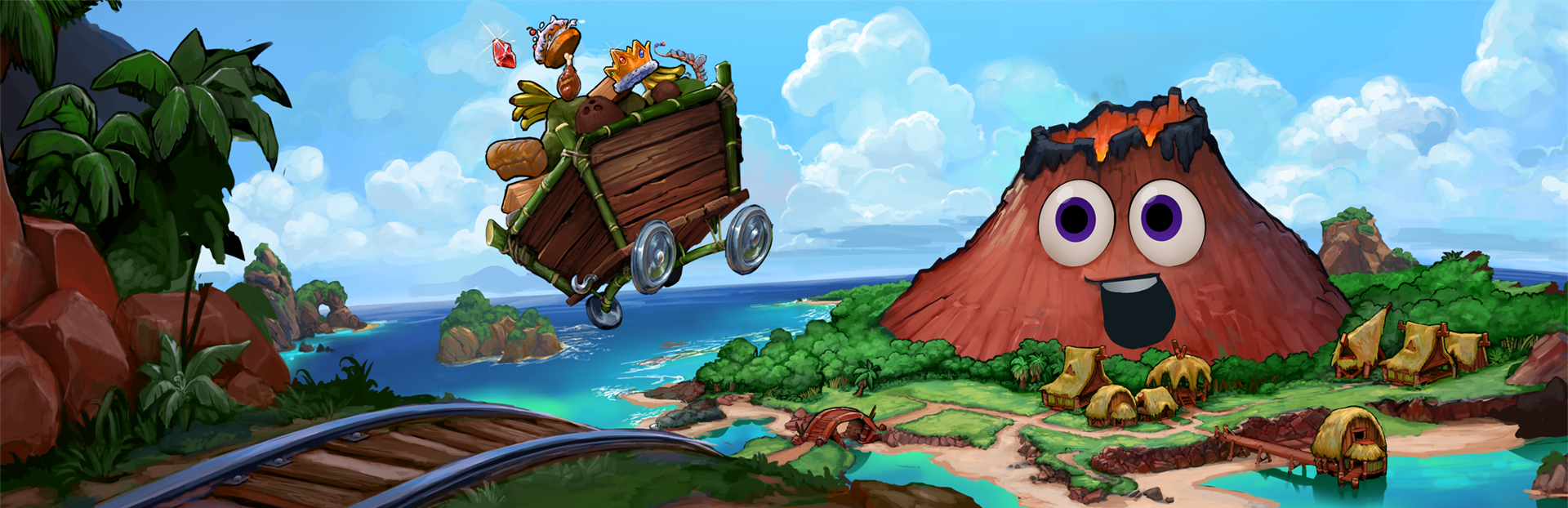
However, from the first moment I started the development of FT2 I had a very clear idea of how the game would take shape, and I knew Volcano was going to be the key driver of progression and it fit very nicely with a narrative that takes the player all the way through the game's conclusion. (There's more details on the functionality of the volcano in the previous month's post.) The story is pretty light and silly - the main focus of the game is still definitely on the satisfaction of growing and automating a mega-factory to produce and sell consumable items. But I've had a lot of fun writing dialogue and animating expressive reactions for the volcano, and I hope people enjoy this extra layer to the game!
~~~
That's not everything that's new, but it's probably enough for one newsletter : ) Next month I think I'll dig more into the various quality-of-life changes, including some of the tech I'm using to render tons of stuff on-screen in an optimized way.
Cheers!
Erik
Source
Changelog.gg summarizes and formats this update. How we read updates.