
Full notes
Full EQUILIBRIUM update
Read the full published notes in a cleaner layout. The original post stays linked below.
What changed
- UI and audio
- Balance
- Gameplay
EQUILIBRIUM changes
In the last devlog we talked about what your government cannot do: the commands that treaties, the constitution and the law won't let you execute.
This week we're talking about the constraint that remains even when you can do something. Because being able to do it doesn't mean being able to do it now, and for free.
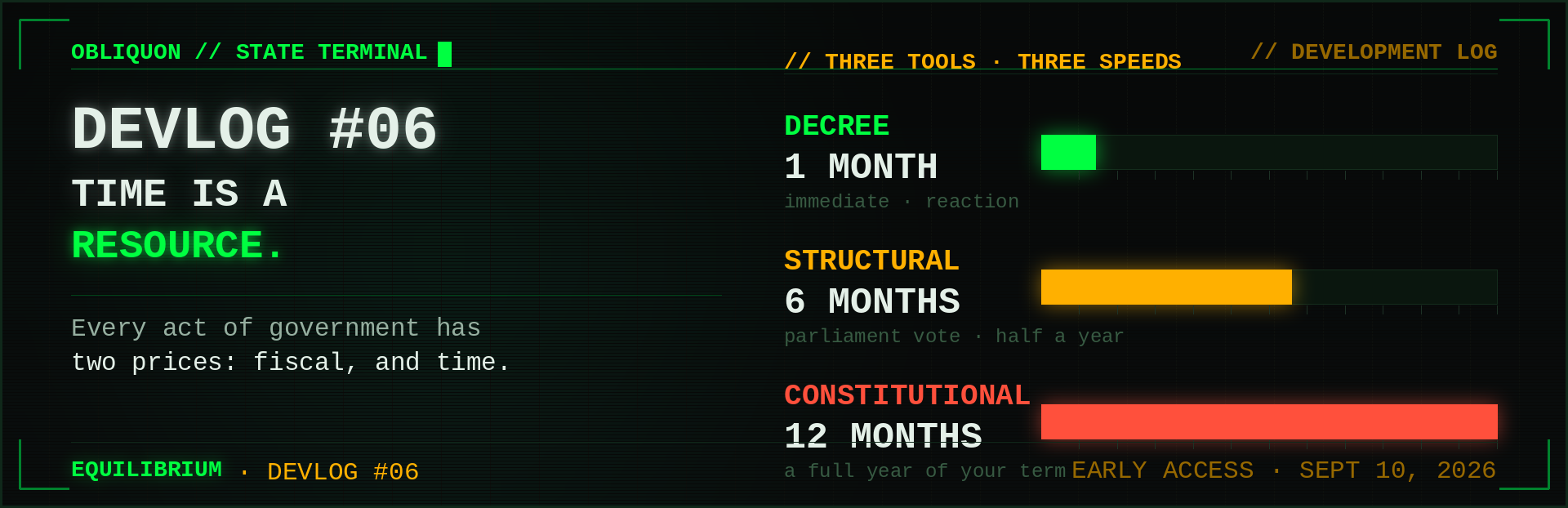
In EQUILIBRIUM every act of government has two prices. One is fiscal, and you see it right away. The other is temporal, and it's the one that changes how you play.
THREE INSTRUMENTS, THREE SPEEDS
Not everything you decide weighs the same on the calendar.
A decree is immediate. You type it into the terminal, it takes effect, the country moves forward a month. It's the instrument of reaction: a crisis blows up in your hands and you have to answer now.
A structural reform costs six months. It isn't a button: it's a bill that goes through Parliament — which can reject it — and if it passes, it takes half a year of your government with it. When you come back up for air, the world has moved on without waiting for you.
A constitutional reform costs a full year.
This scale isn't a penalty. It's how the game puts in front of you the question every real government asks itself: do I have enough time ahead of me to do the right thing, or do I have to settle for the fast one?
An administration at the end of its term can't afford a year-long reform. A government just sworn in that burns six months on the wrong law never gets them back. Time, in EQUILIBRIUM, is a resource you spend — and like every resource, it runs out.
WHY TIME WEIGHS: CRISES LAST
If time has a cost, then problems can't resolve themselves in a single turn.
In EQUILIBRIUM events have a duration. A commodities boom isn't a bonus you collect and forget: it's a window that opens and eventually closes, and it's up to you to decide what to do with it while it's open. A housing bubble doesn't catch you by surprise: it grows in plain sight, it warns you, and it lets you choose whether to act now — with the unpopularity that costs — or hope to reach the elections before it bursts.
And the effects accumulate. Two crises that overlap don't do twice the damage: they do far more, because they take away your resources to respond and your time to think at the same moment.
CONFLICTS LAST EVEN LONGER
The longest scale belongs to regional conflicts.
When one breaks out, it isn't a headline that scrolls past and disappears. It stays open for months. The price of oil moves, and keeps moving. Trade flows shift. Your alliances become suddenly awkward, or suddenly valuable.
And for all that time, every decision you make, you make inside that context. You can't pause the world and wait for it to pass: you have to govern while it passes.
WHAT IT MEANS WHEN YOU PLAY
Put the two pieces together — the time cost of your choices and the duration of what happens around you — and the central question of EQUILIBRIUM is never "what do I do now".
It's "what do I do now, knowing it will cost me months, and that when I'm done the world won't be the one it is today".
It's the reason the Prompt-to-Law mechanic works the way it does: writing what you want to do is instant, but what comes out of it has a weight, a duration and consequences you don't fully control. Like governing for real.
EQUILIBRIUM launches into Early Access on September 10, 2026. If the project interests you, adding it to your wishlist is the most concrete way to help — it helps me get it in front of more people.
The next devlog arrives next week.
— Andrea, Obliquon Corporation
Source
Changelog.gg summarizes and formats this update. How we read updates.