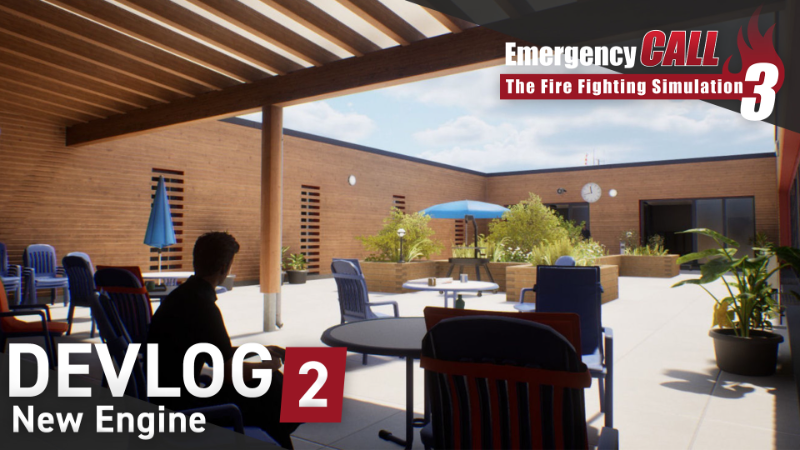
Welcome to the second part of our little devlog series! We spent a long time debating whether to switch to the latest Unreal Engine.
Full notes
Full Emergency Call - The Firefighting Simulation 3 update
Read the full published notes in a cleaner layout. The original post stays linked below.
What changed
0 fixes2 additions3 changes0 removals
Gameplay
Performance
Events
changedWelcome to the second part of our little devlog series! We spent a long time debating whether to switch to the latest Unreal Engine. After an extensive learning phase, however, it became clear that all graphical assets had to be completely reworked — or even recreated from scratch. In the end, very little from the previous titles could actually be reused.
addedCreating new UV mappings for the models
addedSetting up new materials
changedWith a lot of patience, some duct tape, and a bit of shader magic, we finally achieved a result we’re very happy with. The challenge now is maintaining this level of quality — even when deadlines start getting tight again. Here’s a comparison of the three “Notruf” titles that showcases the graphical evolution quite nicely.
changedThe programmers and level designers also had to adapt. Switching from C# to C++, learning the proper use of Blueprints, and exploring the countless implementation possibilities led to a much longer pre-production phase. But spoiler alert: in the end, nothing from pre-production actually made it into the final production build.
Emergency Call - The Firefighting Simulation 3 changes
changedWelcome to the second part of our little devlog series! We spent a long time debating whether to switch to the latest Unreal Engine. After an extensive learning phase, however, it became clear that all graphical assets had to be completely reworked — or even recreated from scratch. In the end, very little from the previous titles could actually be reused.
addedCreating new UV mappings for the models
addedSetting up new materials
changedWith a lot of patience, some duct tape, and a bit of shader magic, we finally achieved a result we’re very happy with. The challenge now is maintaining this level of quality — even when deadlines start getting tight again. Here’s a comparison of the three “Notruf” titles that showcases the graphical evolution quite nicely.
changedThe programmers and level designers also had to adapt. Switching from C# to C++, learning the proper use of Blueprints, and exploring the countless implementation possibilities led to a much longer pre-production phase. But spoiler alert: in the end, nothing from pre-production actually made it into the final production build.
Welcome to the second part of our little devlog series! We spent a long time debating whether to switch to the latest Unreal Engine. After an extensive learning phase, however, it became clear that all graphical assets had to be completely reworked — or even recreated from scratch. In the end, very little from the previous titles could actually be reused.
For the artists, this meant:
Expanding, adjusting, or recreating 3D models
Creating new UV mappings for the models
Reworking all textures
Setting up new materials
Importing everything into Unreal Engine
Optimizing assets for lighting with Lumen
What could possibly go wrong? :-)
With a lot of patience, some duct tape, and a bit of shader magic, we finally achieved a result we’re very happy with. The challenge now is maintaining this level of quality — even when deadlines start getting tight again. Here’s a comparison of the three “Notruf” titles that showcases the graphical evolution quite nicely.
The programmers and level designers also had to adapt. Switching from C# to C++, learning the proper use of Blueprints, and exploring the countless implementation possibilities led to a much longer pre-production phase. But spoiler alert: in the end, nothing from pre-production actually made it into the final production build.
At this point, a huge thank you to Aerosoft for making the transition to Unreal Engine and the learning process possible for us.