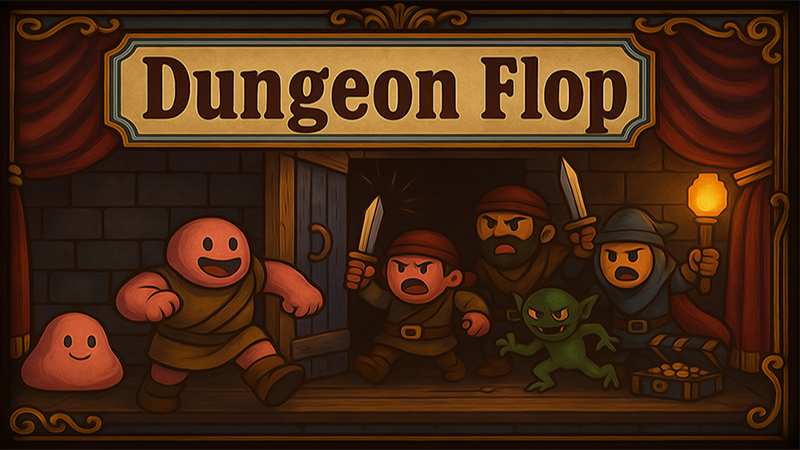
I haven't been posting a lot because I've been working hard on getting the demo done. only 2 months late, but hey, thats games.
Full notes
Full Dungeon Flop update
Read the full published notes in a cleaner layout. The original post stays linked below.
What changed
0 fixes2 additions1 change0 removals
Gameplay
Balance
addedI've decided to kind of hard line it at the end of the month. I need some metrics and i need some encouragement. I'm hoping that pushing it out will get some people together who say, 'Hey! i think thats pretty neat.' I think its close enough that people can kind of get where its going instead of just a wall of ideas. Here we see abilities being added and removed from a unit when items are equipped and unequpped. Also 2 bugs! Hope i solve those before the demo!
changedAnother reason for me to make games is as a field test for decision making frameworks that i like to invent. One of these is called KLEP, a decision making framework that is symbolic in nature and based on how i think we think. Dungeon flop lets me extend the social, emotional and ethical side of that and give it a playground to prove itself in. Units now use chat to interact, formulate memories based on those interactions as well as what happens in a dungeons run, and that influences relationships as well as AI decisions. I think i may want to extend this into a kind of mad lib meets LLM kind of thing where the framework of a message is there, but a model then picks out an adjective instead of a whole sentence. Example: "You nearly hit me you, {orkish insult for elf}!" I dunno. We will see. #BuyMyGame.
addedOh yeah, i almost forgot. I hypothesize that our emotions are expressions of our ethical evaluations of the actions of those around us and ourselves. In other words, when people act like jerks, we get mad. This is expressed as a X/Y chart like the arousal-valence model proposed by James A. Russell in 1980. Yeah i copy pasta that from google. Emotion is tracked as a simple 2D space (calm ↔ intense, negative ↔ positive), so interactions push characters into different emotional states that affect future decisions. Because we can track how emotionally unstable someone has been (high swings) as well as duration of being in a quadrant (consistently high intensity good feeling). This is data that can be used to shift the tone of a dialogue choice. Obviously, pair that with some LLM magic and maybe it could be cool. Maybe it could be a dumpster fire. Maybe it could be Maybelline? Who knows. I'm not to the bridge yet. Leave me alone. Im grumpy now. Hump!
Dungeon Flop changes
addedI've decided to kind of hard line it at the end of the month. I need some metrics and i need some encouragement. I'm hoping that pushing it out will get some people together who say, 'Hey! i think thats pretty neat.' I think its close enough that people can kind of get where its going instead of just a wall of ideas. Here we see abilities being added and removed from a unit when items are equipped and unequpped. Also 2 bugs! Hope i solve those before the demo!
changedAnother reason for me to make games is as a field test for decision making frameworks that i like to invent. One of these is called KLEP, a decision making framework that is symbolic in nature and based on how i think we think. Dungeon flop lets me extend the social, emotional and ethical side of that and give it a playground to prove itself in. Units now use chat to interact, formulate memories based on those interactions as well as what happens in a dungeons run, and that influences relationships as well as AI decisions. I think i may want to extend this into a kind of mad lib meets LLM kind of thing where the framework of a message is there, but a model then picks out an adjective instead of a whole sentence. Example: "You nearly hit me you, {orkish insult for elf}!" I dunno. We will see. #BuyMyGame.
addedOh yeah, i almost forgot. I hypothesize that our emotions are expressions of our ethical evaluations of the actions of those around us and ourselves. In other words, when people act like jerks, we get mad. This is expressed as a X/Y chart like the arousal-valence model proposed by James A. Russell in 1980. Yeah i copy pasta that from google. Emotion is tracked as a simple 2D space (calm ↔ intense, negative ↔ positive), so interactions push characters into different emotional states that affect future decisions. Because we can track how emotionally unstable someone has been (high swings) as well as duration of being in a quadrant (consistently high intensity good feeling). This is data that can be used to shift the tone of a dialogue choice. Obviously, pair that with some LLM magic and maybe it could be cool. Maybe it could be a dumpster fire. Maybe it could be Maybelline? Who knows. I'm not to the bridge yet. Leave me alone. Im grumpy now. Hump!
I haven't been posting a lot because I've been working hard on getting the demo done. only 2 months late, but hey, thats games. All major features are implement, things work but just aren't polished or communicated well. Dont get me wrong, there is still more work to be done, but i'm now into weeks away and not months away territory.
I've decided to kind of hard line it at the end of the month. I need some metrics and i need some encouragement. I'm hoping that pushing it out will get some people together who say, 'Hey! i think thats pretty neat.' I think its close enough that people can kind of get where its going instead of just a wall of ideas. Here we see abilities being added and removed from a unit when items are equipped and unequpped. Also 2 bugs! Hope i solve those before the demo!
Another reason for me to make games is as a field test for decision making frameworks that i like to invent. One of these is called KLEP, a decision making framework that is symbolic in nature and based on how i think we think. Dungeon flop lets me extend the social, emotional and ethical side of that and give it a playground to prove itself in. Units now use chat to interact, formulate memories based on those interactions as well as what happens in a dungeons run, and that influences relationships as well as AI decisions. I think i may want to extend this into a kind of mad lib meets LLM kind of thing where the framework of a message is there, but a model then picks out an adjective instead of a whole sentence. Example: "You nearly hit me you, {orkish insult for elf}!" I dunno. We will see. #BuyMyGame.
Oh yeah, i almost forgot. I hypothesize that our emotions are expressions of our ethical evaluations of the actions of those around us and ourselves. In other words, when people act like jerks, we get mad. This is expressed as a X/Y chart like the arousal-valence model proposed by James A. Russell in 1980. Yeah i copy pasta that from google. Emotion is tracked as a simple 2D space (calm ↔ intense, negative ↔ positive), so interactions push characters into different emotional states that affect future decisions. Because we can track how emotionally unstable someone has been (high swings) as well as duration of being in a quadrant (consistently high intensity good feeling). This is data that can be used to shift the tone of a dialogue choice. Obviously, pair that with some LLM magic and maybe it could be cool. Maybe it could be a dumpster fire. Maybe it could be Maybelline? Who knows. I'm not to the bridge yet. Leave me alone. Im grumpy now. Hump!
Ok. Thats about it. I dont know where i left off and extra lazy right now. So yep.