
In this update3
Full notes
Full DCS World Steam Edition update
Read the full published notes in a cleaner layout. The original post stays linked below.
What changed
- Store
- Gameplay
- UI and audio
- Balance
- Events
- Maps
DCS World Steam Edition changes
Dear Fighter Pilots, Partners and Friends,
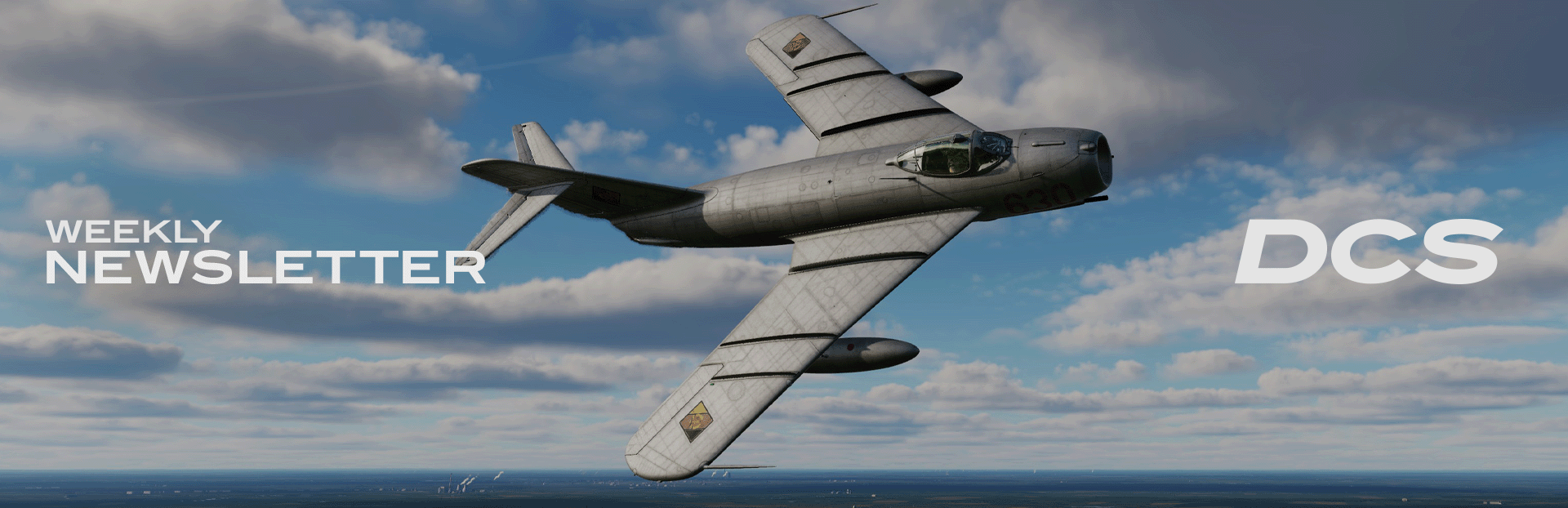
This week, we are taking a closer look at the DCS: MiG-17F by Red Star Simulations and, in particular, the VK-1F engine that powers the “Fresco”. From its distinctive afterburner kick to its unique cockpit cues that all pilots appreciate, this development report details some of the special features of this excellent model. See how the DCS: MiG-17F will look, feel, and perform with authentic, real-world limitations.
This is the final notice of the DCS: C-130J Livery Contest, and your last chance to submit your work. The community has delivered some impressive entries, but there’s still time to make your mark and secure a spot among the top ten. Earn rewards, recognition, and official DCS: C-130J skin while time remains. See the full details below.
Take part in the large-scale, multiplayer operation from the JATF as the Shadderstrike online campaign unfolds over Syria. Built for realism and coordination, this campaign delivers high-intensity, multi-role missions in a structured multiplayer environment. With human-controlled airspace and a wide range of supported modules, it’s a true test of teamwork and discipline. Find out more below.
Thank you for your passion and support.
Yours sincerely,
Eagle Dynamics
DCS: MiG-17F Development Report
By Red Star Simulations
The MiG-17F was powered by the VK-1F turbojet engine, a classic Soviet design that was built on the proven VK-1 turbojet of the MiG-15bis. The engine originated as a reverse-engineered and improved version of the British Rolls-Royce Nene centrifugal-flow turbojet. In 1946–1947, the UK government (under Prime Minister Clement Attlee) authorized the export of Nene engines to the Soviet Union for diplomatic reasons. The Soviets initially produced a direct copy designated the RD-45, then refined it—addressing metallurgy and other issues with larger combustion chambers, an improved turbine, and other modifications—into the more powerful VK-1 under the leadership of designer Vladimir Yakovlevich Klimov. The VK-1 was a workhorse of its era, powering the dawn of Soviet jet aviation, and the VK-1F added an afterburner for that extra kick when needed. The afterburner itself is a simple affair: Fuel is sprayed into the exhaust and ignited, providing a significant increase in thrust. There was a short delay before full afterburner power was achieved, a hallmark of the robust, no-nonsense engineering of early jet engines.
The Look
In real life, through the lens of a camera, the MiG-17F’s afterburner puts on quite a show. Its wisps, segments, and bloom in the exhaust plume are notable. With the naked eye, what you’ll see is a steady, bright flame. This is what we’ve recreated for you in the DCS: MiG-17F module.
The Feel
There’s no afterburner light indication in the MiG-17F cockpit. Instead, pilots rely on aircraft feel and changes in acceleration to provide cues when the afterburner is lit. In DCS, you’ll pick up on these same cues through sound, aircraft response, and subtle shifts in engine readings without a dedicated indicator light.
Afterburner Operation
MiG-17F pilots didn’t just slam the throttle into afterburner whenever they felt like it. Soviet doctrine emphasized engine longevity, so standard takeoffs were usually done without afterburner; even training flights kept engine management conservative. The afterburner was reserved for moments when you really needed it, and it delivered about 25% more thrust.
In DCS, you’ll need to keep a close eye on afterburner use. Once it’s lit, engine temperatures will start climbing, and when you see the needle nearing 730°C (into the red), it’s time to back off. Push it too far, and you risk engine damage or even failure. After shutting down the afterburner, bring the RPMs below 11,200 to help cool the engine. You’ll usually see Exhaust Gas Temperature (EGT) drop below 690°C within half a minute, and you’ll then be able to safely use the afterburner again.
The Bottomline
Even without the afterburner, the MiG-17F is no slouch. At combat weight, you can expect to hold a turn rate of 13 to 14 degrees per second. Kick in the afterburner, and that jumps to around 16 degrees per second, giving you a competitive edge in a dogfight.
During the early Cold War years, 13 to 14 degrees per second, and up to 16 with afterburner, made the MiG-17 a capable opponent when compared to faster but less agile fighters of the era. Later fighters like the F-16A and F-5E Tiger II would eventually raise the bar, but in its day, the MiG-17 set the standard for turn rate.
Final Call for the C-130 Livery Contest!
Contest ends soon!
The window for DCS: C-130J Livery Contest submissions is nearing its end, and if you haven’t already posted your entry, now is the time. The community’s creativity and attention to detail have been outstanding, and there’s still time for your livery to be considered. Together with Airplane Simulation Company and WINCTRL, we’re on the lookout for outstanding liveries that could become official additions to DCS World. The top ten liveries will be included as part of the module, and your will be credited in the C-130J manual.
Don’t miss your chance to see your work featured in DCS, earn valuable ED Miles, and win hardware from WINCTRL. Whether you’re inspired by real-world liveries or dreaming up something completely unique, now is the time to put the finishing touches on your design and get it submitted.
The deadline is April 6th, 2026, at 23:59 GMT. The Tiger Scheme Bonus Challenge is also still open.
For full contest details, visit the official forums, and upload your entry before it’s too late.
JATF Community Campaign
The campaign continues!
The Joint Air Task Force (JATF) is delivering a new, highly structured, immersive, online DCS campaign that is created by a member of the 1st Bosnian Air Squadron. Their Shadderstrike operation is underway, and it puts players in a high-intensity environment over western Syria.
This JATF Community campaign features a hybrid adversary equipped with modern air defence systems and advanced military hardware that is supported by external state actors. Pilots will take part in numerous coordinated tasks that includes SEAD, CAS, CAP, and pinpoint-strike missions during various weather conditions. A strong emphasis is placed on realism, disciplined execution, and aircraft survivability through a structured-consequence system.
Operations are carried out across three primary airbases: Incirlik, Akrotiri, and Ramat David. Each is supported by human ATC controllers, dedicated AWACS/GCI, and a Tactical Commander that oversee the larger battlefield. This creates a highly organized airspace that replicates real-world coalition operations.
A wide range of modules is supported that includes the F-16C, F/A-18C, A-10C II, F-15E, CH-47F, C-130J, AH-64D, Mi-8MTV, and UH-1H. This affords opportunities for both fixed-wing and rotary-wing pilots to contribute across diverse missions.
JATF is preparing its next campaign that is scheduled to begin on April 13, and it will continue its focus on large-scale, coordinated, multiplayer operations.
For a structured, realism-driven experience, visit the JATF website or join the Discord server.
Thank you again for your passion and support.
Yours sincerely,
Eagle Dynamics
Source
Changelog.gg summarizes and formats this update. How we read updates.