
Full notes
Full D.O.R.F. Real-Time Strategic Conflict update
Read the full published notes in a cleaner layout. The original post stays linked below.
What changed
- Maps
- Events
- Compatibility
- UI and audio
- Balance
- Gameplay
D.O.R.F. Real-Time Strategic Conflict changes
One of D.O.R.F.'s major design goals is the inclusion of a functional and fun naval combat system. In addition to your expected ground and air forces, we want to ensure that water in the game isn't limited to just being an obstacle for your conventional land forces, and actually is a battlefield all of its own. Not only will you be able to command powerful naval forces, but these will be able to intersect and abet your ground forces as well, with many options for making amphibious landings, coastal bombardments and creating air defense zones with your sea vessels. Now, while I'm sure plenty of people saw the inclusion of naval combat in D.O.R.F. and were delighted, I'm also sure there were plenty of other people who saw its inclusion and groaned, and honestly, I don't totally blame them. In theory, naval combat in RTS should always be cool, since how hard can it be to implement working battleships? Of course, if you've played a lot of RTS games, you'll recognize that in practice, unless the game is Supreme Commander or one of its derivatives, having ship-to-ship combat usually doesn't go so well.
So, recently, I had the pleasure - and displeasure, as I will elaborate on later - of playing some C&C mods, specifically Dawn Of The Tiberium Age and Combined Arms. Both mods are highly ambitious, aiming to massively expand the content of the original games they modify, as well as include an absolutely gigantic series of campaigns. Both also have a major theme of trying to tie the entire C&C franchise together. DTA uses art assets from the original Command & Conquer and Red Alert, as well as fully new artwork, to create a combined setting that merges factions and concepts from both the original games into a single cohesive world, and even includes a series of campaigns with different mission variants and event triggers than can radically alter the course of the story and how individual missions might play out. Combined Arms is even more ambitious, acting as a sort of C&C Greatest Hits, offering 5 fully playable factions, with their own unique set of subfactions, with all units and features within sourced from one of the many official C&C games, which despite the wildly different worlds they can sourced from, all manage to feel fully cohesive in this new combined universe. Both games manage to also make full use of their respective game engines, utilizing features not fully possible or less explored in the games they are sourcing from.
What does all this have to do with naval combat in D.O.R.F.? While they are ambitious, and pretty well-made in many ways, you can really see both of these mods struggling when it comes to implementing functional naval combat, in both cases, mostly stemming from the latent limitations of their respective engines. As with any game mod, the sky isn't the limit, and often times, what ambitious modders are capable of may just be not feasible within the constraints of the engine they are working with, and some things that are possible may come at the cost of clearly working against a game engine that was never designed to perform such tasks. To be clear, the naval units in these mods feel very much in the vein of struggling against the limitations of their engines, and seem present mostly as a celebration of C&C's entire history, which of course included naval units in some games. In other words, the naval combat in these mods just isn't good, and although naval combat was a relative rarity in both mods' campaigns, but whenever it did show up... oh boy.
Dawn Of The Tiberium Age, being built off of the Tiberian Sun engine, is a recreation of the original Command & Conquer and Red Alert, using graphical assets from those games while adding new features that the upgraded Tiberian Sun engine allows for. This also, of course, includes naval units, which were a feature of Red Alert, and also something that technically did exist in the original Command & Conquer, if we are being comprehensive. Right away, this feature does run into one of the major issues of C&C games (and old RTS games in general), which is the problem of scaling. No matter the actual visual size of the unit, units must always necessarily be a single tile size in terms of pathfinding and collision, and so this means their actual sprite must be kept small. Another problem latent to the engine of Tiberian Sun is the lack of multi-weapon targeting. While some units can have multiple weapons (such as a unit that can fire cannons at a ground target and missiles at aircraft), there is no inherent limitation on turret traversal (turrets must be able to rotate 360 degrees), and separate weapons cannot be bound to separate turrets. If you know what a warship looks like in real life, you can see why these would be problems; DTA naval combat inevitably degenerates into using a swarm of slow-moving boats, all clipping through each other's sprites, to fire at each other with one weapon type using a single turret, because having more accurately-scaled warships bristling with different weapons that must be well-positioned to use simply would not be possible in the game engine. It is playable, it is technically functional, but it certainly leaves something to be desired.
Playing through DTA's campaign (or campaigns, as the game is split into multiple story routes, and includes a number of bonus missions that don't tie in anywhere story-wise), it became obvious the developers were aware of these problems, as naval gameplay was still relatively rare, and when it did show up, in many cases it involved a limited number of ships, and you couldn't build any more. Some of the later missions also did feature some powerful endgame naval units, such as an extremely powerful Soviet super submarine that you can only build one off, which can fire long-range ICBM's at land targets, and torpedoes for ship-to-ship combat. Another fun one was a GDI aircraft carrier, that similarly was rare and expensive, but could dish out extreme firepower over long ranges. These tiny few super units seemed to better grasp the ideal of how naval combat should function. Also worth pointing out is that a number of the game's naval missions are featured in those unaffiliated bonus missions mentioned above, rather than in proper storyline missions, and so were likely just beta missions, where the devs realized that naval combat in general was too rough to be worth putting into the main game.
[c]Somehow, something about these car-sized warships makes this epic naval bombardment sequence a lot less epic than the developers probably intended.[/c]
Combined Arms, being based on the OpenRA engine, has similar limitations, with the addition of that engine also including no acceleration or deceleration logic for ground units (units will move to their top speed instantaneously, and stop instantaneously). OpenRA also has a feature that the older Command & Conquer games don't have, which is that units can fire on the move. This sounds good in theory, except in the case of naval combat, it actually becomes quite a balance problem. So, not only do you have no weapons variety for ships and tiny pathfinding collision boxes, but they also move to top speed instantly, and can fire while moving. The end result is that navies that include rosters of fast moving units (such as Nod's rocket-launching speedboats) absolutely dominate the seas, while more conventional naval units are just terrible.
Now, the counter to these are submarines, which strangely, have torpedoes that deal splash damage to large numbers of boats (a single torpedo can sink multiple speedboats). In theory, this means you should be able to reliably use submarines if you have access to them, since they often outrange other ships, and can sink multiple smaller ships in one shot. In reality, however, the end result is the worst sort of gameplay, the kind where something sucks for the player to use, but is also absolutely devastating when used against the player by the AI. Any missions where you face enemies using submarines means that the mission becomes a slog of hurling swarms of expendable boats to overwhelm submarines that may be hidden in the waters, because any time the enemy does have submarines, the ocean will be absolutely littered with them.
To make matters worse, because submarines often outrange other naval units with their torpedoes, whenever the enemy does attack with subs, your own naval units will just sit around like idiots while they are torpedoed to death, and because there are no naval defense structures, you'll need to rely on naval units to defend your waters. On top of all this, Combined Arms naval units are squishy. As strange as it is, while most tanks in the mod can take a bit of punishment, naval units will absolutely get blasted to pieces very quickly, even from weapons that would do much less damage to tanks. You can't just leave your fleet sitting around idly; a single torpedo can easily destroy several light naval units in a single blast, and the larger vessels don't fare much better. This all means that you'll need to have extreme micromanagement skills, between micro-ing your fast boats to navigate around enemy torpedoes constantly, while also constantly babysitting your other naval units to keep them from just getting blasted by enemy submarines while you weren't paying attention.
Just like with DTA, it seems the developers of Combined Arms also realized these limitations, as proper naval missions were still relatively rare throughout the game, to the point where (unless I'm mistaken), the GDI campaign only has a single mission that so much as features their own navy. Given that these problems, again, stem largely from the constraints of the engine that the game operated on, it seems like the developers were in an awkward position, where not putting in naval combat would feel like leaving out a substantial component of the original games they are sourcing from, but then putting in naval combat meant they'd simply have to include sub-par unit design as a necessity.
Of course, a lot of these problems go back to the source, which is the original Red Alert. While the naval combat in that game was certainly an innovation for 1996, Westwood didn't focus on that aspect of the game as much its ground combat, and so the end result in that game is similar problems to those described above, with the added issue of an extremely limited naval roster for each side. Not including transport ships, the Allies only get a Gunboat, a Destroyer and a Battlecruiser, while the Soviets are even worse off, with only a single Submarine type to their name, although they do get a missile-bombardment submarine in one of the expansions to the original game. So not only do the naval units not play well or control well, but there's not a whole lot of strategy to be had with such a limited roster. To bring this all back around to what this means for D.O.R.F., we are working on ensuring that the game's systems don't run into all these issues. While D.O.R.F. still runs on OpenRA, the same engine that Combined Arms uses, it's been heavily modified to the point where many fundamental things like unit movement and attack logic function totally differently and are much more advanced, and at this point, D.O.R.F.'s engine is completely different from its OpenRA ancestor.
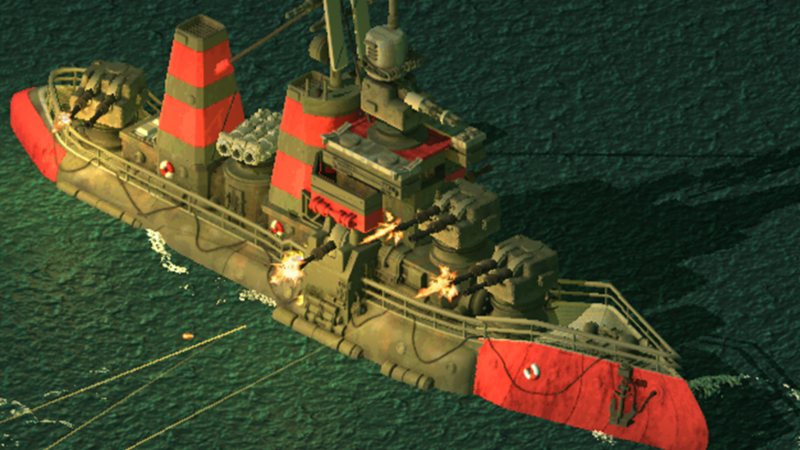
As seen in the video, units are not constrained by the sorts of weapons they can possess, which turrets they are assigned to, and turrets can have a limited traverse, allowing for warship units that can have multiple weapons on them (some may even have dozens of different weapons). Units will also be able to have large collision boxes, leading to warships that are actually more accurately-scaled. This all means we'll be able to design naval units around this lack of restriction, and so naval units won't be these pathetic crappy units that are tantamount to waterbound gun trucks, but instead will be extremely powerful, extremely expensive units that you will only ever field a few of, more akin to endgame super units than normal units.
As an example, the Destroyer (the vessel in the thumbnail of the above video) is largely a ship-to-ship and air-defense vessel, equipped with three double-barreled 5cm autocannon turrets, two side-mounted 5cm autocannons, a torpedo launcher, an anti-missile turret on its main tower, and we are also experimenting with giving it both surface-to-air and surface-to-surface missiles. Of course, there will be many more naval units than just the Destroyer. To avoid the Red Alert problem of barely having any naval unit variety, each faction will have enough naval units to provide enough strategic depth to naval combat that naval-only maps will still be fun and engaging, and not feel like using the same one or two units over and over again. Each side will get their share of light patrol craft, anti-air vessels, ship-to-ship vessels, ships intended for shoreline bombardment, submarines, and even some logistics vessels, as well as various permutations or combinations thereof.
We've even updated the game to include acceleration and deceleration for units, as well as movement that's unbound by the map grid, making for far more natural movement (although this movement logic was only just implemented, and isn't present in the video posted above). We've also implemented a convenient automated transport route system; if you designate a transport route across a body of water from one shore to another, and then attach an amphibious transport to the route, any units ordered to cross the otherwise impossible to cross body of water will instead automatically seek out the transport route and use that instead. We also plan on including water in the logistics gameplay, where reinforcements brought from off-map will have to use water transports in certain circumstances, and there will be special naval cargo units to transport supplies and resources between bases, if the situation arises, and naval units will also need to have a supply chain of ammunition, lest they run out of rounds for their heavy guns. There will also be some special capturable water structures, such as off-shore oil rigs.
Also, while not totally related to naval combat itself, we are also going to go with a rather unique solution to water itself. Rather than water just existing as regular terrain tiles, water will instead be partially simulated, insofar as water levels are dynamic, and water can be drained from a reservoir if its surrounding ground barrier is destroyed, and will dynamically flow from terrain tile to terrain tile. This sounds like a lot of work for something that doesn't provide much benefit to the game, but, aside from the fact that it will solve a lot of graphical issues in the game, as well as solving the issue of how water fits into our terramorphing gameplay, a lot of this work has already been done for us. We can essentially modify the flow simulation logic we already have in place for the game's pipeline structures, and just apply that to water flowing on the terrain itself.
The goal of our naval unit design philosophy is simple; navies should actually be fun to use. Naval units should be epic, powerful units, expensive to produce but being able to individually deliver extreme firepower. They should not be crappy, cheap units you send off to die in droves. They should be a floating fortress of armor and armaments, not something that can be destroyed in an instant if you stop paying attention to that part of the map for one too many seconds, and not something armed only with a single pathetic weapon. A naval unit being deployed to the battlefield should be a considerable change in the course of the battle, and a naval unit being destroyed should feel like an event in of itself.
Source
Changelog.gg summarizes and formats this update. How we read updates.