
Full notes
Full Canyons update
Read the full published notes in a cleaner layout. The original post stays linked below.
What changed
- Gameplay
- UI and audio
- Store
- Balance
- Server
- Maps
Canyons changes
Greetings to all fans of sand, shooting, and various toothy monstrosities! Today’s big (huge — or even gigantic, like our writer’s ego) update is dedicated, as you might’ve guessed from the title, to the grand reimagining of Canyons. Yes, that’s right — the project has changed a lot since the first trailer, and we feel morally obligated to tell you why, in which direction, and what on Earth (or rather, in the canyons) is actually going on.
Oh, and very soon we’ll be releasing a 15-minute gameplay video, recorded straight from the test build — no cuts, no editing! But before that, we’d like to share a new short trailer, from which you can already draw your first conclusions:
Pew-pew, tra-ta-ta-ta! Some voice shouting, everything flashing, people running around. Looks cool, looks clear enough. See you next time, folks! Add Canyons to your wishlist!
A-aand… fine, fine. Details then. Where do we even start… probably from the beginning. So what exactly is Canyons? What kind of game is it, and what do you actually do there? Surprisingly, that’s the part that’s changed the least — at least in the grand scheme of things. Canyons can safely be called a third-person co-op action game with survival elements. The core gameplay focuses on exploring a procedurally generated world, completing missions, collecting loot, and returning to your settlement to upgrade, rebuild, and prepare for the next adventure. Each gameplay loop can last anywhere from five minutes to infinity — depending on your motivation, skill, and luck. The deeper you venture into the canyons, the tougher it gets to survive: enemies grow stronger, but their loot becomes all the more precious.
So wait — if nothing’s changed, then what has changed? Everything! How’s that even possible? Like this!
The original concept — riding crawlers through hordes of zombies — looked kind of fine on paper, but also raised a few eyebrows. Early tests confirmed it: yes, it technically worked, but playing a technically fine game with technically fine gameplay and technically fine lore wasn’t exactly what we wanted. So we started tearing it all down and rebuilding the game from the ground up.
First thing in the trash: the lore — or, more accurately, the near-complete lack of it. Zombies are fun, sure… but a bit dull. We decided to move away from completely overused ideas toward ones that are only slightly overused. One concept that really clicked for us, both thematically and visually, was the Crusaders — all those insane warriors with their unshakable belief in being right; a messy blend of mysticism, religion, politics, and economics. The Crusaders became the foundation for a new, strong, and somewhat questionable organization: The Order of the Divided Cross — the faction you’ll be trudging around with in the game.
The Order’s core idea is the worship of the Holy Captains and their symbiotic pacts with The Awakened — living, or rather reanimated, things (we’ll get to those later). The Crusaders pray to Life itself and glorify it — even when it takes the form of a dried-up, toothy monster head or the severed hands of a “saint.” Their faith is... richly debatable.
The Order is so ancient that nobody remembers when it began. Its members grew in power, as religious orders tend to do — oppressing everyone who disagreed with them — until strange rumors began to spread: reports of things coming to life without a Pact! Impossible! The power of Life within an object requires complex rituals monopolized by the Holy Church! That simply won’t do, people.
To investigate this blasphemous revival, the Order sends out whoever it can — including rookies and disgraced Crusaders. Those of lesser importance are dispatched to hopeless, godforsaken places like the Canyons, where they’re expected to remain until further notice… or until they somehow complete the mission assigned by their holy superiors.
And so here we are — our team of misfits, outcasts, and unwanted zealots — stranded deep within the Canyons, trying to survive, fulfill our sacred mission under the watchful eye of our “God of Life” and the revered Awakened Ka’dorrul, as we slowly descend into the mysteries of a world that refuses to stay dead.
Next into the trash — the design. Previously, everything looked like a post-apocalyptic circus with traces of Mad Max scattered all over it. But once we shifted toward Crusaders and mysticism, the project finally found a clear stylistic direction.
On one hand — cuirasses and cloaks; on the other — since the game takes place after an unprecedented catastrophe that wiped out a far more advanced civilization, our Crusaders couldn’t completely escape the post-apocalyptic vibe. They ended up fused with the aesthetics, weaponry, and machinery of World War I.
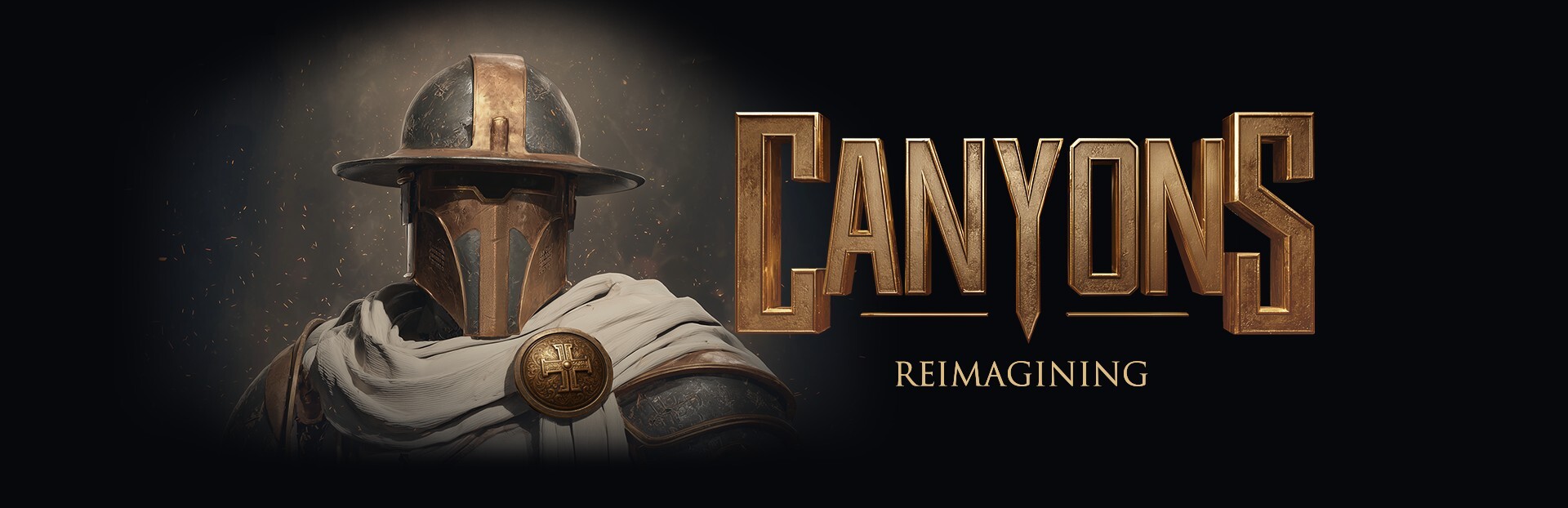
You can easily see that blend in the Crusaders’ outfits and gear. For example, in the concept art of the main character — the Captain (yes, he has a real name, but everyone just calls him that) — you can clearly trace how a medieval cuirass and bracers merge with military boots, ammo pouches, and firearms, while his old-style helmet has adopted the wide brim typical of many WWI designs.
In addition, belonging to a special religious order leaves its mark on the overall design. The main symbol of The Order of the Divided Cross, surprisingly enough, is… the divided cross itself. (Yes, we truly shine with originality.) It represents the sacred pact with The Awakened — two sides united by common purpose, walking the same path.
Beyond the crosses, certain elements of the Crusaders’ attire draw clear inspiration from ecclesiastical fashion. For instance, the standard outfit of another team member, Temira, closely resembles traditional monastic robes — long garments, covered head — which makes sense, considering that’s where she originally came from.
Of course, not all members of the Order wear heavy ceremonial attire — there are more casual outfits too, especially among those at the very bottom of the hierarchy. For example, Ilmar — the youngest, most inexperienced, and still-optimistic member of our squad — is depicted in a simple field uniform, with only subtle hints of allegiance to the Divided Cross.
Naturally, all those bits of metal and fabric will ultimately be up to the player. You’ll be free to dress Temira in a bikini or slap a clown suit on yourself — assuming you can dig one up from the ancient ruins — though the defensive qualities of such fashion choices may leave something to be desired.
The redesign didn’t just affect the main characters — everything else went into the trash as well. But before we dive into the schizophrenic fantasies of our artist, we should probably talk about the zombies we threw out and the new concept of enemies in general — courtesy of the schizophrenic fantasies of our writer.
So… who exactly are The Awakened?
The name says it all — they’re “the Awakened.” Simply put, alongside the world of humans, there exists another plane of reality from which strange entities emerge and inhabit inanimate objects, bringing them to life. Some call it Hell, others call it something else entirely — nobody really knows, beyond the scattered legends. The Awakened themselves never speak about their realm, though they don’t seem particularly fond of it.
Much of the world’s religious conflict stems from differing views on these entities. The Crusaders see them — at least publicly — as the souls of saints and ancestors, and form sacred Pacts with them. Others see them as invaders or demons. Still others believe they’re artificially created abominations. As for what the Awakened think about all these bipedal creatures… well, who knows. They’ve never been great at sharing their opinions.
One way or another, the Awakened have always been here. Ancient texts are filled with stories of otherworldly beings and the humans who forged alliances with them. And since we’ve started talking about paperwork, we might as well talk about those Pacts themselves. So what exactly is a Pact with an Awakened?
A Pact is a complex ritual between a living human and a reanimated object. The Awakened grants you its power and abilities — and in return, you give it... something. Depends on the deal. Each entity demands its own type of sacrifice and pursues its own goals, which you are then obliged to assist with. According to Crusader doctrine, only a member of The Order of the Divided Cross may enter such a Pact — and only with the explicit blessing of the High Council.
For example, one of the first Awakened we’ll meet is Ka’dorrul, a member of our crew and the keeper of the crawler.
Encased within the massive wooden figurehead of our ship, Ka’dorrul serves as our assistant, our emergency evacuation system for when things go horribly wrong, and the official observer assigned by the Cardinal and the High Council of the Order. Why such an ancient and powerful entity was exiled with us to the edge of the world remains a mystery — but for now, it’s probably best to stay on his good side.
The sign of a sealed Pact — much like in real life — is a beautifully decorated piece of parchment written in the sacred Karaskan tongue. It’s sealed with a red stamp made from human blood and the “tears” of the Awakened.
And no, we have absolutely no idea what this “Warhammer” thing is, and we’ve certainly never heard of any “purity seals.”
Let’s take a short break from the Awakened and talk about the sacred language we just mentioned.
Karaskan is the ritual language used by the Crusaders of the Order for reciting Covenants, laying spirits to rest, commanding Awakened artifacts, and, of course, for everyday conversation — usually as filler words, greetings, or the occasional creative insult.
The language was inspired by Latin, Ancient Greek, and Georgian. It has its own written form and can actually be translated (because our team definitely doesn’t overcomplicate things, ever).
You can spot Karaskan inscriptions on many concept arts — or even hear them in some of our test music tracks. For example, in the theme of another important member of our crew: the desert warrior Dorran, long-time battle companion of the Captain.
But let’s get back to the Awakened. Of course, the Church and its Order aren’t the only ones capable of bringing objects to life and summoning entities into our world — but there’s always someone behind it. Which is why the sudden, widespread appearance of the Awakened has thrown the world into panic. Who’s animating all these objects, and how? The planet is being overrun — hordes of uncontrolled, insane Awakened rampaging across the land without any Pacts to bind them. And without a Pact, there’s no control. And without control — there are no limits. Which means the Awakened are doing some truly horrific things. It’s happening more and more often. The whole world is, quite literally, coming alive. Some even fear that this is exactly how the previous civilization perished — the world itself simply woke up, including the ground and the oceans.
Visually, it’s not that hard to spot an Awakened — if a screaming toilet is charging at you or your grandmother’s stool is trying to murder you, chances are, that’s one of them. Anything can awaken — from a cactus to a house — and we’ll encounter many different forms of Awakened on our journey. But the most common of them are, of course, humans themselves. Because dying doesn’t necessarily mean you’re done. A human body is an ideal vessel for an Awakened.
The moment of uncontrolled awakening is a strange one. The Awakened feels what the vessel should be, but the vessel never quite lives up to expectations. Maybe it’s missing a hand. Or a leg. Or a heart. Or maybe it’s just been rotting for a few years. The Awakened flails, suffers, tries to compensate — absorbing whatever junk happens to be nearby. That’s how the Defiled are born — human corpses fused with the debris of the world around them. Their appearance varies from region to region, but in the Canyons — where there’s plenty of scrap and people are buried in wooden coffins — the Defiled look… appropriately thematic.
Sometimes it’s a skeleton. Sometimes it’s a wooden birdhouse on legs. Funny? Sure. Especially when a few thousand of them are sprinting toward you with only one goal — to tear you apart for spare parts.
By the way, massive enemy crowds are one of the key features of Canyons. And now our programmer will bravely try to wrestle the keyboard away from the artist to say a few words—ghfghsl…smsdf... ahem.
Hi! We’ve built our own custom system for rendering huge numbers of fully functional enemies — each with their own animations, behaviors, and health. These aren’t some sad little particles or fake background sprites. No! These are real enemies, each with a unique shader and their own physics! And there are hundreds — no, thousands — of them! They react to gunfire, explode when hit by vehicles, lose limbs, climb over obstacles, and even scale walls. There’s still a lot of work ahead to make the system run smoothly on lower-end hardware and in multiplayer, but even now — with thousands of enemies on screen — it’s performing impressively well.
Facing a horde is a true test for both your team and your crawler. (And your hardware, hah! Just kidding. Probably...)
What utter nonsense. Particles, shaders — who cares? The real question is: have you seen how fabulous their little hats and pants look? Priorities, people.
Or, for example — here’s an early concept of the awakening cacti.
They’re not particularly dangerous — just unpleasant little creatures.
Of course, there’s always a hierarchy of threat. Some Awakened are completely harmless, weak things that would rather scatter than face a Crusader. And then there are the big ones — dangerous, powerful entities capable of animating massive objects. Like, for example… a fence.
But even such massive creatures aren’t as dangerous as the Awakened born through cursed Pacts — rituals sealed with blood sacrifices. Yes, that happens too. Some renegades of the Church dabble in that kind of thing. These Awakened are far stronger, tightly bound to their totems and Pacts, and serve as the game’s unique boss encounters.
A giant boulder is proof enough of that. Putting one of those to rest won’t be easy — even for the entire team.
Another key feature of Canyons is the Crusaders’ arsenal. Unlike most other things, we didn’t exactly throw it into the trash — we just gave it a proper haircut. The most common weapons are improvised firearms cobbled together from the leftovers of a once-glorious civilization: rifles, machine guns, pistols — and, of course, every kind of melee weapon you can imagine.
But the real treasures are the artifact weapons — along with artifact armor and, well, assorted junk. In a world of the Awakened, even the artifacts themselves are... awakened. You can form a Pact not only with a massive wooden figurehead, but also with smaller entities — the kind that would be thrilled to inhabit, say, an axe made out of someone’s limb.
Or a pistol with teeth.
Such weapons require you to fulfill the terms of their Pact — but in return, they grant unique abilities.
The most powerful artifacts are those infused with the strength of the Holy Captains themselves. These relics often contain the actual remains of the Captains — like a rifle powered by the arms of Saint Kael.
Deadly applause guaranteed.
Of course, even a steering wheel can awaken. Then it goes vroom-vroom and whoosh-whoosh all on its own, without us even touching it. By the way, having an eye is a pretty common trait among the Awakened objects — a small detail with absolutely no scientific explanation, even according to the Church’s brightest minds.
And of course, since we’re talking about steering wheels, we have to mention the crawlers. According to legend, the Holy Captains, who once sailed the ancient dried-up oceans, were the first and most powerful wielders of the Awakened Pacts. Their relics, artifacts, and likenesses are revered by the Crusaders — as is their way of life. That’s why the Order’s crawlers are built in the image of ships: yes, they roll on wheels instead of waves, but it’s a symbol of faith and ancestry. The crawler system wasn’t scrapped — just reimagined a little.
Technically speaking, though, crawlers turned out to be one of the most complex and unique challenges we’ve faced, right up there with the enemy crowds. See, there’s no ready-made solution for a moving platform that can honestly traverse terrain and let multiple players run around on it in real time — walking up and down freely. Any attempt to do it the “usual” way leads to jittery, glitchy, gravity-defying player corpses yeeting themselves into orbit. That’s why, in most games with similar systems, it’s usually faked — either by moving the world instead of the platform, teleporting the characters, forbidding them from leaving the vehicle altogether, or some other creative nonsense. We, however, managed to create our own fully functional movement system, and we’re very proud of it — chests out, wings flapping and all.
So what’s it all for? Gameplay, of course. Our crawler is essentially a mobile home — complete with crafting, repairs, storage, healing, protection from natural disasters, powerful offensive and defensive systems, and all those other nice things that keep you from dying horribly. It’s also directly linked to our guardian, Ka’dorrul. Without him, resurrection is impossible, and we’d have no way to return to our settlement after death. That’s why letting him die simply isn’t an option. In case of mortal danger, Ka’dorrul forcibly drags both us and the crawler back to safety — and then lectures us for our incompetence. The crawler and its guardian set the pace of the journey. It’s our most vulnerable — and most precious — possession.
Crawlers come with plenty of modifications and upgrades. They can unfurl sails to save fuel or run purely on good old diesel. They can mount heavy cannons — or harpoons for hauling in oversized loot. You can equip your crawler with armor plating, extra storage, crafting stations, and all sorts of glorious attachments. Every crawler must also have a crew — a team you can assign to various tasks: defending, repairing, evacuating, or patching up your half-dead comrades. Crawlers are the beating heart of every expedition.
Do we have to be chained to that slow, sand-crawling machine forever? Yes…and no.
On the big scale, we can’t just abandon the crawler — that’d be dangerous for both it and us. But at any moment you can leave it to do your own thing: run off on foot, hop into vehicles for quick forays down canyon side-paths, fight, scout, loot, or just go and do dumb stuff.
So what’s the actual foundation of the game — you know, beyond this whole stream of consciousness? Details, please. Clearly. Well… ehhh. That’s complicated. But fine, we’ll try. If we sum up everything above, the gameplay loop goes something like this:
A team of outcasts, exiled to a dying, dirt-poor settlement belonging to the Order, receives one major task — to discover the source and cause of the uncontrollable awakening spreading through the region. Alongside this grand mission, the team will always have more immediate, smaller goals: delivering supplies to fellow Crusaders, scouting, checking up on nearby settlements deep within the Canyons, and so on.
After eating, drinking, refueling, fixing everything that’s broken, and generally preparing for an expedition (assuming the team actually has the resources), the Crusaders board their crawler and head into the currently accessible zones of the Canyons.
Completing the main task is great, but the real key to success lies in exploring the procedurally generated wilderness. The team is constantly searching for something useful — building materials, food, water, ammo, fuel, artifacts, and other precious junk. All this loot gets hauled back to the settlement to aid your development… or lost entirely if the crawler gets destroyed (technically “emergency evacuated,” but still — gone).
Standing in the way are countless enemies. Combat will be heavy — both visually and physically brutal. A single Crusader can mow down a small army like a true Ultramarine (whom we know absolutely nothing about and have certainly never heard of before). You’ll be doing that pretty often, too.
After surviving a wave of enemies, you can scavenge their bodies for useful scrap and study the area they infested. Sometimes foes will be strong instead of numerous. Sometimes — sneaky, intelligent, or just flat-out weird, like the Living Sand, unhappy with your noisy footsteps across its back.
The deeper you venture into the Canyons, the stronger and more aggressive enemies become — but so does the reward. The choice is yours: wrap it up and return safely with your spoils, or risk everything for a much greater prize… or lose it all. After all, risk is the true fetish of a Crusader, isn’t it?
Besides escorting the crawler, you can temporarily leave it in the care of Ka’dorrul and selected teammates, while you explore side passages: caves, narrow canyons where the crawler can’t fit, abandoned settlements, anomaly zones, or massive open areas made for wheeled vehicles.
Upon returning to the settlement — whether intact or half-dead — you’ll be able to develop your team, your crawler, your gear, and the settlement itself. That includes new items, buildings, upgrades, and both passive and active abilities. The more you bring back and the more successful your expedition, the stronger you become, allowing you to venture deeper into the Canyons next time — discovering new areas, missions, items, and enemies.
The adventure will be playable solo or in a team of up to four players. NPC crew members will accompany you regardless, depending on the crawler’s size and upgrades.
And that’s… more or less how it goes. That’s where we’re at for now.
We hope you’ve enjoyed reading this novel — at least by your third attempt. If not, well, no worries — you won’t be seeing this text anyway. To those who did make it through, we salute you. You’ve earned a monument for outstanding patience and perseverance.
We truly want Canyons to become a proud representative of the “brutal pew-pew” genre, so we’d love to hear your thoughts, comments, ideas — and anything else that makes our tiny chicken hearts flutter.
If you’ve missed the news about our other project, Breathedge, you might not realize just how active and outrageously positive we’ve become in the media space. Yes, yes — we’ve started a whole bunch of social pages and now post all sorts of nonsense there. Come join the chaos:
Twitter (X):
Instagram:
https://www.instagram.com/redruinssoftworks/
TikTok:
https://www.tiktok.com/@redruins
YouTube:
(don’t mind the name — we were young and foolish, but now it’s too late)
As it happens, our most active community lives on Discord. Don’t forget to drop by and say hi:
And if you don’t have Discord, your grandma won’t let you post anywhere, but you’ve still got a wagon full of thoughts — we’ve got email for that:
And of course — don’t forget to add Canyons to your wishlist!
Because imagine this: tomorrow we wake up, boom — there you are, you’ve added it! And we’re like, “Wow!” and you’re like, “Yeah,” and we’re like, “Thank you!” and you’re like, “No problem,” and we’re like, “Actually, it’s you’re welcome,” and you’re like, “pshh,” and we’re like, “no, you pshh,” and then you remove us from your wishlist, and we’re like sob sob, and next time… we’ll think twice.
Source
Changelog.gg summarizes and formats this update. How we read updates.