
In this update5
Full notes
Full Brave New Wonders update
Read the full published notes in a cleaner layout. The original post stays linked below.
Repeated intro
Hello, Pioneers!
What changed
- Gameplay
- UI and audio
- Maps
- Events
- Balance
Brave New Wonders changes
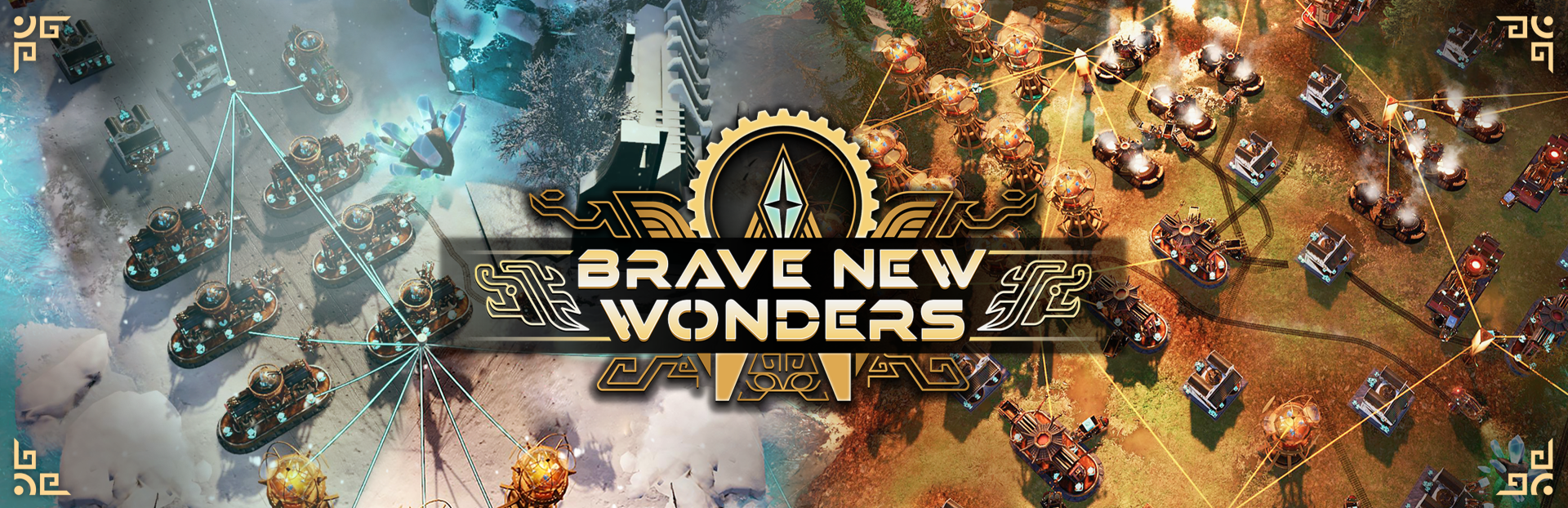
As we continue to work on the development of Brave New Wonders, one thing we’re consistently proud of is how all of the visuals and art have come together throughout this process.
We couldn’t have gotten here without the significant contributions of our amazing team.
In this deep dive we’re sharing more of a behind-the-scenes look at some of the work we’ve created so far, and the inspiration behind what helped craft it all.
Every Model, Texture, and Sound: Made by Human Artists
This is a statement you can hold us to.
No illustrations, 3D models, textures, animations, sound effects, music, voice performances, dialogue or narrative in Brave New Wonders were generated by AI: every visual and audio element in this game was made by people. We believe in the place human artists have had and will have in creative work.
That commitment is the reason the game looks the way it does. What follows is a breakdown of how our artists built this world, what they were aiming for, and why the decisions they made connect directly to how the game plays.
The Visual Brief: Three Aesthetics in One World
The world of Brave New Wonders is built on three distinct visual traditions: pre-modern era industrial steampunk, traditional Asian-inspired architecture and artistic forms, and near-future science fiction. These are not themes that occupy separate areas of the game - they are layered on top of each other everywhere you look.
The brief our artists worked from was: make these feel like they belong together. Not a fusion that flattens any one tradition, and not a collision where they sit awkwardly alongside each other. A synthesis that feels like it grew from a shared history we do not fully know yet.
Here is how each aesthetic shows up in practice.
⚙️ The factories: steampunk meets traditional Asian design
Your production buildings are where the European industrial steampunk aesthetic is most present. The genre-familiar brass gears, steam pipes, pressure gauges, and riveted iron - the things that make up the material vocabulary of 19th-century industrial machinery.
What Brave New Wonders does differently is the architectural language framing all of that machinery: rooflines are curved, and structural elements borrow from traditional Asian construction. Columns carry the proportions of historical Asian-inspired architecture, and interior spaces are arranged around courtyard logic rather than the grid-based floor plans of Western factory design.
The result is a building that reads immediately as an industrial facility. You know what it does at a glance, but it feels like it was built by a civilization that arrived at industrialization through a completely different cultural path, which is exactly what happened in this world.
🤖 The automatons: machines designed to feel alive
The Wonders take this further. These are colossal megastructures, the size of small cities, and their design integrates factory and automaton aesthetics at a scale that becomes genuinely architectural. The Floating Sun is a fusion reactor built around a ring structure that draws on both orbital installation design and traditional circular temple architecture. It looks like it was built by the same civilization that built everything else in the game, just with more resources and higher stakes behind it.
The automatons are the most difficult design problem in the game. They need to do two things that pull against each other: read as purely mechanical, and feel like living creatures.
They are machines built from brass and iron in a steam-powered world, but they are also your workers. Automatons are units you give commands to, watch complete tasks, and signal for help when things go wrong. If they feel like furniture, the command system loses its emotional pull. If they feel too organic, the industrial aesthetic breaks.
The solution our artists came up with was to base each automaton type on an animal silhouette, then execute that silhouette entirely in mechanical materials.
For example, the mining automaton is built around the silhouette of a mystical Chinese creature - the Loong: heavy, forward-leaning, clearly designed for sustained physical work. Everything about it is wood, brass, and jade. But the proportions, the way it distributes its weight, the way it shoots out lasers to mine, all read as Loong behaviours. You do not consciously register it as a machine; you just feel that it is working.
The decorative motifs on each automaton body are drawn from East Asian mythological creatures and traditional craftsmanship. These are patterns referencing historical metalwork, textile design, and architectural decoration. They are not visible at standard game zoom. - they are there for the players who zoom into screenshots and wonder what that pattern is.
Logistics automatons, the ones running your supply chains, carry a more adaptable form, designed to be capable of whatever task they are assigned. They are the workhorses of your production lines, and the design reflects it. Reliable. Purposeful. Not the ones that get screenshots taken.
The Islands: Environments Designed to Serve Gameplay
Every island in the Archipelago was designed around its gameplay function first and its visual identity second. That order matters. If an environment looks striking but makes it difficult to read where resources are or identify terrain hazards, it has failed at its job, regardless of how it looks in screenshots.
The design brief for each island: make it immediately readable, and make it feel like it has a history.
🗺️ The Americas Island
The visual reference for the Americas is New York's outer boroughs as they might look after being submerged, flooded, and then re-emerged thousands of years later. Broken bridges frozen mid-collapse and building foundations with upper floors still partially standing are now functioning as terrain features. Rusted vehicles are also distributed across the landscape, utilized as environmental objects.
The colour palette is warm: amber, gold, green overgrowth, late-afternoon light - America is designed to be the island you return to. As your factories expand across the terrain, the contrast between old-world wreckage and your new construction becomes part of the visual story the game tells about itself.
🧊 Europe Island
Stark. Cold. Near-monochromatic in its base palette, Europe features icy blues, grey stone, and dark sky. The ice sheet is visually prominent, and beneath it, you can see the shapes of buried infrastructure. The design team’s references included Arctic research station photography and deep-winter landscape imagery as starting points.
The challenge with Europe was making it look hostile without looking empty: there is a great deal under the ice. The buried scientific knowledge, the Collider infrastructure, the geological scarring from the Levitanium Disaster - the environment needed to signal that something is worth finding here, even when everything on the surface reads as dead.
The Large Hadron Collider ruins are a focal point. Tunnel architecture peeks through the ice in several locations. Energy signatures, visual effects that read as old-world technological output, pulse faintly in a handful of spots. They are breadcrumbs.
🌄 Africa Island
Africa is the warmest island in every sense - amber and terracotta landscapes, large open plains well-suited to solar arrays, and the distinctive Hanging Garden complexes that define the island's agricultural economy. However, the Africa island was originally the North Pole thousands of years ago, where the Seed Vault was built to preserve Earth's plant life. The melting ice transformed the region into an oasis of lakes, providing resources for new recipes and nurturing trees and other plant life. The design reference was Nigerian architecture combined with Near Eastern agricultural architecture: domed greenhouse structures, terracotta storage buildings, and shading canopy systems.
Africa is the most visually peaceful island in the Archipelago. The contrast: warm, productive and beautiful, against the spoilage mechanics and tight logistics timing the island demands, is intentional. The difficulty in Africa is not environmental hostility; it is the invisible pressure of time.
🌋 Asia Island
The most kinetic island in the game visually
active lava flows are persistent environmental objects that move, change shape as eruptions occur, and destroy anything in their path.
The colour palette is high contrast
dark volcanic rock, orange-red lava, ash-choked sky, and occasional green in the thermal zones where heat-tolerant vegetation has taken hold.
The industrial facilities in Asia carry a different architectural language than those in the Americas island. More heat-tolerant materials, more exposed metal framework, more vertical structures designed to vent heat upward - they look like buildings designed by people who understood exactly what environment they were building for.
🏺 The Ruins: making the old world feel like something real was lost
The ruins scattered across every island are the game's primary vehicle for world-building, and they needed to look like they came from a civilization genuinely more advanced than the one currently exploring them.
Our environment artists drew on real-world locations as starting points: the architectural scale of Manhattan, the engineering ambition of the Large Hadron Collider, the Svalbard Global Seed Vault within the Arctic Circle. They then overlaid near-future science fiction technology on top. The goal was to make ruins that look like they were built by recognizable human purposes but at a level of technological sophistication the current civilization cannot fully interpret.
Some ruin locations are still partially operational: energy signatures are still active, mechanical sounds are still audible, and lights are still on that have no obvious power source. The old-world machines that guard them are the most visible expression of this: units that have been running defensive programming continuously for thousands of years, with no awareness that their original purpose is obsolete.
A ruin encounter is designed to feel archaeological as much as tactical. You are not fighting guards to reach a resource node - you are uncovering a mystery.
Sound Design
The audio in Brave New Wonders is composed to produce what the team describes as megalophobic awe: the specific sensation of standing in front of something vast and not entirely comprehensible. The score does not ease you in, it opens with full weight: deep resonant tones, guttural basslines, industrial sound design processed through atmospheric reverb, ritualistic rhythms layered with mechanical percussion.
The intent is that the music confronts rather than accompanies. The scale of what you are building, and the scale of what the civilization before yours left behind, should feel personal and inescapable rather than a cinematic backdrop.
All sound effects, music, and voice performances in the game were produced by humans. No audio in Brave New Wonders was generated by AI.
Steam Next Fest
Next Fest kicks off next week, where an updated playable demo version of the full game will be available alongside featured streamers showcasing the game, new videos, a Reddit AMA with the devs, and more.
Have a question you’d like to throw to our devs in advance of the Reddit AMA? You can add it to the list over on r/basebuildinggames right here.
Don’t forget your save data from the demo carries over to the full game on launch, so anything you build during Next Fest is part of your real playthrough.
Wishlist now so you don’t miss a beat:
-- Sala @ City From Naught
Source
Changelog.gg summarizes and formats this update. How we read updates.