
In this update3
Full notes
Full Becoming Saint update
Read the full published notes in a cleaner layout. The original post stays linked below.
What changed
- Balance
- UI and audio
- Maps
- Gameplay
Becoming Saint changes
- Ancientmap
Heretics,
Our third dev blog will preach the importance of the setting of the game and how it shapes your journey in sanctity as well as the way to achieve it through conquest.
Medieval Italy as a place of changes and evolution
14th century Italy was an interesting place: commerce and investments were flourishing in Italy. It was the time of the birth of international banks Italy-based, but with European (and beyond) wide markets, when, at the same time, there was an emergence of pauperistic movements. These movements conflated social justice and religious issues, the latter part and its contrasts are masterly presented in The Name Of The Rose book. We wanted to have a setting that triggered reflection on social issues that are actually relevant for everyone today within a historical context.
Your surroundings during battles
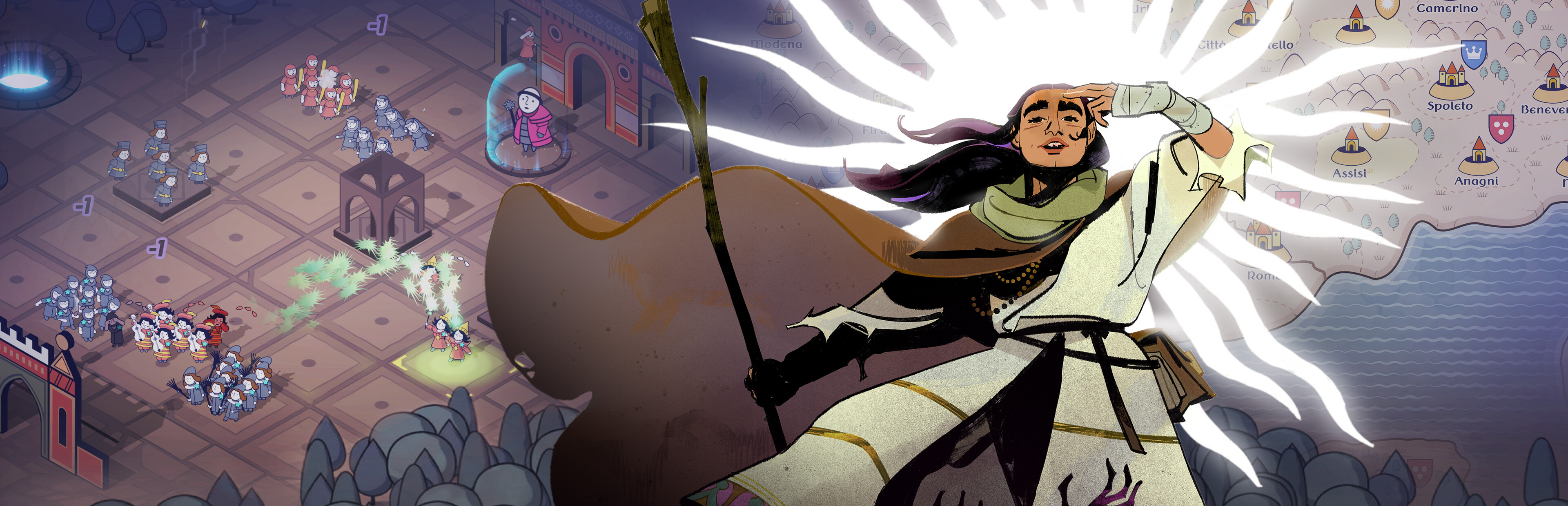
At each starting game, patterns are generated for each town; platforms, fountains, and monuments are placed in the town grids accordingly to these patterns. Thanks to this mechanic, each campaign generates a different set of town grids.
Platforms give the occupying unit an advantage in both defence and attack;
Fountains block a cell so that nobody can cross it;
Monuments both block the cell where they are set and also can block projectiles.
So, placing and moving units on platforms and behind fountains or monuments can be a great way to improve your chances of converting a town to your faith.
Giving birth to an environment
The artistic style is directly inspired by the preference for simplicity and lyricism found in the paintings of Giotto and his school and by the austere and minimalist style characteristic of medieval miniatures. Consequently, the emphasis is on symbolic and expressionistic value rather than on realistic and verisimilar representation.
Source: Sailko, CC BY 3.0 , via Wikimedia Commons & Codex Manesse, UB Heidelberg, Cod. Pal. germ. 848, fol. 14v, Markgraf Heinrich von Meißen
For the scenarios and architectural elements, let's consider for example the "2D" representations that we find in ancient manuscripts and in Giotto's paintings where architecture is predominant.
Source: Cacciata dei diavoli da Arezzo, https://it.wikipedia.org/wiki/Cacciata_dei_diavoli_da_Arezzo (2024, October 4), Wikipedia
We chose cities and regions that had somehow evolved at the time as independent entities, which is, of course, a new historical feature that emerged at the time. So the map of Italy is “distorted” if compared to modern projections because most “free towns” were around central Italy, so that part of Italy is wider, and as the south of Italy at the time had very few independent towns, it is shrunk. Also, in several maps of the time, the upper part of the map is not north but East, and that fit the user interface orientation of the game, so we adopted it
Source: Sailko, CC BY 3.0 , via Wikimedia Commons
To you, which Italian towns are the most iconic and should have their own battle map and buildings? Feel free to comment your suggestions on Steam or share it on our Discord!
The next dev blog will dive deeper into the gameplay mechanics and is planned for next month!
Stay blessed, heretics!
- The Becoming Saint team -
Source
Changelog.gg summarizes and formats this update. How we read updates.